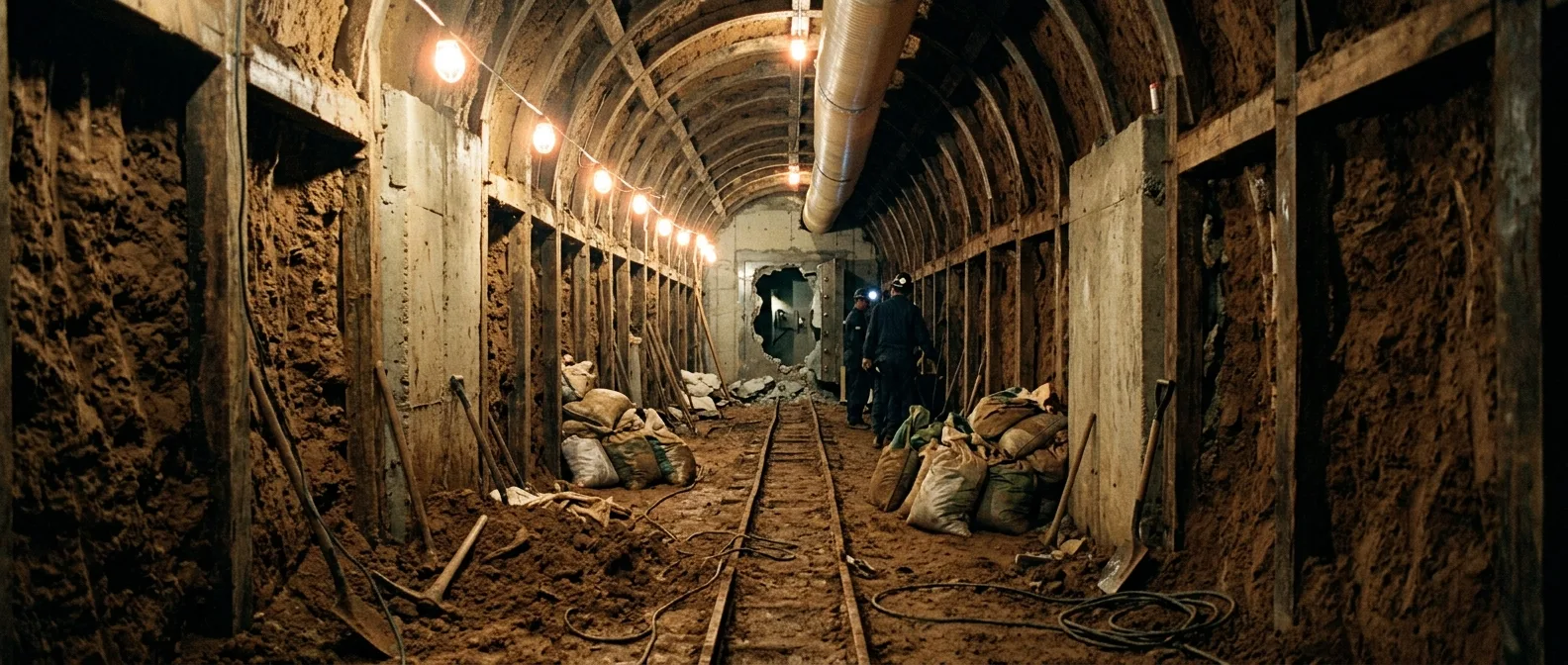
The Bank Heist Through a Tunnel in Brazil
A True Story
📖 Read more: The $100 Million Diamond Heist in Antwerp
A quiet street in Fortaleza
Fortaleza, northeastern Brazil. A sprawling, sun-baked city of three million people, where the heat wraps around you like a wet cloth and the streets hum with traffic, vendors, and the sound of forró music drifting from open windows. In the heart of the city's commercial district, on Rua 25 de Março, stands a squat, unremarkable building — the regional branch of Brazil's Central Bank, Banco Central do Brasil.
Inside that building, in a vault buried beneath reinforced concrete and one meter of steel, sat approximately 160 million Brazilian reais in used banknotes — roughly 70 million US dollars. The bills were waiting to be taken out of circulation and destroyed. They were unregistered, untraceable. The kind of money that, once gone, could vanish forever.
Someone knew this. Someone had been watching, measuring, planning. And what they would pull off over the next three months would become one of the most audacious bank robberies in the history of the world — a heist so elaborate, so patient, so bold that even the investigators who eventually cracked it admitted a grudging respect for the sheer ambition of the operation.
📖 Read more: The Family That Vanished While Their Home Remained Untouched
The plan takes shape
The mastermind was a man with connections to Fortaleza's criminal underworld, though his name would only become known to the public months later. His plan was deceptively simple in concept but staggering in execution: dig a tunnel from a nearby property, cross beneath two entire city blocks underground, and break through the floor of the bank's vault from below. No guns. No hostages. No alarm triggers. Just patience, sweat, and an extraordinary amount of dirt.
Mid-2005 — Acquiring the propertyThe gang rented a small commercial property at 1071 Rua 25 de Março, located roughly 80 meters from the bank. The street-facing shop sat in a row of modest businesses — a bakery on one side, a clothing store on the other. Nobody paid much attention when a new sign appeared above the door: a synthetic grass and landscaping company. The fake business was the front. It explained away the constant movement of people, the delivery trucks, the odd hours. Most importantly, it explained the dirt.
The weekend of the heist
The gang chose their moment with surgical precision. The Brazilian Central Bank branch in Fortaleza did not operate on weekends. That meant any breach of the vault on a Friday night would go undetected until Monday morning — giving the thieves an entire weekend to work, clean up, and disappear.
Friday, August 5, 2005 — EveningAs the last bank employees locked their offices and headed home for the weekend, the tunnel team gathered for the final push. They had reached a point directly beneath the vault floor. Above them: a slab of reinforced concrete roughly one meter thick, layered with steel plating. This was the moment of truth. Using power tools, pneumatic drills, and sheer determination, they began cutting upward. The noise was muffled by the depth and the layers of earth and concrete above. The street was deserted. Nobody heard a thing.
📖 Read more: The Gardner Museum Art Heist: $500 Million Mystery
Monday morning — the discovery
When bank employees arrived on Monday, August 8, everything appeared normal at first. The security system had not been tripped. There were no broken windows, no forced doors, no signs of entry. It wasn't until vault personnel attempted their routine inventory that someone noticed the containers were light. Then empty. Then the hole in the floor.
The Brazilian Federal Police were called immediately. Within hours, officers traced the tunnel back to the rented property on Rua 25 de Março. They stood inside the fake landscaping shop and stared at the shaft in the back room — a neat, square opening that descended into the earth and stretched out of sight into the darkness beneath the city. The tunnel was still intact. The lights still worked. The fans still hummed. It was, in its own grim way, impressive.
The investigation and the unraveling
For all its brilliance in planning, the heist fell apart where all heists eventually do: in the spending. 164 million reais in cash is an enormous amount of physical money. It weighs 3.5 tons. It fills rooms. And when criminals suddenly start buying cars, houses, and land with bags of cash, people notice.
📖 Read more: The Great Escape from Alcatraz
August–October 2005 — The money trailWithin weeks, the Federal Police began tracing unusual purchases across northeastern Brazil. A car dealership reported a man who bought multiple vehicles entirely with 50-real notes. A real estate agent flagged a buyer who paid for a property in cash, bundled in rubber bands. Neighbors reported acquaintances who were suddenly living far beyond their means — new trucks, renovated houses, expensive electronics — all appearing overnight.
How much was recovered?
Of the roughly 164 million reais stolen, Brazilian authorities managed to recover only about 20 million — barely 12 percent of the total. The rest was spent, laundered, hidden, or simply vanished into the vast informal economy of northeastern Brazil. Some of it was reportedly used to buy land, cattle, and small businesses. Some may have been moved offshore. Some was almost certainly destroyed — burned or buried by panicked gang members as the arrests closed in.
The Brazilian Central Bank itself came under harsh criticism. How could a vault that held over 160 million reais not have underground sensors? Why was there no motion detection beneath the floor? Why were the banknotes — even if destined for destruction — left unmonitored over an entire weekend? Internal audits revealed a cascade of security failures: outdated alarm systems, insufficient floor-level reinforcement, and a dangerous assumption that the vault's walls and doors were the only points of vulnerability. Nobody had imagined someone would come from below.
The 2005 Banco Central heist in Fortaleza was not the largest bank robbery in absolute dollar terms — that distinction, adjusted for inflation, arguably belongs to the looting of Iraq's Central Bank in 2003. But in terms of sheer criminal craftsmanship, it has few equals. A group of ordinary people — not safecrackers, not explosives experts, not armed commandos — dug a tunnel under a city, crawled beneath people's feet for 80 meters, broke through reinforced concrete from below, and walked out with 3.5 tons of cash. No one was hurt. No gun was fired. No alarm went off.
The heist became a sensation in Brazil. Books were written about it. Films loosely inspired by it appeared in Brazilian cinema. In Fortaleza itself, the story took on an almost folk-hero quality — a scrappy gang from the northeast outsmarting the mighty Central Bank. Taxi drivers told the story to tourists. Locals pointed out the street where the fake shop once stood.
But the folk-hero narrative ignores the darker reality. People died because of this heist. Families were torn apart by arrests and prison sentences. The money that vanished was public money — Brazilian taxpayer currency — and its loss was absorbed by the nation's financial system. The tunnel was not a work of art. It was a crime.
Epilogue
Today, the property on Rua 25 de Março where the fake landscaping company once operated has long since been occupied by other tenants. The tunnel was sealed and filled with concrete. The Banco Central branch upgraded its security systems, adding ground-penetrating sensors, reinforced sub-floor plating, and 24/7 motion detection beneath the vault.
Most of the convicted gang members have served their sentences and been released. The stolen money — the vast majority of it — was never recovered. It is out there, somewhere, woven into the fabric of a city, a state, a country. Transformed into walls, roofs, roads, cattle, and quiet lives lived on the proceeds of one extraordinary weekend in August 2005.
Eighty meters of tunnel. 3.5 tons of cash. One fake grass shop. And a hole in the floor that nobody saw coming.