Tarrare: The Man Who Ate Everything
A True Story
📖 Read more: Flight MH370: Plane Vanished with 239 Passengers
A child who was never full
Tarrare was born around 1772 near Lyon, France. His real name is not known with certainty — “Tarrare” was most likely a nickname given to him later, perhaps a corruption of a French expression for someone who eats violently. From a very young age, his family realized something was wrong. The young Tarrare ate without stopping. Not like a hungry child — like a child whose hunger had no bottom.
His parents were farmers with limited means. Even if they worked all day, they could not produce enough food to satisfy him. Already in his teenage years, Tarrare was consuming quantities of food equal to his own body weight in a single day. This was not a matter of greed or character — it was a condition beyond all control. At some point, his parents were forced to throw him out because they simply could not feed him anymore. He found himself alone at an age we would today consider childhood.
Tarrare was not obese. Despite his enormous consumption of food, he remained thin throughout his entire life. His body simply did not store fat — everything he ate seemed to vanish.
A spectacle in the streets
After being cast out from his home, Tarrare joined a band of traveling performers, charlatans, and “medicine” sellers who toured the French countryside. There he found a way to turn his curse into a profession. His ability to devour enormous quantities became a spectacle: he would stand in town squares and markets, and in front of an audience watching with a mixture of disgust and fascination, he swallowed baskets full of apples, raw meat, stones, and even corks.
His appearance was unsettling. Although he was young, his hair was thin and wispy. His skin hung like a sack — if he raised his arms, you could see folds of skin around his belly large enough to wrap an apron. His cheeks were wrinkled and loose, and he could store enormous quantities of food inside them before swallowing. His body was always feverishly hot to the touch — as if it were burning from within. And his smell was unbearable, even if he had just bathed.
"The stench emanating from him was so repulsive that you could detect him from a distance of twenty paces. He sweated incessantly, and his perspiration had an almost visible odor."
War and hunger
When the French Revolutionary Wars broke out in 1792, Tarrare enlisted in the French army. But the military ration — already meager — was not enough even to begin with. Tarrare consumed his own ration and then ate the portions of four soldiers. He was forced to scavenge in garbage bins, in drains, in the leftovers of the camp. He ate whatever he found: rotten food, waste, animal remains.
📖 Read more: The Child Who Grew Up in the Jungle: Marina Chapman Story
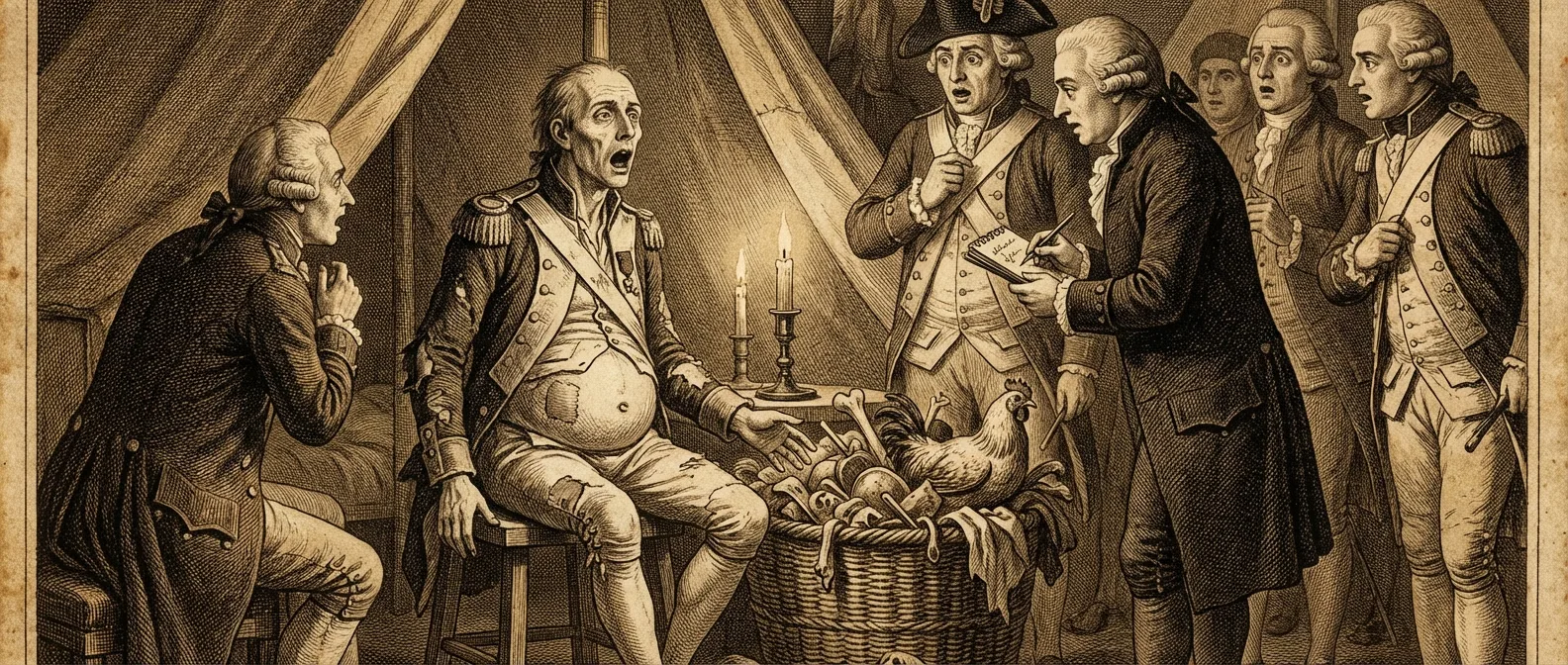
He soon collapsed from exhaustion and was transferred to the military hospital at Soultz. There, the doctors — rather than treating him as a patient — were so impressed by his abilities that they began experimenting. They gave him enormous quantities of food — two huge meat pies, four liters of milk, dozens of eggs — and he swallowed everything without difficulty. His belly swelled like a balloon and within hours became flat again.
The doctors noted that after every monstrous meal, Tarrare would be drenched in sweat, his eyes would glaze over, and they could hear digestive sounds from a distance. His abdomen moved visibly, as though something alive was inside him.
Cats, snakes, eels
At the hospital, the doctors — chiefly the surgeon Dr. Pierre-François Percy, the principal chronicler of Tarrare's life — decided to test the limits. They gave him a live cat. Tarrare seized it, tore open its belly with his teeth, drank its blood, and then swallowed everything except the bones and fur, which he vomited up later. They gave him snakes — he swallowed them whole. Lizards — the same. An entire eel was split in two but vanished from his mouth in seconds, without being chewed.
Tarrare's jaw could open to an abnormal degree. Dr. Percy described how he could fit twelve eggs simultaneously in his mouth. His esophagus was so dilated that if you looked inside his mouth, you could see almost directly into his stomach. It was like a tunnel without end. His lips did not close properly around his teeth, and his breath was so foul that no doctor could stand near him for long.
"His jaws could open so wide as to admit a whole apple. His gullet was so broad that looking into his mouth, one could see directly into the cavity of his stomach."
A spy who swallows messages
General Alexandre de Beauharnais — husband of the future Empress Joséphine — had an idea. If Tarrare could swallow anything, why not have him swallow secret messages? The proposal was simple: Tarrare would swallow a sealed box containing a document, cross enemy lines posing as a simple peasant, and deliver the message after “recovering” it naturally on the other side.
To test the idea, he was given a wooden box with a rolled-up paper inside to swallow. Two days later, the box was recovered intact. The experiment was deemed a success, and Tarrare was sent on an actual mission behind Prussian lines. But reality was less romantic: Tarrare did not speak German, his appearance aroused suspicion, and he behaved strangely. He was captured almost immediately.
The Prussians beat him savagely, chained him to a wall, and prepared to execute him. But they ultimately released him — most likely because he carried no real intelligence, only a piece of paper of little value. Tarrare returned to French lines terrified and exhausted. He begged the doctors to cure him — he wanted, at last, to stop being hungry.
📖 Read more: The Epidemic That Made People Laugh Until They Collapsed
Using humans as carriers of hidden messages was not uncommon in the era, but the method of swallowing documents was unique. No other soldier had ever been employed in this manner.
Attempts at treatment — and horror
Dr. Percy undertook to try to cure Tarrare. He administered massive doses of laudanum (an opiate), vinegar, soft-boiled eggs, tobacco smoke. Nothing worked. The hunger remained merciless. Tarrare would escape from his ward at night and wander the alleys around the hospital rummaging through garbage. He was caught drinking blood from bloodletting buckets. He was found eating corpses in the hospital mortuary. There was no moral filter — only hunger.
The situation reached its peak when a fourteen-month-old infant disappeared from the ward. No one was able to prove what happened, but Tarrare was the primary suspect. There was never conclusive evidence, but the case was never closed. Dr. Percy and the hospital staff decided that Tarrare was now too dangerous. They expelled him from the hospital.
"He was caught many times drinking blood from the bloodletting vessels. He was accused of eating corpses in the mortuary. He was expelled after an infant disappeared."
The end at 26
Four years after his expulsion, Tarrare appeared again at a hospital in Versailles. He was emaciated, exhausted, and suffering from advanced tuberculosis. He asked Dr. Percy to treat him. But his condition was now irreversible. Tarrare died a few months later, at roughly 26 years of age.
Before he died, he suffered from continuous, unrelenting diarrhea which — according to reports — was “beyond all tolerance” in its stench. His body emitted vapors. No one could remain in the same ward with him. His life ended in absolute solitude — no friend, no relative, only the unbearable hunger that had accompanied him since birth.
Tuberculosis was the most common cause of death in 18th-century Europe. But in Tarrare's case, the disease was dramatically worsened by his already devastated physical condition.
A body that did not look human
Tarrare's autopsy was performed by Dr. Tessier in Versailles, in the presence of Dr. Percy. What they found was beyond all medical experience. The esophagus was so dilated that you could look through the mouth and see directly into the stomach — almost like a tunnel. The stomach was enormous, occupying a large portion of the abdominal cavity. The liver was abnormally large and in advanced putrefaction.
📖 Read more: The Woman Who Was Declared Dead and Woke Up in the Morgue
The body was “rotten from within” — the internal organs were flooded with pus. The intestines were distended and filled with gases. No surgeon could endure the stench long enough to complete a full examination. The autopsy was cut short due to the unbearable state of the corpse.
"The entrails were putrid. The gullet was so wide that one could see into the stomach almost without instruments. The liver was enormous, extraordinarily soft, and saturated with pus."
What was really going on?
Modern medicine has attempted to explain Tarrare's case without reaching a single definitive answer. The most widespread theory involves damage to the amygdala — the brain region that controls the emotional response to food and satiety signals. If the amygdala had been damaged, Tarrare would never have felt full, regardless of how much food he consumed.
A second theory focuses on hyperthyroidism — a condition where the thyroid gland produces excessive amounts of hormones, increasing metabolism to an extreme degree. This would explain his permanently hot body, the excessive sweating, the rapid digestion, and his inability to store fat. However, hyperthyroidism does not account for the physical ability to swallow enormous objects.
Some researchers have proposed polyphagia due to hypothalamic damage, or even an extremely rare syndrome combining polyphagia with physical malformation of the digestive system. The truth is that no single syndrome fully explains all the symptoms: the abnormal jaw, the enormous esophagus, the oversized organs, the relentless hunger, and the visible waves of movement inside his abdomen.
Some modern physicians believe Tarrare may have suffered from a combination of multiple rare conditions — a “perfect storm” of biological dysfunctions that has never been observed again. His case is still studied at medical universities as an example of extreme human pathology.
The man who was never full
Tarrare was not a monster. He was a human being trapped in a body that did not follow the rules of biology. He never chose to devour everything — his hunger was biological, uncontrollable, merciless. As a child he was cast out, as an adult he was exploited, as a soldier he was used, and in the end he died alone, rotting from within.
Tarrare's story is a reminder that human biology harbors mysteries we have not yet deciphered. Somewhere between medicine and legend, between horror and compassion, lies the memory of a man who was never full — and no one yet knows why.