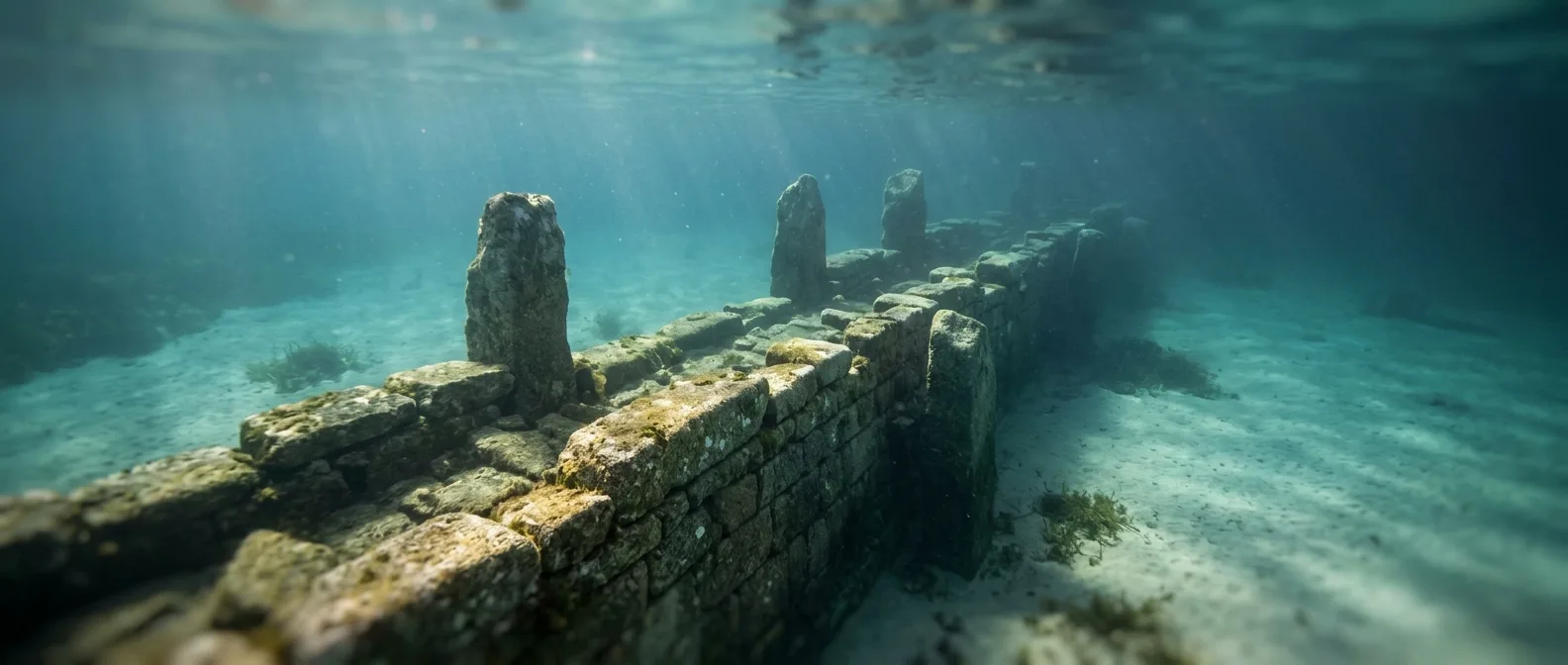
A mystery built from 3,300 tons of granite emerges from the cold waters off Brittany, 30 feet below the Atlantic's surface. The stone wall archaeologists discovered in 2024 could be 7,000 years old — but its purpose remains an enigma that sheds new light on prehistoric European societies.
When geologist Yves Fouquet studied depth charts created with LIDAR technology, something looked wrong. "A 120-meter line cutting cleanly across an underwater valley," he describes to the BBC. "It couldn't be natural." Nature, as a rule, doesn't create straight lines. His gut instinct led him to one of France's most significant underwater discoveries. The wall near the tiny island of Sein, at Brittany's western tip, is the largest underwater structure ever found in the country.📖 Read more: Thutmose II Tomb Found: Egypt's Lost Pharaoh After 100 Years
🏗️ A Construction That Defies Expectations
The wall stretches 400 feet, averages 65 feet wide, and stands six feet tall. What's striking is its organization. About 60 massive granite monoliths were placed directly on bedrock in pairs at regular intervals. Smaller slabs and "packing" stones filled the gaps, creating a unified, deliberate construction.3,300 tons total mass
400 feet long
30 feet underwater
Between Tidal Zones and Mysteries
Archaeologists propose two main theories for the wall's function. The first sees it as a fish trap. The protruding monoliths would support a "net" of branches and wood to catch fish as tides receded. Similar wooden structures dating to 6150-5750 BCE have been found in Ireland. The alternative hypothesis interprets the wall as a protective barrier against rising sea levels. During its construction period, sea levels rose at rates of 5.2 to 8.4 millimeters annually — dramatic enough for coastal communities to observe significant changes within a generation.📖 Read more: 1,000-Year-Old Whale Trap Found on Norway's Seafloor
🌊 Connection to Lost City Legends
The wall now provides physical evidence for ancient Breton legends of sunken cities. The most famous is the story of Ys, believed to be in the Bay of Douarnenez, just miles east of the wall site.According to the 2024 study, "the flooding caused by rapid sea level rise, followed by the abandonment of fishing structures, protective works, and residential areas, must have left a lasting impression.""It's likely that the abandonment of land developed by a highly structured society became deeply rooted in people's memory"
Study in International Journal of Nautical Archaeology
Tradition That Survives Millennia
Ys was said to be a wealthy city, ruled by King Gradlon from a palace of marble, cedar, and gold. A great dike protected the city from the sea, sealed by a unique gate that opened only at low tide to let ships pass. Only the king held the key. His daughter Dahut stole it to admit her lover — with catastrophic results. The sea rushed in, drowning the city and all its inhabitants except Gradlon.📖 Read more: Pharaoh Thutmose II Tomb Found After 100-Year Search
🔬 Knowledge Transfer Between Cultures
The wall demonstrates remarkable knowledge transfer between populations. The monoliths resemble but predate Brittany's famous megalithic monuments by about 500 years. According to archaeologist Yvan Pailler, there could have been "knowledge transfer in quarrying, cutting, and transporting stones between older Mesolithic hunter-gatherers and incoming Neolithic farmers." This suggests continuity of knowledge during the crucial transition from hunter-gatherer to agricultural societies around 5500-5000 BCE.Analysis revealed that 80% of granite blocks came from low-lying areas, while monoliths appeared to be quarried from nearby outcrops. The variety of construction materials and techniques — including vertical monoliths, large horizontal slabs, small vertical slabs, and angular stones — shows sophisticated design and work organization.
A Community with Impressive Capabilities
The project's scale, involving thousands of tons of stone, required coordinated community effort and resources that challenge traditional assumptions about Mesolithic societies. The fact that the construction survived 7,000 years shows it was an exceptionally solid structure. "It was built by a very structured hunter-gatherer society, the kind that became sedentary when resources allowed," explains Pailler.📖 Read more: Thutmose II Tomb Found After 100-Year Hunt in Valley of Kings
🗺️ A Landscape Shaped by Humans
The Sein wall isn't an isolated curiosity. The surrounding seafloor contains at least eleven separate stone structures, ranging from fishing weirs to larger protective walls. Together they suggest a landscape deliberately shaped for long-term use. Some constructions incorporated small monoliths under three feet tall, while others featured impressive six-foot standing stones. This variety suggests populations that actively managed and modified their landscape for extended periods.Challenges of Underwater Archaeology
The team from the Society of Archaeology and Naval Memory (SAMM) conducted 59 dives totaling over 35 hours underwater to document the structures between 2022 and 2024. They had to wait for winter — when seaweed had died back — before they could properly map the wall. "Visibility in summer was nearly zero," the researchers explain. The cold, turbulent waters off Brittany aren't ideal conditions for underwater work, but the results reward the effort.🎯 What It Means for Prehistoric Europe
The Sein wall represents the oldest and deepest stone structure ever found in France at this significant depth. Its discovery creates opportunities for understanding how coastal prehistoric communities adapted to environmental change and organized complex construction projects. It shows that coastal communities built complex stone structures centuries before the oldest known megaliths on land. It also hints at how much of humanity's deep past still lies offshore, erased from sight but not from history. As sea levels continue rising today, the ancient wall serves as a poignant reminder that coastal communities have faced — and responded ingeniously to — environmental challenges for millennia.A New Picture of the Mesolithic Period
The construction stands as testimony to the ingenuity and organizational capabilities of societies that lived seven thousand years ago. It challenges us to rethink what we know about prehistoric Europeans — and wonder what other mysteries hide in our ocean depths. LIDAR technology and improved underwater techniques now allow archaeologists to explore these lost worlds. How many other "lost cities" await discovery? How many more walls and constructions lie hidden beneath the waves, guarding secrets about societies we thought we understood? At the island of Sein, where locals say "Qui voit Sein, voit sa fin" (Who sees Sein, sees their end), the 7,000-year-old wall may be just the beginning of a much larger story waiting to be told.Sources: