Shackleton: 2 Years Trapped in Antarctica
A True Story
📖 Read more: The Man Who Survived Two Atomic Bombs
The Imperial Trans-Antarctic Expedition
Ernest Shackleton was no stranger to the polar world. He had already taken part in two Antarctic expeditions — one under Robert Falcon Scott in 1901, and his own Nimrod expedition in 1907, during which he came within 180 kilometers of the South Pole before turning back to save his men. That decision — choosing lives over glory — would define his character for decades to come.
After Roald Amundsen conquered the South Pole in 1911, Shackleton decided the last great Antarctic prize was a full crossing of the continent — 2,900 kilometers through ice, mountains, and temperatures plunging to -50°C. He named the venture the Imperial Trans-Antarctic Expedition. The recruitment advertisement he placed has since become legendary: "Men wanted for hazardous journey. Low wages, bitter cold, long hours of complete darkness. Safe return doubtful."
Departure from London
The Endurance, a wooden barquentine reinforced for polar ice, sailed from London. On board were 28 men — sailors, scientists, a photographer, a cook, a carpenter — and 69 sled dogs. Europe was plunging into war. But Shackleton looked south, toward the last unconquered frontier on Earth.
After a brief stop in Buenos Aires, the ship headed for South Georgia — a small British island in the southern Atlantic, the last outpost of civilization before Antarctica. There, whaling station managers warned Shackleton that the pack ice that year was unusually dense and far-reaching. Shackleton listened carefully. Then he decided to press on.
Into the Weddell Sea
Endurance left South Georgia and sailed south into the most treacherous waters on the planet. The Weddell Sea is known for its massive icebergs and crushing pack ice — enormous frozen plates that grind together like slow-moving millstones, destroying anything caught between them. For the first few weeks, Endurance navigated through loose ice, finding channels and leads between the floes.
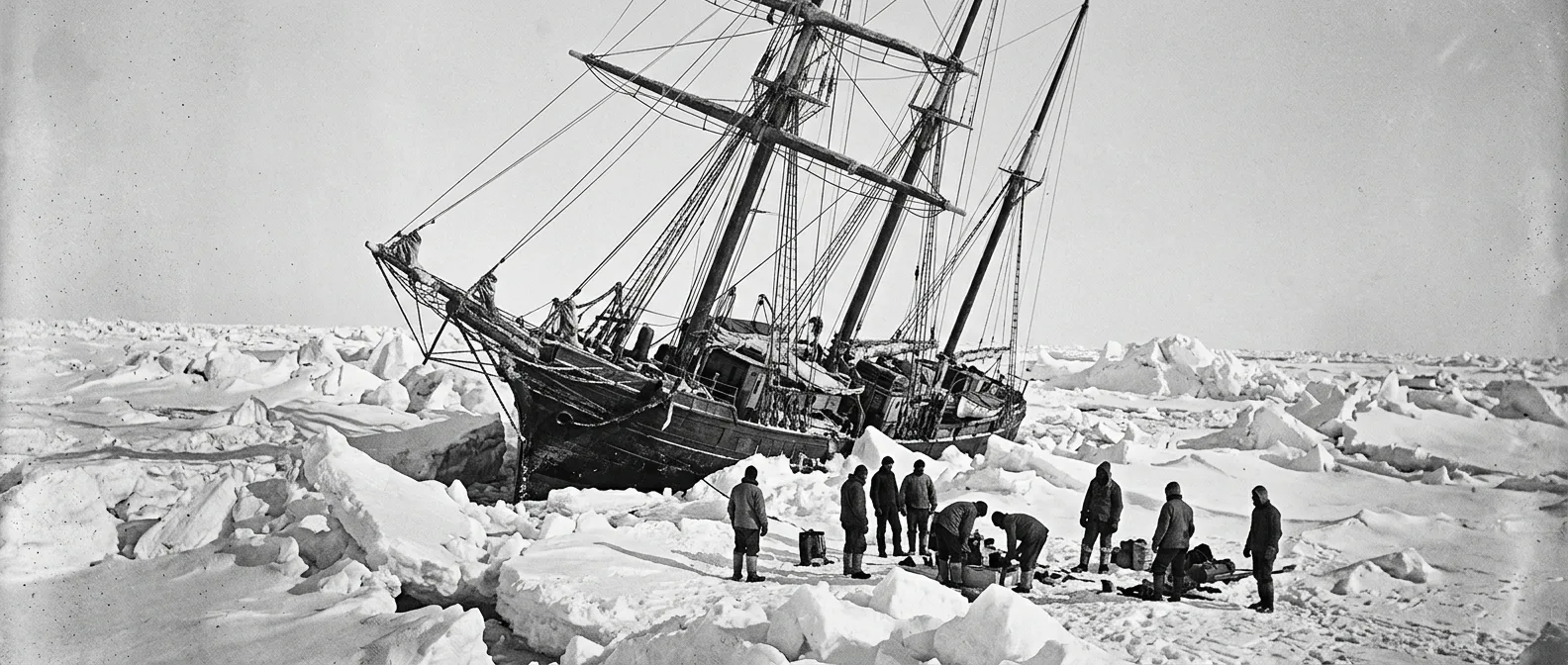
But gradually, the ice thickened. Temperatures dropped. Each day, progress slowed. By mid-January 1915, just 130 kilometers from their landing point at Vahsel Bay, the ship stopped moving entirely. The ice closed around it like a fist. Endurance could go neither forward nor backward. The ship was trapped.
The Weddell Sea contains some of the densest and most dangerous pack ice on Earth. Ocean currents trap enormous masses of ice in a clockwise gyre, generating pressures powerful enough to crush steel-hulled vessels like tin cans.
Trapped in the Ice
For nine months, Endurance remained locked in the ice, drifting helplessly with the pack. Shackleton quickly understood that the crossing expedition was over. The only objective now was survival. The 28 men transformed the ship into a winter station. Dogs were exercised, rations were carefully managed, and evenings were filled with music, card games, and amateur theatricals.
Shackleton operated as psychologist as much as leader. He placed the most difficult personalities in his own tent. He maintained morale through routine and humor. The expedition's photographer, Frank Hurley, captured images that would later become iconic — haunting photographs of a ship slowly being squeezed by jaws of ice.
But the ice did not relent. By October, the gigantic floes began crushing Endurance from both sides. Timbers groaned and splintered. Water flooded in. Shackleton ordered the ship abandoned. Supplies, food, lifeboats — everything salvageable was hauled onto the ice. On November 21, Endurance slipped beneath the frozen surface and vanished. Twenty-eight men now stood alone on a drifting ice field in the middle of the most hostile ocean on Earth, with no ship, no radio, and no one in the world who knew where they were.
What the ice takes, the ice does not give back. From this moment forward, our only goal is to get home. Alive.
Camped on the Ice
For five months, the 28 men lived on a floating slab of ice — first at “Ocean Camp,” then at “Patience Camp.” They slept in tents at temperatures reaching -30°C. They ate seal meat, penguins, and whatever provisions they had salvaged from the ship. Darkness lasted up to 20 hours each day.
Shackleton refused to let anyone lose hope. Discipline in camp was strict but fair. He shared the same duties as everyone else — cooking, cleaning, standing watch. No privilege of rank. This style of leadership earned the men's devotion to a degree that would later determine whether they lived or died.
The ice slowly carried their camp northwest, drifting further from any land. Shackleton tracked their coordinates with growing anxiety, hoping the currents would push them toward Paulet Island or some other point of solid ground. But the ice followed its own rules.
The Ice Breaks — Into the Boats
In April 1916, the ice finally began to break apart. But this was not good news — it meant their platform was disintegrating. Shackleton ordered the three salvaged lifeboats launched: the James Caird, the Dudley Docker, and the Stancomb Wills. The 28 men divided among the three boats and began rowing through ice-choked, freezing seas.
Seven days of agony followed. Waves crashed over the tiny boats. Ice scraped against the hulls. The men froze — literally. Bitten by the wind, soaked to the bone, sleep impossible. But on April 15, they spotted land: Elephant Island. A gray, windswept rock at the edge of the world. It was no paradise. But it was solid ground.
It was the first time in 497 days that the 28 men had stood on solid ground. Some dropped to their knees. Some wept. Shackleton allowed himself neither — he still had work to do.
The Voyage of the James Caird
Elephant Island was uninhabited. No ship ever passed nearby. If they stayed, they would die. Shackleton made a decision that sounded like suicide: he would sail 800 nautical miles across the most savage ocean on Earth — the Drake Passage and the Southern Ocean — in a single 22-foot lifeboat, to reach South Georgia Island and bring back rescue.
He chose five men: navigator Frank Worsley, Tom Crean, carpenter Harry McNish, Timothy McCarthy, and John Vincent. McNish reinforced the James Caird with salvaged wood and canvas. They loaded stones for ballast, water casks, and a month's worth of food. On April 24, they set sail.
📖 Read more: Flight 19: 5 Planes Lost in the Bermuda Triangle
What followed was 16 days of pure hell. Waves towered 20 meters high. Hurricane-force winds lashed the tiny boat. It nearly capsized multiple times. Ice coated the sails and rigging so thickly that the men had to chip it away by hand or the boat would sink under the weight. Worsley navigated by sextant through nearly permanent cloud cover — he managed to sight the sun only four times in 16 days. Every calculation had to be perfect. An error of one degree, and they would miss South Georgia entirely, disappearing into the empty ocean.
I looked into the faces of my men and knew that if we failed, we would lose not just our own lives — but the 22 who waited for us on Elephant Island.
Landfall at South Georgia
After 16 days at sea, Worsley accomplished what is still considered one of the greatest feats of navigation in maritime history: he found South Georgia in a featureless ocean. They spotted land. But relief was short-lived — a massive storm drove them back, and for 24 hours they fought to avoid being smashed against the rocky coast. They finally found a small cove and landed.
But they had come ashore on the wrong side of the island. The Stromness whaling station — the only inhabited outpost — was on the opposite coast, behind a chain of uncharted mountains that no one had ever crossed. Three of the six men — McNish, McCarthy, and Vincent — were too exhausted to continue. Shackleton left them with the boat and set out with Worsley and Crean to cross the mountains on foot.
Crossing the Mountains
Without a map, without climbing equipment, carrying only a rope and an ice axe, the three men began their crossing of South Georgia's glaciated interior. No human being had ever traversed it — and for good reason. Glaciers, crevasses, knife-edge ridges, and dense fog surrounded them at every turn.
They walked for 36 hours without stopping. At one point, trapped atop a ridge with a sheer cliff below and night falling fast, Shackleton made a desperate decision: they coiled the rope beneath their bodies and slid down the mountainside blind, with no idea what waited at the bottom. They survived.
On May 20, they heard something they had not heard in 17 months: a factory whistle. Stromness station lay before them. Three ragged figures — filthy, bearded, barely recognizable as human — stumbled down from the mountains. The station manager, Thoralf Sørlle, stared at them without recognition. “Who are you?” he asked. “My name is Shackleton,” came the reply. Sørlle turned away and wept.
They had given us up for dead. No one expected to see any of us again. When I said my name, the man before me turned his head and cried.
The Rescue
Shackleton wasted no time. He first sent a boat to retrieve the three men on the other side of South Georgia. Then he launched rescue attempts for the 22 men still stranded on Elephant Island. The first three attempts failed — ships could not penetrate the pack ice.
On the fourth attempt, aboard a Chilean tugboat named Yelcho, Shackleton reached Elephant Island on August 30, 1916. He raised his binoculars and scanned the beach. He counted figures. One. Two. Three... Twenty-two. They were all there. No one had died. Four months alone on a barren, frozen island, sheltering under overturned boats, eating penguins and seals — and every single man was alive.
Shackleton called out from the ship: “Are you all well?” The answer came back instantly: “All well!” The evacuation was completed in under an hour — Shackleton feared the ice would return.
Why Nobody Died
This is the greatest mystery of the entire story. On expeditions like this, death was practically certain. Scott's expedition, just a few years earlier, ended in tragedy — five of the lead party perished. The explanation lies almost entirely in Shackleton's character as a leader.
He was not the most skilled explorer. He was not the best navigator — that was Worsley. He was not even the toughest man on the team — that was arguably Crean. But he was the only one who could keep 27 men psychologically alive in conditions that would have broken anyone. He shared everything with his men. He never demanded anything he would not do himself first. And he never — not once — allowed himself to show doubt.
After the Expedition
Shackleton returned to an England consumed by the First World War. His expedition went almost unnoticed. There was no heroic welcome, no banner headlines. Several of his men enlisted immediately — three were killed in the trenches, having survived the ice only to fall on the Western Front.
Shackleton organized one final expedition — the Quest Expedition — in 1921. But on January 5, 1922, while his ship was anchored at South Georgia — the very island where he had achieved his greatest feat — he suffered a heart attack and died. He was 47 years old. His wife Emily requested he be buried there, on the island he loved most. His grave faces south, toward Antarctica.
The Shackleton Legacy
The Endurance expedition failed to achieve its objective. Antarctica was not crossed. No discoveries were made. No flags were planted. But what Shackleton accomplished was something far deeper: he proved that leadership is not measured by conquests, but by the people you bring back alive.
Today, the Endurance story is taught in leadership schools, used as a case study at NASA, and referenced by every team facing extreme conditions. In March 2022, the Endurance22 research team located the wreck of the ship on the floor of the Weddell Sea at a depth of 3,008 meters — in remarkable condition, nearly intact, as though the ice had preserved it.
The bow of the Endurance still bears the ship's name in gold lettering. Below it, the Shackleton family motto: “By Endurance We Conquer.” More than a century later, those words still hold true.