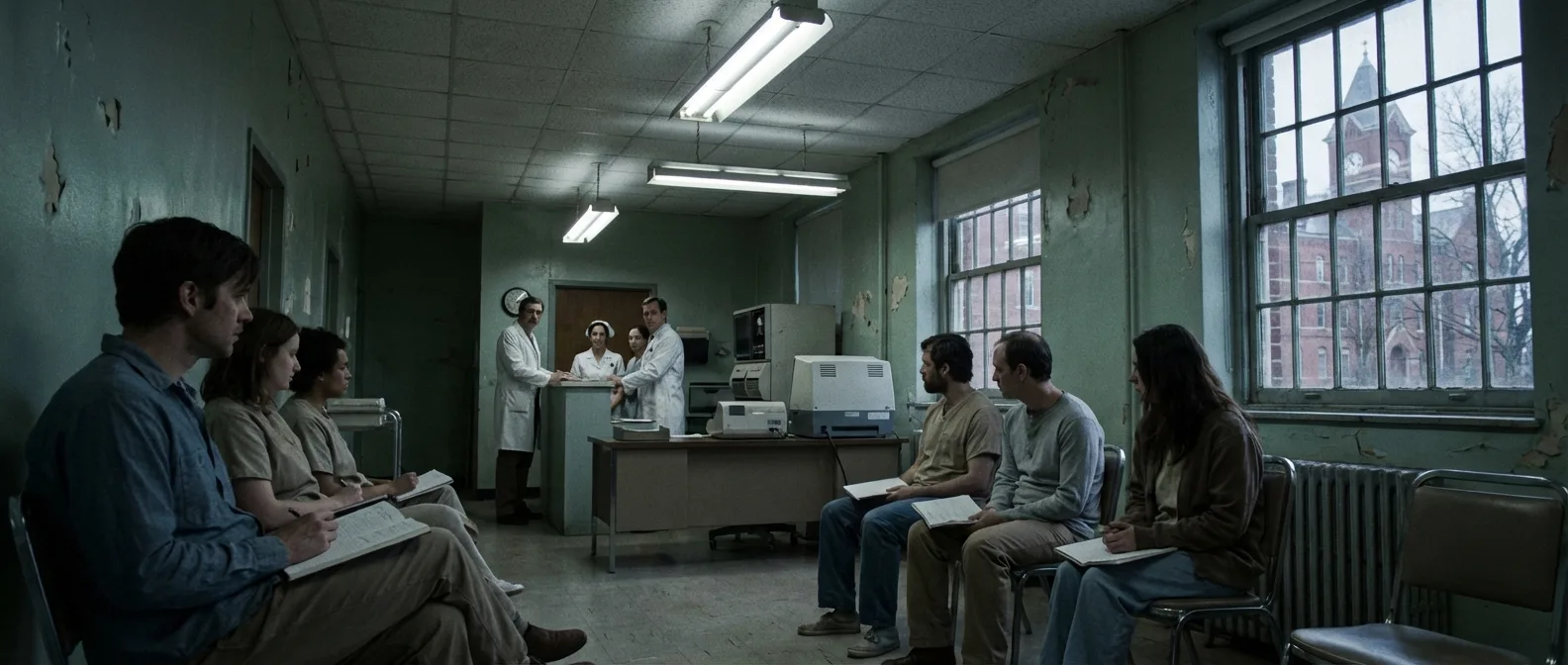
Rosenhan Experiment: Fake Patients in Psychiatric Hospitals
In January 1973, an article published in the journal Science delivered results that would shake psychiatry to its very foundations.
📖 Read more: Asch Experiment: Do You Lie Just to Fit In?
The Idea Behind the Experiment
David Rosenhan was a professor of psychology at Stanford University. By the late 1960s, psychiatry was under growing scrutiny. Theorists like Thomas Szasz and R.D. Laing were challenging the field's basic assumptions — whether mental illness could truly be “diagnosed” in the same way one diagnoses a broken rib or a stomach ulcer. Rosenhan decided to pose the question in the most direct way possible: if you send perfectly sane people to psychiatric institutions, will the system recognize them as sane?
The answer, it turned out, was a resounding “no.”
The Eight Pseudopatients
Rosenhan recruited seven volunteers — three psychologists, a pediatrician, a psychiatrist, a painter, a homemaker, and a psychology graduate student. Together with Rosenhan himself, they formed a group of eight “pseudopatients.” Some used aliases. All provided false occupations to prevent their true identities from being uncovered.
The design was simple yet audacious. Each pseudopatient would call a psychiatric hospital, request an appointment, and during the evaluation mention that they heard voices. The voices were unclear, of the same gender as the patient, and said three words: “empty,” “hollow,” “thud.” Nothing more. These three words were chosen deliberately because they did not correspond to any recognized psychiatric syndrome in the literature.
Apart from this single fabrication, the pseudopatients reported truthful details about their lives — childhood, relationships, work history. They added no other pathological symptoms. They did not behave strangely. They did not put on unusual facial expressions. They were — literally — their most normal selves, with one exception: those three words.
The Admission
All eight were admitted. None were turned away. In seven cases, the diagnosis was schizophrenia. In one, manic-depressive psychosis. The hospitals were scattered across five different states — from New York to California. Some were old public institutions with minimal funding. At least one was a private hospital with adequate staffing. It made no difference: every hospital admitted the pseudopatients without a second thought.
The most unsettling detail: once admitted, the pseudopatients immediately stopped reporting any auditory hallucinations. They said they felt fine. They asked to be discharged. They behaved entirely normally — they talked naturally with staff, read books, walked through the corridors, took notes.
Invisible Inside the System
The average length of hospitalization was 19 days. The shortest, 7. The longest, 52 days — nearly two months of confinement for a person who had absolutely nothing wrong with them. Not a single pseudopatient was identified as an impostor by the medical or nursing staff. Not one.
📖 Read more: Mass Hysteria: How a Town Gets Sick for No Reason
The real patients, however, figured it out. In three hospitals, 35 out of 118 actual patients expressed suspicions that the pseudopatients were normal. "You're not crazy. You're a journalist, or a professor checking up on the hospital," one patient told Rosenhan. The patients recognized them. The doctors did not.
Rosenhan observed something even more disturbing: once a patient received a label — “schizophrenic” — every behavior was interpreted through that lens. One pseudopatient mentioned having a close relationship with his mother during childhood but growing distant during adolescence — an extraordinarily common experience. The psychiatrist recorded it as “an unstable emotional pattern consistent with schizophrenia.” The diagnosis did not interpret the data — the data was forced to fit the diagnosis.
Daily Life Behind Locked Doors
The pseudopatients' notes revealed a bureaucratic hell of indifference. Staff spent minimal time in contact with patients. In one hospital, psychiatrists appeared on the ward an average of 6.8 minutes per day. The remaining 23 hours and 53 minutes, patients were left to themselves — in corridors with locked doors, without activity, without purpose, without meaningful supervision.
Depersonalization was a daily occurrence. Patients were referred to by numbers rather than names. Pills were administered without explanation — the pseudopatients flushed theirs down the toilet, only to discover that many real patients did exactly the same. Privacy was nonexistent: open-door bathrooms, nurses entering without knocking, unexpected physical examinations. One pseudopatient asked a nurse when he could see the doctor. The nurse replied without even making eye contact.
The pseudopatients felt that their stays ended not because anyone recognized they were healthy, but simply because enough time had passed. Their discharge never came with a diagnosis of “sane” — it came with the phrase “schizophrenia in remission.” The label followed them even through the exit door.
The Counterattack and the Double Trap
The publication of the experiment caused a seismic shock. Psychiatrists, hospitals, and medical schools reacted with fury. One prestigious psychiatric hospital — a research institution with an excellent reputation — publicly challenged the results. They claimed that at their hospital, such a thing could never happen. They challenged Rosenhan: “Send pseudopatients to us. We'll find them.”
Rosenhan accepted. They agreed that over the next three months, Rosenhan would send one or more pseudopatients to the hospital. Staff would evaluate every incoming patient and rate the likelihood that each was a pseudopatient on a scale of 1 to 10.
The results were devastating — but not for Rosenhan. Over three months, out of the 193 patients who were admitted, staff identified 41 as “likely pseudopatients.” At least 19 of those were flagged as “suspect” by at least one psychiatrist and one staff member. Those 41 “fakes” were real patients. Rosenhan had sent no one.
The Power of the Label
The Rosenhan experiment was not merely a critique of psychiatric hospitals. It was a profound analysis of the power of categorization. Psychiatric diagnosis did not function as a description — it functioned as a prison. Once your file reads “schizophrenia,” every word you say, every move you make, even your silence, is interpreted through that prism. You become invisible behind your diagnosis.
📖 Read more: Milgram Experiment: Would You Kill If Asked?
Rosenhan used the term “sticky label” — a diagnosis that literally sticks to the patient and never comes off. Even when symptoms vanish, the label remains. Schizophrenia was never “cured” — it merely “went into remission.” The patient never became “healthy,” only “in remission.”
This reflects a fundamental asymmetry in diagnostic logic. In medicine, if you take an X-ray and find no fracture, you say “there is no fracture.” In the psychiatry of that era, if you saw no symptoms, you did not retract the diagnosis — you simply assumed the illness was “hiding.”
The Impact on Psychiatry
The publication of “On Being Sane in Insane Places” in 1973 in Science became one of the most cited articles in the history of psychology. The impact was enormous and multifaceted. First, it contributed decisively to the revision of the DSM — the Diagnostic and Statistical Manual of Mental Disorders. The third edition (DSM-III, 1980) introduced stricter, more objective diagnostic criteria, partly in response to the Rosenhan experiment.
Second, it fueled the deinstitutionalization movement — the shift from large closed psychiatric institutions to community mental health centers. The idea that psychiatric hospitals could harm rather than heal — that they could create illness where none existed — became academically accepted.
Third, it strengthened the anti-psychiatry movement's critique. Theorists such as Michel Foucault and Erving Goffman had already argued that psychiatry functioned as a mechanism of social control. Rosenhan added empirical evidence to that theoretical framework.
Criticism and Controversy
The experiment did not go unchallenged. Psychiatrist Robert Spitzer, a key architect of DSM-III, argued that Rosenhan's methodology was flawed. “If you go to an emergency room spitting blood,” Spitzer wrote, "the doctor will admit you — and they wouldn't be wrong. Admission doesn't prove a bad diagnosis; it proves precautionary care." In other words, hospital admission did not demonstrate that psychiatry could not tell normal people from patients — it only demonstrated that precautions were taken.
More recently, journalist Susannah Cahalan reinvestigated the experiment in her book “The Great Pretender” (2019). She found inconsistencies in Rosenhan's data, was able to identify only one pseudopatient, and discovered that some of the details Rosenhan reported could not be fully verified. The psychologist had died in 2012, without ever completing the monograph he had planned about the experiment.
Yet even Rosenhan's harshest critics acknowledged that the experiment highlighted real problems — diagnostic uncertainty, the power of labeling, and the inhumane conditions inside psychiatric institutions. The criticism targeted the method, not the message.
Epilogue"On Being Sane in Insane Places" remains one of the most influential experiments in the history of psychology — and one of the most controversial. It did not prove that psychiatry doesn't work. It proved something more subtle and more unsettling: that an entire era's diagnostic tools could be so weak that mere presence inside a psychiatric hospital became the dominant “proof” of illness.
The pseudopatients entered normal and left with a diagnosis stapled to their records. No doctor recognized them. But the real patients — the ones supposedly unable to tell reality from fantasy — saw through them immediately. Perhaps that was the Rosenhan experiment's most painful discovery: that the true ability to recognize sanity resided in the “mad,” not in their doctors.