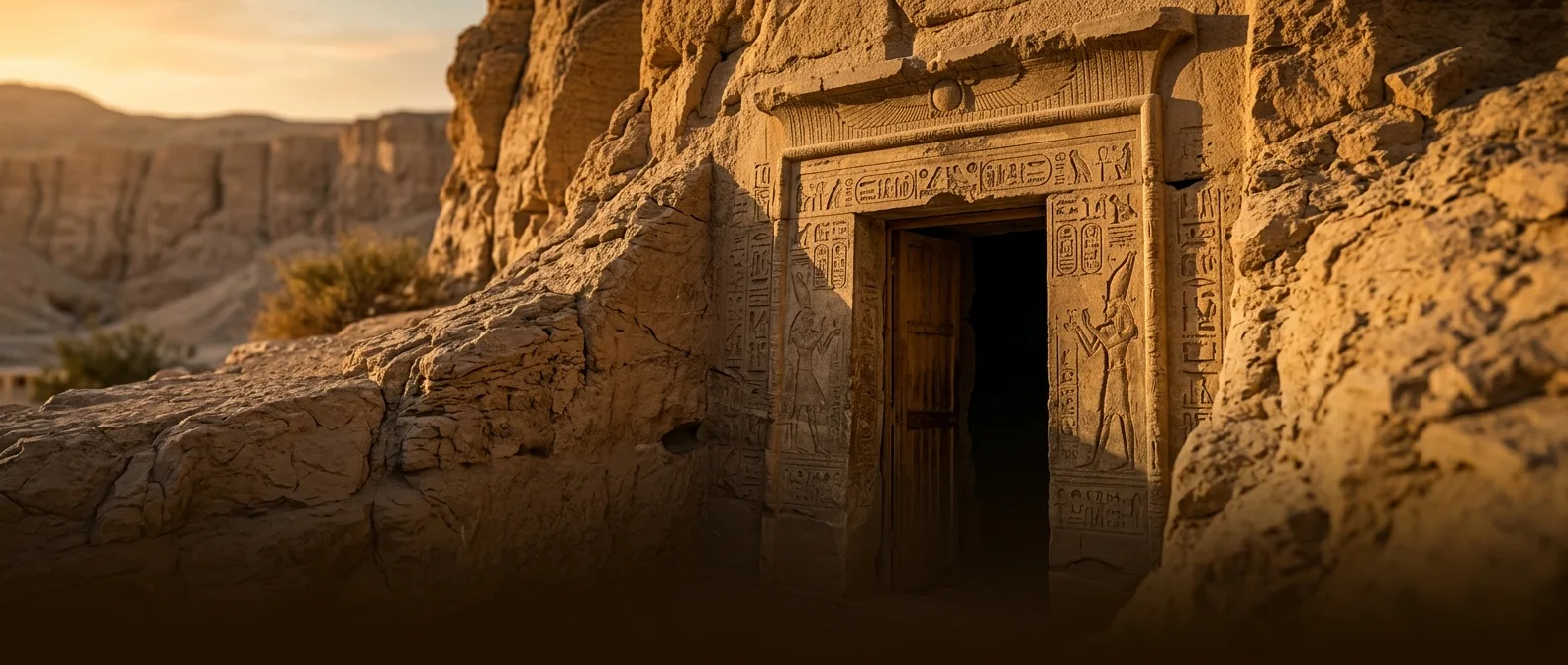
An alabaster stela bearing the name "Thutmose II." That single artifact cracked a 3,500-year-old mystery — the location of the lost pharaoh's tomb. In February 2025, archaeologists found what they'd hunted for 103 years. The first royal tomb discovered since Tutankhamun.
At the foot of the Theban mountain, 1.5 miles west of the Valley of the Kings, a narrow passage leads to a world hidden since 1479 BC. The entrance looks dubious — barely 40 square centimeters of opening that forces researchers to crawl for 33 feet.
When Dr. Piers Litherland of Cambridge University reached the burial chamber, he saw something that defined the discovery. "Part of the ceiling remained intact — a blue ceiling with yellow stars. And blue ceilings with yellow stars are found only in royal tombs." The clincher was scenes from the Amduat, a religious text reserved exclusively for pharaohs.
🏺 The Missing King of the 18th Dynasty
Thutmose II — the name sounded unfamiliar even to Egyptology specialists. He ruled from 1493 BC to 1479 BC, just 14 years on the throne. Compared to his grandfather Thutmose I or his son Thutmose III, this king appears almost... invisible in history.
He married his half-sister Hatshepsut — a political alliance that would define his downfall. When he died young, Hatshepsut first served as regent for his underage son, Thutmose III. Then she simply... stayed. She became pharaoh herself, sidelining the rightful heir.
The Silence of the Historical Record
Why did Thutmose II remain so obscure? Evidence from his body (found in a cache at Deir el-Bahari in 1881) shows a man with chronic health problems. Skin conditions, possibly hereditary disease from centuries of royal inbreeding. He died around 30, leaving behind an infant successor.
Hatshepsut built monuments. Thutmose III conquered empires. Thutmose II left nothing spectacular — except a mystery that lasted 3,500 years.
The Century-Long Hunt
Since 1922 and the discovery of Tutankhamun's tomb, archaeologists have searched for the "missing" pharaoh of the 18th Dynasty. Every other king of the period had been found — except Thutmose II. Somewhere in western Thebes, his tomb had to be hiding.
⛏️ 12 Years of Digging in the Right Spot
In October 2022, Dr. Litherland's team spotted an entrance at a location they called "Wadi C-4." It sat beneath a waterfall of the Theban mountain — an odd choice for a royal tomb. Initially they thought it belonged to one of the Thutmoside royal wives.
The wide staircase and large doorway suggested something more significant. But it was the alabaster stelae bearing the name "Thutmose II" and the reference "deceased king" that provided the answer. In 2025, after 12 years of methodical research by the New Kingdom Research Foundation with Egypt's Ministry, the mystery was solved.
An Empty Tomb with a Fascinating Story
The tomb was empty. Not from thieves — from the ancient Egyptians themselves. Dr. Litherland believes the tomb flooded about six years after burial, around 1473 BC. The location beneath a waterfall proved catastrophic — during the wetter climate period of the 18th Dynasty.
Evidence shows deliberate evacuation. Layers of mud and limestone debris sealed the entrance, protecting the space from future robbers. Somewhere else, the pharaoh's mummy and burial equipment were relocated.
🔍 The Second Tomb Theory
But the excavation revealed more. Dr. Litherland has a theory: there's a second tomb for Thutmose II. "There are 75 feet of man-made layers above a spot where we believe — and have other confirming evidence — that there's a monument hidden underneath."
For a year, the team has worked to penetrate layers of mud and tufa (fine-grained limestone). They've found pieces of beer jars and tomb-builder tool fragments — clear proof of human activity. Some layers are "dining table-sized," others "car-sized."
The Architect with a "Serious Dilemma"
Dr. Litherland believes both tombs were designed by Ineni, the famous architect of the 18th Dynasty. In his biography (tomb TT81), Ineni mentions that he "dug the exalted tomb of His Majesty, unseen and unheard by anyone," facing a "most serious dilemma."
The theory? When the first tomb flooded, Ineni built a second — and this one may contain Thutmose II's burial equipment intact.
"This discovery solves a major mystery of Ancient Egypt — the location of the tombs of the early 18th Dynasty kings."
Dr. Piers Litherland, excavation leader
🌟 Why Hide the Tomb So Well?
The question remains: why was Thutmose II buried in such a remote and hidden location? The Valley of the Kings hadn't yet begun as a royal cemetery — that came later. The early Thutmosides searched for secure spots away from potential tomb robbers.
The choice beneath a waterfall seems paradoxical today — but perhaps held mystical meaning. Water for the ancient Egyptians connected to rebirth and afterlife. The pharaoh who "vanished" from history found eternal rest to the sound of running water.
The Search Continues
Dr. Litherland's team expects to complete removal of layers above the potential second tomb within the next month. If suspicions prove correct, we may see the first intact pharaonic tomb since Tutankhamun.
The First in a Century
The claim that this is the first royal tomb since 1922 isn't absolutely precise — tombs of princes and minor kings have been discovered. But for public perception and global impact, the symbolic power remains. Thutmose II returned to the spotlight after 103 years of silence.
In 2026, despite advances in satellite imagery and DNA analysis, this discovery happened through traditional methods. Classic excavation, 12 years of patience, and the eye of a specialist who recognizes the details.
🎯 Frequently Asked Questions
Was Thutmose II's mummy found in the tomb?
No, the tomb was empty. The pharaoh's mummy had been found in a royal cache at Deir el-Bahari in 1881, where it had been moved by the ancients for protection from tomb robbers.
When exactly was the tomb found?
The entrance was spotted in October 2022, but confirmation that it belonged to Thutmose II came in February 2025, after discovery of alabaster stelae bearing his name.
Is there a chance of finding an intact pharaoh's tomb?
Dr. Litherland believes there's a second tomb hidden beneath tectonic layers. If confirmed, it may contain Thutmose II's burial equipment intact.
The "forgotten" pharaoh shows how much of Egypt remains unknown. In western Thebes, each excavation could rewrite history. Thutmose II waited 3,500 years to make headlines again.