Nicholas Winton: Saved 669 Children in Secret
In late 1938, a 29-year-old British stockbroker cancelled his skiing holiday in Switzerland.
📖 Read more: The Man Who Survived Two Atomic Bombs
A Telegram Instead of a Holiday
Nicholas George Wertheim was born on May 19, 1909, in London, to a family of German-Jewish immigrants who had settled in Britain at the turn of the century. His parents converted to Christianity and changed their surname to Winton to fully integrate into British society. The young Nicky — as his friends called him — studied at Stowe School and traveled to Germany and France to learn banking. By 29, he worked as a stockbroker in London, with a comfortable flat and a life entirely free of drama.
In December 1938, his friend Martin Blake — a member of a humanitarian mission — telegrammed him from Prague: "If you're looking for something useful to do, come here. You won't have enough hands." Czechoslovakia had just been dismembered following the Munich Agreement. The Sudetenland had been surrendered to Hitler. Thousands of Czechs, Jews, and dissidents found themselves trapped in a country that would soon cease to exist.
Winton cancelled his skiing plans for Switzerland. On December 31, 1938, he arrived in Prague.
These Children Cannot Wait
What he witnessed in Prague marked him forever. In freezing refugee camps, families waited in line without hope. There was already a British scheme — the Kindertransport — that moved Jewish children from Germany and Austria to Britain. But Czechoslovakia was not covered. Nobody was organizing anything for the children of Prague.
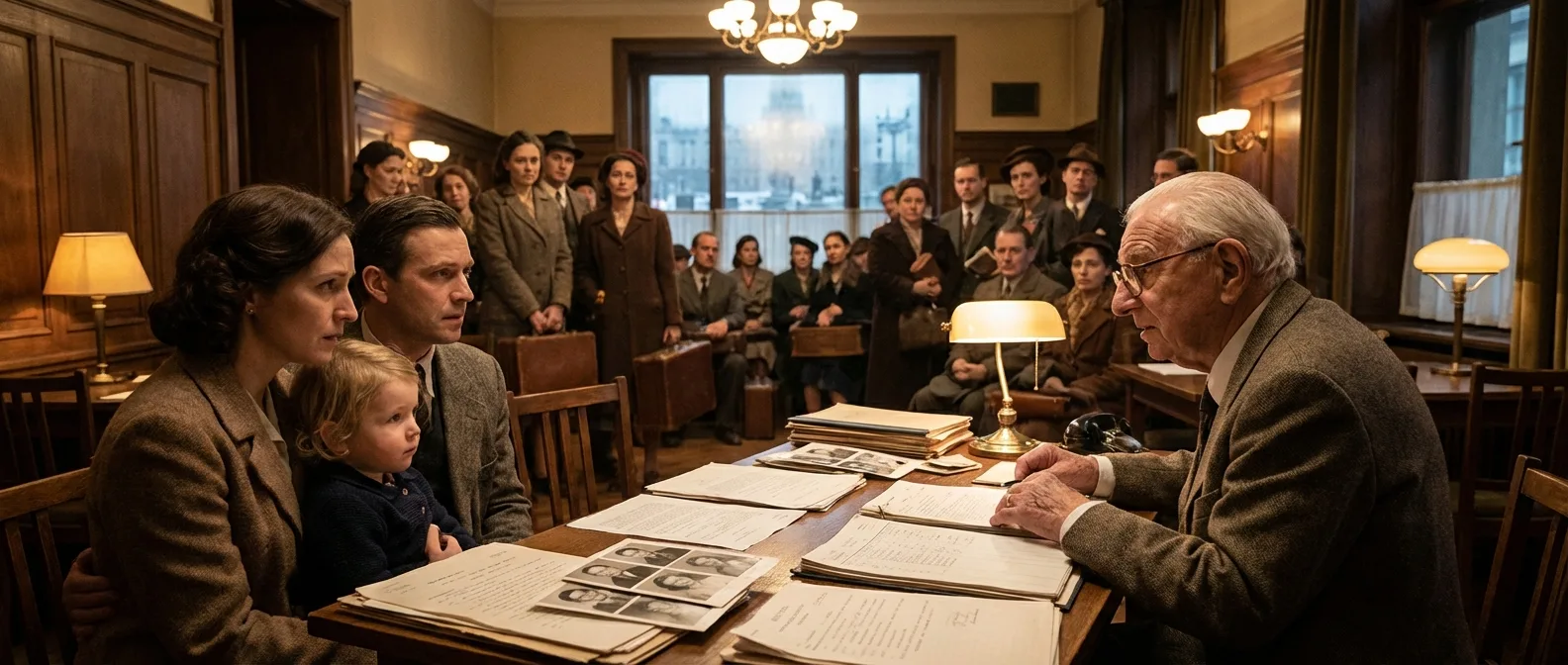
Winton did not wait for government decisions. He set himself up in a hotel room in central Prague and began recording names. Parents formed an endless queue, clutching photographs of their children, birth certificates, medical documents. Within days, the list had surpassed 5,000 applications.
📖 Read more: Wojtek: The Bear That Fought in World War 2
Winton realized he could not save all the children. But every name on that list was a human life. He returned to London in early January 1939 with a determination that would soon transform everything.
An Office at the Kitchen Table
Winton turned his living room table into a rescue center. He worked every morning at the Stock Exchange and every evening at his “office.” His mother, Babette, handled the telephones. He himself printed forged documents, crafted convincing letters of guarantee, and contacted every British family, church, school, and charitable organization that could host a child.
The British Home Office required for each child: registration with a foster family, a guarantee of 50 pounds — a staggering sum for the era — and complete travel documentation. Winton secured them one by one. He found willing families across all of Britain. He raised money through collections and personal contacts. He forged several documents where bureaucracy refused to cooperate.
The first transport departed on March 14, 1939 — twenty children on a train from Prague through Germany and Holland to Liverpool Street station in London. Each child wore a label with their name and number. Most carried a small suitcase. Many did not understand they were saying goodbye to their parents forever.
Eight Trains — and One That Never Left
Between March and August 1939, Winton organized eight Kindertransport trains from Prague. Each mission was a logistical nightmare: the visas, the stamps, the customs, the German checkpoints at the borders. On several occasions, German officers stopped trains for routine inspections that lasted hours while three-year-olds cried from fear and hunger.
📖 Read more: The Soldier Who Hid in the Jungle 30 Years After the War
The seventh train departed on August 2, 1939, carrying 68 children. It was the last successful transport. The eighth train — the largest of all, carrying 250 children — was scheduled for September 1, 1939. On that day, Germany invaded Poland. The borders closed. The train never departed.
None of the 250 children were ever found. They are believed to have perished in concentration camps along with their families. Winton never spoke publicly about it. But those who knew him said the weight of that train never left him.
Fifty Years of Silence
After the war, Winton told no one what he had done. He sought no recognition, wrote no book, gave no interviews. He married, had children, and lived the life of an ordinary Briton. He worked at the Stock Exchange, volunteered at the local hospital, chaired a small charitable trust. Nobody — not his neighbors, not his colleagues, not most of his friends — had any idea.
For fifty years, the only evidence was an old scrapbook in the attic. Inside it: lists of children's names, photographs, copies of documents, route maps, and letters from parents thanking an unknown Briton for keeping their children alive.
In 1988, his wife Grete found the scrapbook during a thorough cleaning of the attic. She leafed through the pages and froze. She asked her husband what it was. He replied vaguely: “Something from the war.” Grete pressed further. Gradually, the story came to light.
📖 Read more: The Castaway Who Survived 133 Days Alone on a Raft
The BBC Evening That Changed Everything
Elisabeth Maxwell — a Holocaust historian — learned about the scrapbook and informed the producers of the popular BBC show “That's Life!” hosted by Esther Rantzen. In 1988, Winton was invited to the studio as a member of the audience — without knowing the real reason.
Rantzen held the scrapbook in her hands. She read out a few names. Then she asked: “Is there anyone in the audience tonight who owes their life to this man?” A woman stood up. Then a second. Then three, five, ten. The entire row behind Winton rose to their feet. They were his “children” — now adults, grandmothers and grandfathers — who had been traced through the lists in his scrapbook.
Winton said nothing. He stood slowly, turned around, looked at those faces — faces that had grown up, lived, raised families, had children, known joy and pain thanks to the train that took them from Prague — and tears rolled silently down his cheeks. That moment, captured by BBC cameras, is considered one of the most powerful moments in television history.
The 669 Children Become Thousands
After the broadcast, “Winton's children” launched a worldwide search. Hundreds of adults in Britain, Canada, Australia, Israel, and the United States discovered they owed their lives to a British stockbroker they had never met. Many did not even know how they had arrived in Britain as children — their foster families had told them nothing.
To this day, it is estimated that over 6,000 people across the globe owe their existence to Winton — the 669 children, their children, their grandchildren, their great-grandchildren. Among them are scientists, doctors, lawyers, artists, teachers, filmmakers. An entire genealogy that would not exist if a young man from London had not cancelled his holiday that December.
Winton was knighted by Queen Elizabeth in 2003. The Czech Republic honored him with its highest state decoration. A train — a replica of those from 1939 — departed symbolically from Prague to London in 2009, filled with the now elderly “children” and their descendants. Winton, 100 years old, greeted them at Liverpool Street station.
EpilogueSir Nicholas Winton died on July 1, 2015, at the age of 106. He did not live to see how many books, documentaries, and plays would be written about him. Titles did not interest him — nor did the fifty years of recognition that were lost. In his final interview, he was asked why he never spoke. He answered: “There was nothing to say. What I did was what any decent person should have done.”
Six hundred and sixty-nine children boarded trains that carried them away from their homeland, away from their parents, away from death. Many parents did not survive. But the children — the children lived, loved, grew old, and every day that passed after those trains was a day granted thanks to a young stockbroker who, simply, did not look the other way.