Mass Hysteria: How a Town Gets Sick for No Reason
How a Town Gets Sick for No Reason
Mass Hysteria: How a Town Gets Sick for No Reason
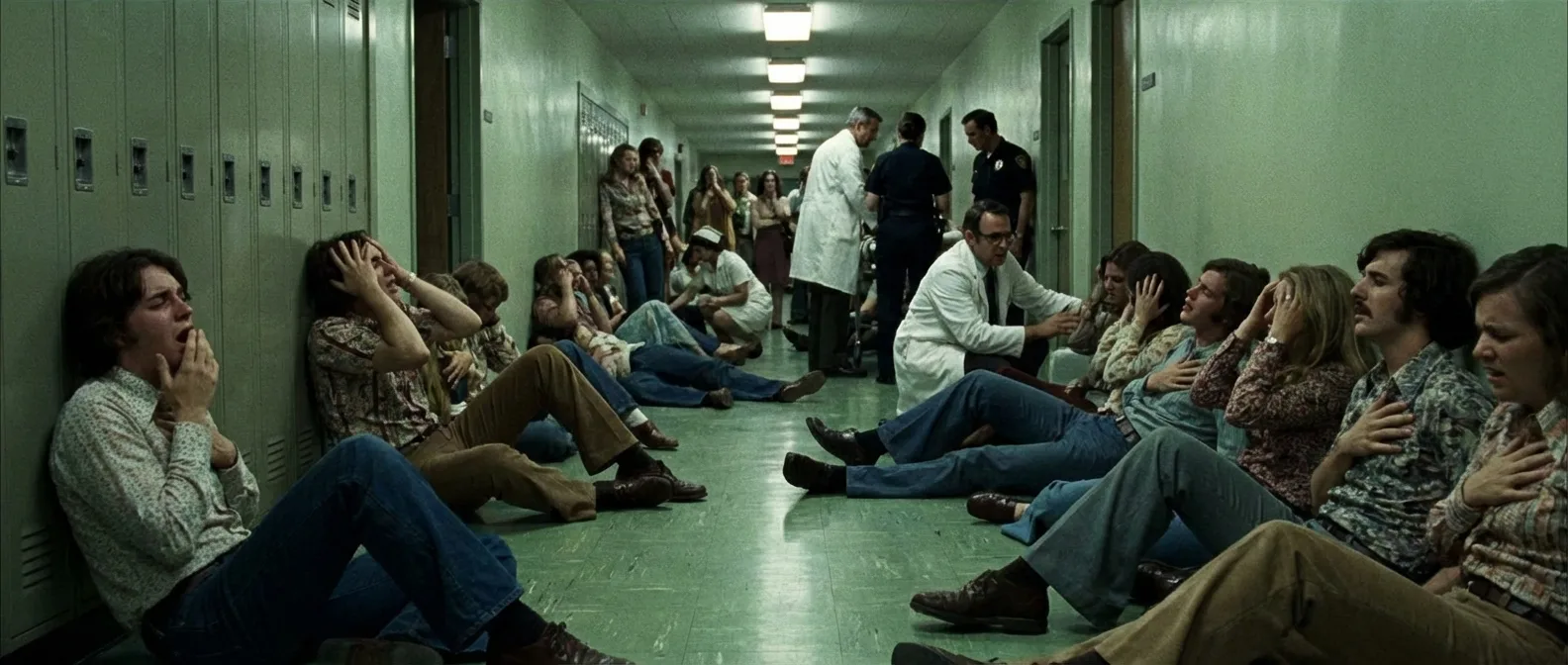
It begins with one person. A twitch. A cough. A sudden, uncontrollable burst of laughter. Within hours, it spreads to a second person, then a third, then a dozen. By morning, an entire school has shut down. By the end of the week, a town is paralyzed — and every doctor, every blood test, every X-ray comes back perfectly clean. There is no virus. No poison in the water. No toxin in the air. And yet hundreds of people are unmistakably, genuinely, physically ill.
Welcome to the world of mass psychogenic illness — once known by its more dramatic name: mass hysteria. It is one of the oldest, strangest, and most unsettling phenomena in the entire catalogue of human behavior. And it is far more common than you think.
Chapter I: The Streets of Strasbourg, 1518
On a warm July morning in 1518, a woman named Frau Troffea stepped into a narrow lane in Strasbourg, then part of the Holy Roman Empire, and began to dance. There was no music. No celebration. No apparent reason. She simply started moving her feet, swaying her body, twisting and turning with an expression that witnesses described not as joy but as something closer to anguish.
She danced for hours. Then she danced through the night. When the sun rose the next morning, Frau Troffea was still dancing — her shoes soaked in blood, her face contorted, her body convulsing in rhythmic spasms that she seemed completely unable to stop.
By the end of the first week, thirty-four others had joined her. By August, the number had swelled to around four hundred. The city's authorities were baffled. Their first instinct was staggeringly misguided: they built a wooden stage, hired musicians, and encouraged the dancers to keep going, believing the affliction would burn itself out if people danced long enough. It did not. People collapsed from exhaustion. Some suffered strokes. Some died.
The Dancing Plague of 1518 is one of the best-documented cases of mass hysteria in history, with records surviving in physician notes, city council minutes, and sermons of the period. Historian John Waller, who spent years studying the event, concluded that the people of Strasbourg were primed for psychogenic illness by an extraordinary convergence of pressures: a series of brutal famines, an outbreak of smallpox, and the gnawing fear of divine punishment that hung over late-medieval life like a permanent fog. The dancing was not a choice. It was the body's scream when the mind could no longer hold its silence.
Chapter II: The Laughter That Wouldn't Stop
On January 30, 1962, at a small boarding school near the village of Kashasha in what was then Tanganyika (now Tanzania), three girls began to laugh. It started during a lesson — perhaps someone told a joke, or maybe the absurdity of a long and tiresome school day simply tipped over into something physical. Whatever the trigger, the laughter did not stop.
Within hours, ninety-five of the school's one hundred and fifty-nine students were convulsed in uncontrollable laughter. It wasn't pleasant. The girls described pain — pain in their chests, pain in their stomachs, a feeling of breathlessness and rising panic. Some cried. Some fainted. Teachers couldn't restore order. The school was forced to close on March 18, nearly seven weeks after the first giggle.
But closure didn't kill it. When students were sent home, they carried the affliction with them like invisible seeds. The laughter epidemic spread to the village of Nshamba, then to Bukoba. Other schools closed. In total, roughly a thousand people were affected across multiple communities over a period of about eighteen months. Symptoms included crying, screaming, restlessness, and occasional running — but the dominant feature, the one that gave the epidemic its name, was laughter. Relentless, agonizing, involuntary laughter.
Medical investigators found no pathogen. No environmental contaminant. No explanation rooted in biology. What they found instead was stress — enormous, grinding, ambient stress. Tanganyika had won its independence from Britain just weeks before the epidemic began. The country was in the grip of massive social upheaval. Children at rural boarding schools were navigating a world that their parents could barely recognize. The pressure had no outlet until the body created one.
Chapter III: The Invisible Bug in the Factory
In June 1962 — the very same year as the Tanganyika laughter epidemic, half a world away — workers at a textile factory in a small Southern US town began falling ill. It started with one woman who complained of a rash and nausea. She was convinced she had been bitten by some kind of insect from a shipment of cloth that had recently arrived from overseas. Within days, sixty-two workers had reported similar symptoms: nausea, numbness, dizziness, and vomiting. Several were hospitalized.
Entomologists were called in. They inspected the factory from floor to ceiling. They examined the cloth shipments. They set traps. They found nothing — no insects, no toxins, no allergens that could possibly account for the symptoms. The US Public Health Service was contacted. Epidemiologists conducted thorough investigations. The conclusion was clear: there was no bug. There never had been a bug.
What there was, however, was strain. The factory had recently introduced overtime shifts. Workers were exhausted, underpaid, and anxious. The social fabric of the workplace was fraying. When one person's anxiety became physical — a rash, a wave of nausea — it gave everyone else's anxiety a name, a shape, a target. The “June Bug,” as it came to be known, became one of the landmark case studies in the medical literature on mass psychogenic illness.
Sociologists Alan Kerckhoff and Kurt Back studied the case in detail. They found that affected workers tended to be socially connected — friends, people on the same shift, people who ate lunch together. The illness traveled along the invisible wires of human relationships. It was, in a very literal sense, contagious — not through germs, but through meaning.
Chapter IV: Witchcraft, Ergot, and the Devil in Salem
The year is 1692. In the small Puritan settlement of Salem Village, Massachusetts, a group of young girls begin to behave strangely. They scream. They contort their bodies. They claim to see specters and phantoms. They accuse their neighbors of witchcraft. The adults — ministers, judges, upstanding members of a godly community — believe them.
Over the following months, more than two hundred people are accused of practicing witchcraft. Thirty are found guilty. Nineteen are hanged. One man is pressed to death under heavy stones for refusing to enter a plea. It is one of the darkest chapters in American colonial history.
For centuries, scholars have debated what actually happened in Salem. Some have pointed to ergot poisoning — a fungus that grows on rye and can produce symptoms resembling hallucinations and convulsions. Others have focused on the political and property disputes seething beneath the surface of the community. But many modern researchers have arrived at a simpler, more uncomfortable conclusion: the girls' afflictions were psychogenic. They were real — the screaming, the convulsions, the apparent trances — but they were produced by the mind, not by Satan and not by ergot.
Salem was a community saturated in fear. Fear of the Devil. Fear of Indigenous raids on the frontier. Fear of divine abandonment. The girls lived in an atmosphere of crushing religious conformity, where every deviation from the norm was potentially damnable. Mass psychogenic illness doesn't emerge from nowhere — it erupts from pressure cookers, and Salem in 1692 was a pressure cooker with the lid welded shut.
What makes Salem especially instructive is how authorities responded. Rather than recognizing the behavior as illness, they treated it as evidence — evidence of invisible supernatural forces at work. They built a judicial apparatus around the girls' suffering and used it to destroy lives. The lesson is devastating in its clarity: when a society doesn't understand psychogenic illness, it reaches for the explanations its culture provides. In 1692, that explanation was witchcraft. In other centuries, it has been demonic possession, divine punishment, or enemy sabotage.
Chapter V: It Still Happens — More Than You Know
If you think mass psychogenic illness is a relic of superstitious centuries, think again. It is happening right now, somewhere in the world, as you read this sentence.
In 2011 and 2012, a cluster of teenage girls in Le Roy, a small town in upstate New York, developed uncontrollable tics and verbal outbursts resembling Tourette's syndrome. The case made national headlines. Environmental activists suspected contamination from a long-ago chemical spill. Parents demanded answers. Eventually, neurologists concluded it was a case of conversion disorder — a psychogenic condition, accelerated by social media, where emotional distress is “converted” into physical symptoms.
In developing countries, mass hysteria outbreaks are reported with striking regularity, particularly in schools. In 2019, dozens of students at a school in Malaysia fell ill with screaming fits and apparent seizures. Teachers reported that students claimed to see dark figures and supernatural entities. Investigations found no medical cause. Similar episodes have been documented in Bangladesh, Nepal, Sri Lanka, Mexico, and Kenya — sometimes affecting hundreds of students at once.
The pattern is remarkably consistent across cultures and centuries. The affected groups tend to be people in subordinate positions — students, factory workers, soldiers, young women in restrictive communities. The symptoms emerge during periods of heightened stress and social tension. And the illness spreads through social networks: friends, classmates, people who see each other every day.
In the age of social media, some researchers worry that mass psychogenic illness has gained a terrifying new vector. During the COVID-19 pandemic, reports surfaced of teenagers on TikTok developing tics after watching videos of people with tic disorders. The phenomenon was widespread enough to generate a flurry of academic papers. The screen, it turns out, can serve as a carrier just as effectively as a shared classroom or a crowded factory floor.
Chapter VI: The Science Behind the Sickness
So what is actually happening inside the body during a mass psychogenic event? The first and most important thing to understand is this: the symptoms are not fake. The nausea is real. The pain is real. The rashes, the tremors, the fainting — all of it is physically happening. The person is not pretending. The difference is that the origin is psychological rather than pathological. There is no invading organism, no toxic exposure, no structural damage. The mind is generating the symptoms, and the body is faithfully carrying them out.
The mechanism is believed to involve the autonomic nervous system — the unconscious machinery that controls heart rate, digestion, breathing, and the fight-or-flight response. Under intense or prolonged stress, the autonomic system can misfire, producing symptoms that mimic physical illness. Anxiety becomes chest pain. Dread becomes nausea. Panic becomes paralysis. The medical term for this is conversion disorder or functional neurological disorder: the brain converts psychological distress into neurological symptoms.
But that explains individual cases. What makes mass psychogenic illness so uncanny is the social dimension — how it leaps from person to person. This is where the concept of social contagion comes in. Humans are profoundly imitative creatures. Mirror neurons in our brains fire not only when we perform an action but when we observe someone else performing it. We yawn when others yawn. We flinch when we see someone get hurt. And under the right conditions, we become ill when we see others become ill.
The psychologist Robert Bartholomew, who has spent his career cataloguing mass psychogenic events, identifies two distinct types. The first is mass anxiety hysteria: rapid-onset, short-lived, triggered by a sudden perceived threat (like a rumored gas leak or chemical attack). The second is mass motor hysteria: slower to develop, longer-lasting, involving twitching, tremors, convulsions, or — as in Strasbourg — dancing. The first type tends to occur in any group. The second tends to occur in populations under sustained, inescapable stress.
In both cases, a crucial ingredient is belief. People must believe that something is wrong — that there is a toxin, or a curse, or a disease — for the symptoms to take hold. This is not gullibility. It is the way human cognition works. Our expectations shape our physical experience. If you are told the water is contaminated, your body may begin to respond as though it is, even before a single drop touches your lips. The nocebo effect — the evil twin of the placebo — is one of the most powerful forces in medicine, and mass hysteria is the nocebo effect writ large.
Chapter VII: Why It Matters
Mass psychogenic illness is not a curiosity. It is not a footnote in the history of medicine. It is a mirror held up to the darkest corners of how societies function — or fail to function.
Every major outbreak tells the same story if you know how to read it. A community under pressure. People without agency, without voice, without a safe channel for their fear and frustration. A trigger — sometimes trivial, sometimes dramatic — that gives the accumulated stress a shape. And then the spread, person to person, body to body, along the invisible lines that connect us to the people we live and work and suffer alongside.
The response of authorities matters enormously. Outbreaks that are met with calm reassurance, separation of affected individuals, and quiet treatment tend to resolve quickly. Outbreaks that are met with panic, media frenzy, invasive investigations, and accusations tend to escalate. The worst possible response is to search aggressively for a physical cause that doesn't exist — because every failed test, every inconclusive investigation, feeds the collective anxiety that is driving the illness in the first place.
Perhaps the most profound lesson of mass psychogenic illness is what it reveals about the boundary between mind and body. We like to believe there is a firm line separating the psychological from the physical. Mass hysteria demolishes that boundary. It shows us, in the most dramatic way imaginable, that the mind is not a passive passenger in the vehicle of the body. It is the driver. And sometimes, under enough pressure, it drives everyone off the road at once.
Epilogue
In Strasbourg, they built a stage and hired musicians. In Salem, they built gallows. In Tanganyika, they closed schools and waited. In a textile factory in the American South, they called the exterminators.
Each time, the mystery was the same. No germ. No poison. No curse. Just human beings, wired to each other by empathy and proximity and shared suffering, their bodies speaking the words their mouths could not. The illness was always real. The cause was always invisible. And the cure — if there ever was one — was always the simplest and hardest thing in the world: to see the pain for what it was, and to stop looking for monsters that weren't there.
The body keeps the score — even when the threat exists only in the minds of everyone around you.