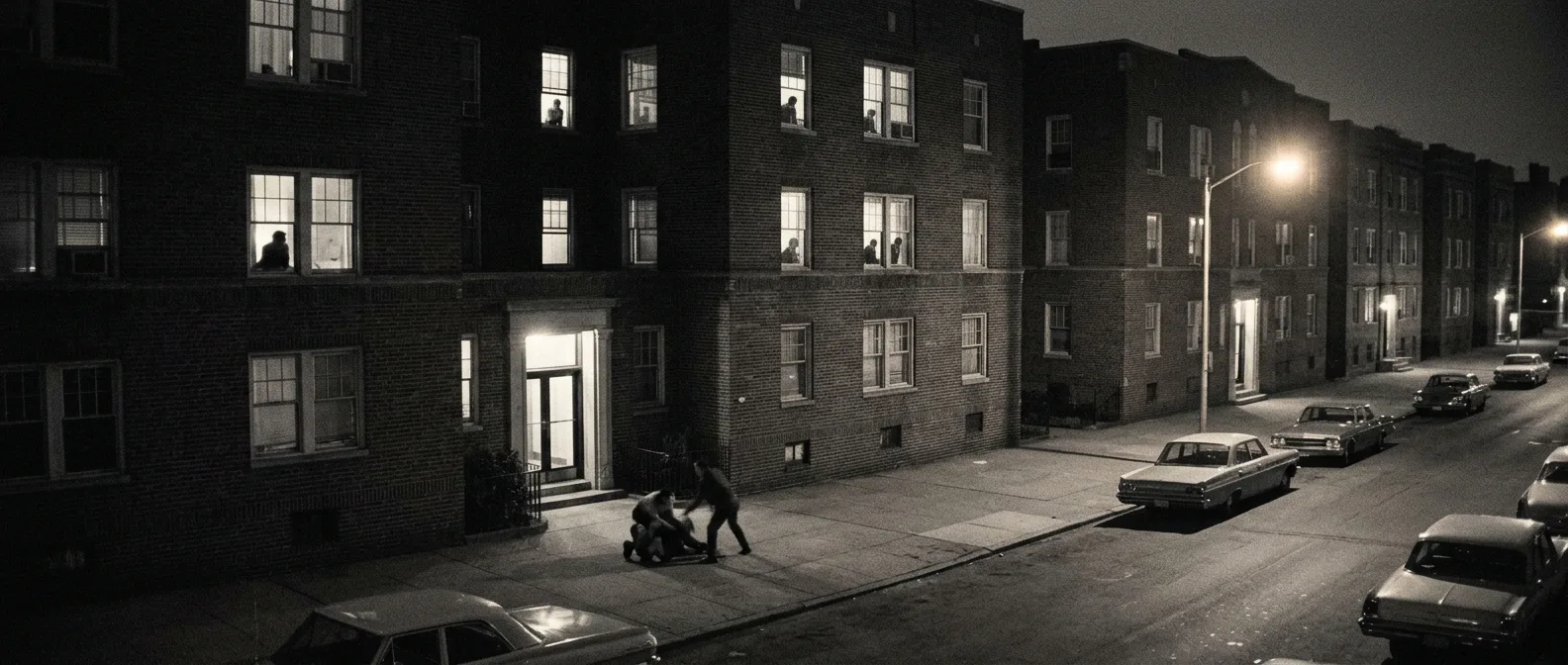
Kitty Genovese: Murder in Front of 38 Bystanders
A True Story
📖 Read more: The Postman Who Hoarded 40,000 Letters at Home
Chapter 1: Kitty
Catherine Susan Genovese — “Kitty” to her friends — was a 28-year-old Italian American who lived in Kew Gardens, a quiet neighborhood in Queens. She worked as a manager at a bar called Ev's Eleventh Hour and came home late at night. She was lively, sociable, loved by her neighbors. She lived with her partner, Mary Ann Zielonko, in a small apartment above a shop.
Kitty had been born in Brooklyn but moved to Queens to live away from her family's disapproval of her lifestyle. She was known in the neighborhood for her broad smile and her late-night conversations with nearby shop owners who kept similar hours.
That night, Kitty finished her shift around 3 a.m. She drove her red Fiat through the dark neighborhood, parked about thirty meters from her building's entrance, and started walking. She did not know that someone was watching her.
Chapter 2: The attack
Winston Moseley, a 29-year-old accountant, father of two, with no criminal record, approached her from behind. He did not know her. He had no motive beyond his sadistic urge. He stabbed her twice in the back.
Kitty screamed: “Oh my God, he stabbed me! Help me!” A window opened on an upper floor of a nearby building. A neighbor shouted: “Leave that woman alone!” Moseley retreated into the darkness. Kitty crawled away, bleeding, desperately searching for a door. No one came down to help her.
Ten minutes later, Moseley returned. He had changed his hat so he would not be recognized. He found Kitty at the rear of the building, in a stairwell entrance, nearly unconscious. He stabbed her again, multiple times. He robbed her. He raped her. And he left.
Kitty died in the ambulance on the way to Queens General Hospital. It was 3:50 a.m. — thirty-five minutes after the first scream. Police were called only at 3:50 — thirty-five minutes after the first scream. The only person who finally dialed was a neighbor who first called a friend on Long Island to ask “what should I do.”
📖 Read more: Jim Twins: Separated at Birth, Lived Identical Lives
Chapter 3: The headline that shocked America
Two weeks after the murder, on March 27, 1964, the New York Times published a front-page article with the headline: “37 Who Saw Murder Didn't Call the Police.” The number was soon rounded up to 38. The article, written by reporter Martin Gansberg, described a scene of nightmarish indifference: dozens of people behind their windows watching a woman being butchered in slow motion, with no one picking up the phone.
The reaction was explosive. The Genovese case became a symbol of a society losing its humanity. Sermons in churches, magazine editorials, debates in Congress. The press condemned the residents of Kew Gardens as cold, numb, morally bankrupt.
Reader letters to the Times were furious. “What is wrong with this country?” they asked. “How is it possible that 38 people heard a woman dying and did nothing?” The question was not rhetorical. Two young psychologists decided to study it scientifically.
Chapter 4: The bystander effect
John Darley and Bibb Latané, social psychologists at Columbia University, were not satisfied with the easy explanation that the neighbors were simply “bad people.” They suspected something deeper was at play — something that concerned fundamental human psychology.
In 1968, they published their groundbreaking study. They designed experiments in which individuals faced some kind of “emergency” — for example, a person having a seizure — either in the presence of others or alone. The results were sweeping: when someone was alone, they almost always helped. When in a group, the likelihood of intervention collapsed.
They called this the “bystander effect.” The core idea: in a group situation, each individual assumes someone else will take action. Responsibility “diffuses” among the observers — and ultimately no one does anything. It is not cruelty. It is a deeply rooted cognitive trap.
Subsequent experiments confirmed the findings across dozens of cultural contexts. The bystander effect was not an American problem — it was a human problem. It appears in every society, in every era, whenever a crowd faces a crisis.
Chapter 5: The myth of the 38 witnesses
For decades, the story remained untouched. Thirty-eight cold-hearted neighbors. A soulless city. A society in moral crisis. But in the early twenty-first century, journalists and researchers began digging into the actual facts, and the picture proved far more complex.
The number 38 was largely fabricated. A. M. Rosenthal, the Times' editor, later admitted the number was “an estimate.” Many of the so-called “witnesses” did not actually see anything — they heard screams but could not determine what was happening. Some thought it was a couple's quarrel or drunken revelers. At least one person did call the police, but the call was lost in bureaucracy.
In 2014, journalist Kevin Cook published “Kitty Genovese: The Murder, the Bystanders, the Crime that Changed America,” in which he deconstructed nearly every aspect of the original narrative. The first attack was not visible from most windows. The street was dark. The screams were brief. And the second attack — the fatal one — took place in an enclosed space, in a stairwell, far from the neighbors' eyes.
Chapter 6: The killer
Winston Moseley was arrested six days after the murder, during a house burglary. In interrogation, he calmly confessed to Kitty's murder, as well as two other murders of women. He described his actions with clinical detachment, without remorse.
In 1968, Moseley escaped from prison during a hospital visit. He held five people hostage in a house before being recaptured — an incident that intensified public outrage against him and made any future clemency virtually impossible.
He was initially sentenced to death, but the sentence was commuted to life imprisonment on appeal. In prison, Moseley earned a degree in sociology. He filed numerous parole applications — all were denied. At one hearing, Kitty's sister, Bill Genovese, told him to his face: “Kitty never got a second chance. Why should you?”
Moseley died in prison in 2016, at the age of 81, having served 52 years. He was one of the longest-serving inmates in New York State history.
Chapter 7: The legacy
The murder of Kitty Genovese — or rather the terrifying narrative built around it — had profound consequences. New York City created the 911 emergency system, partly in response to the case. Before 911, citizens had to know the local precinct phone number — something that rarely happened in the confusion of an actual emergency. The idea of a single number that anyone can call without hesitation traces directly back to that night in Kew Gardens.
Academically, the bystander effect became one of the most studied topics in social psychology. It is taught in every university in the world. It inspired hundreds of studies, experiments, books, and documentaries. “Kitty Genovese” became synonymous with inaction in the face of evil — even though the full truth was far more nuanced.
Mary Ann Zielonko, Kitty's partner, disappeared from public life for decades. It was not until 2004 that she spoke publicly for the first time, describing four decades of pain. Her identity as Kitty's partner was sidelined in the original reporting — the 1960s were not a friendly era for same-sex relationships.
The story of Kitty Genovese contains two tragedies. The first is the murder itself — a violent, unjustifiable act against an innocent woman. The second is the way the story was used: distorted, simplified, turned into a parable. The 38 witnesses were not 38 — and many were not witnesses at all. But the number was so powerful, the narrative so gripping, that the truth could never catch up. And that, perhaps, is yet another "bystander effect": we watch a story unfold before us, false, and no one challenges it — because everyone is waiting for someone else to do it.
Chapter 5: The myth of the 38 witnesses
For decades, the story remained untouched. Thirty-eight cold-hearted neighbors. A soulless city. A society in moral crisis. But in the early twenty-first century, journalists and researchers began digging into the actual facts, and the picture proved far more complex.
The number 38 was largely fabricated. A. M. Rosenthal, the Times' editor, later admitted the number was “an estimate.” Many of the so-called “witnesses” did not actually see anything — they heard screams but could not determine what was happening. Some thought it was a couple's quarrel or drunken revelers. At least one person did call the police, but the call was lost in bureaucracy.
📖 Read more: The Bank Heist Through a Tunnel in Brazil
In 2014, journalist Kevin Cook published “Kitty Genovese: The Murder, the Bystanders, the Crime that Changed America,” in which he deconstructed nearly every aspect of the original narrative. The first attack was not visible from most windows. The street was dark. The screams were brief. And the second attack — the fatal one — took place in an enclosed space, in a stairwell, far from the neighbors' eyes.
Chapter 6: The killer
Winston Moseley was arrested six days after the murder, during a house burglary. In interrogation, he calmly confessed to Kitty's murder, as well as two other murders of women. He described his actions with clinical detachment, without remorse.
In 1968, Moseley escaped from prison during a hospital visit. He held five people hostage in a house before being recaptured — an incident that intensified public outrage against him and made any future clemency virtually impossible.
He was initially sentenced to death, but the sentence was commuted to life imprisonment on appeal. In prison, Moseley earned a degree in sociology. He filed numerous parole applications — all were denied. At one hearing, Kitty's sister, Bill Genovese, told him to his face: “Kitty never got a second chance. Why should you?”
Moseley died in prison in 2016, at the age of 81, having served 52 years. He was one of the longest-serving inmates in New York State history.
Chapter 7: The legacy
The murder of Kitty Genovese — or rather the terrifying narrative built around it — had profound consequences. New York City created the 911 emergency system, partly in response to the case. Before 911, citizens had to know the local precinct phone number — something that rarely happened in the confusion of an actual emergency. The idea of a single number that anyone can call without hesitation traces directly back to that night in Kew Gardens.
Academically, the bystander effect became one of the most studied topics in social psychology. It is taught in every university in the world. It inspired hundreds of studies, experiments, books, and documentaries. “Kitty Genovese” became synonymous with inaction in the face of evil — even though the full truth was far more nuanced.
Mary Ann Zielonko, Kitty's partner, disappeared from public life for decades. It was not until 2004 that she spoke publicly for the first time, describing four decades of pain. Her identity as Kitty's partner was sidelined in the original reporting — the 1960s were not a friendly era for same-sex relationships.
The story of Kitty Genovese contains two tragedies. The first is the murder itself — a violent, unjustifiable act against an innocent woman. The second is the way the story was used: distorted, simplified, turned into a parable. The 38 witnesses were not 38 — and many were not witnesses at all. But the number was so powerful, the narrative so gripping, that the truth could never catch up. And that, perhaps, is yet another "bystander effect": we watch a story unfold before us, false, and no one challenges it — because everyone is waiting for someone else to do it.