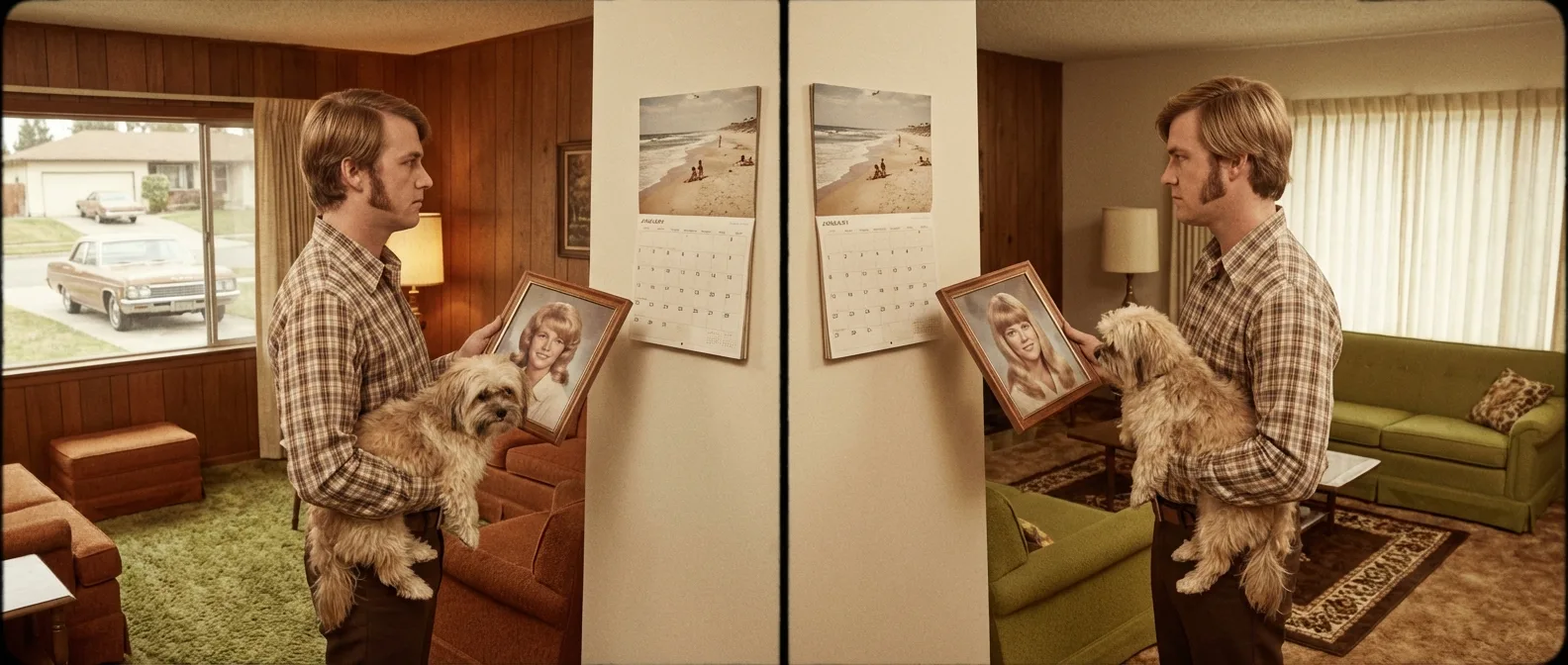
Jim Twins: Separated at Birth, Lived Identical Lives
In 1979, two men aged 39 met for the first time in their lives.
📖 Read more: Rosenhan Experiment: Fake Patients in Psychiatric Hospitals
The separation
Jim Lewis and Jim Springer were born on August 19, 1939, in Piqua, Ohio. Their biological mother couldn't raise them — she was poor and unmarried in an era when out-of-wedlock births carried severe social stigma. At three weeks old, the twins were given up for adoption to two different families in Ohio, with no information about each other.
The practice of separating twins was common during that era — many adoption agencies believed twins had a better chance of being adopted if offered individually. Some agencies deliberately concealed the existence of a sibling to avoid complications.
The Lewis family took one boy and named him James Edward Lewis. The Springer family took the other and named him James Arthur Springer. No one knew that the same fate — or perhaps something deeper than fate — had already begun connecting them.
Both families lived in Ohio but in different cities, with no contact between them. The adoptive families didn't even know a second twin existed. The adopting couples were told that “there was once a second baby, but it died.” The separation was complete and theoretically irreversible.
Two parallel lives
As they grew up, the two Jims developed strikingly similar lives — without knowing it. Both were average students in school. Both were good at math but indifferent to language arts. Both worked at gas stations as young men. Both entered law enforcement — Jim Lewis as a deputy sheriff, Jim Springer as a part-time police officer.
📖 Read more: The History of Speed: Why Everything Must Happen Now
Both married women named Linda. Both divorced. Both remarried women named Betty. Both named their first son James Alan — one with one “l,” the other with two (Allan). Both had a dog named Toy.
The list of similarities was incomprehensibly long: both smoked Salem cigarettes, both drank Miller Lite beer, both drove Chevrolets, both vacationed at the same beach in Florida, both had built wooden benches around trees in their yards, both bit their fingernails, both suffered from migraines.
Both had a woodworking workshop in their garage. Both left love notes for their wives around the house. Both gained roughly 10 pounds at the same age. Both described experiencing tension headaches that began behind the left eye — a detail so specific that researchers initially suspected a reporting error.
Both Jims began suffering from the same type of migraine at the same age — around 18. The intensity, frequency, and even the location of the pain were nearly identical.
The reunion
Jim Lewis had always known he was adopted. At 39, he decided to search for whether a second baby existed — his mother had mentioned something vague about “another child.” He contacted the Montgomery County authorities in Ohio and requested access to adoption records.
The records confirmed: there was a second twin, alive, in Dayton, Ohio. Jim Lewis picked up the phone. The moment Jim Springer answered and Jim Lewis said “I'm your brother” was the beginning of a story that would change the way we understand genetics.
📖 Read more: The Invisible Gorilla: Why We Don't See Everything
Their first meeting was on February 15, 1979. Jim Lewis drove to Jim Springer's house. When they stood face to face, the resemblance was staggering — same height, same weight, same posture, same facial expressions. But what truly shocked them were the details they exchanged endlessly that night.
It was like looking in a mirror — but the mirror didn't just reflect my face. It reflected my entire life.
The MISTRA study
The Jim Twins' story reached Thomas Bouchard, a psychologist at the University of Minnesota. Bouchard had just launched the Minnesota Study of Twins Reared Apart (MISTRA) — an ambitious research program aimed at studying twins raised separately to understand the relationship between genetics and environment.
The two Jims became the study's first subjects. They underwent weeks of testing: intelligence tests, psychological assessments, medical examinations, personality evaluations. The results were stunning: the two Jims had nearly identical scores in every category. Their IQ scores differed by only 2 points. Their EEGs (electroencephalograms) were virtually indistinguishable.
The MISTRA study eventually examined over 100 pairs of twins raised apart. The findings were consistent: genetics determines far more than we believed — from IQ and personality to political views, religious tendencies, and even aesthetic preferences.
The MISTRA study ran for two decades (1979-1999) and was published in top scientific journals, including Science. Bouchard and his team developed testing protocols lasting an entire week per pair, with more than 15,000 questions per participant. The study examined not only identical twins raised apart, but also fraternal twins and siblings raised in different households, providing crucial comparison data.
📖 Read more: The Teacher Who Created a Dictatorship in a School
MISTRA estimated that the heritability of IQ is approximately 70% — meaning 70% of the variation in intelligence is attributable to genetic factors. Before the study, the prevailing view was that environment was the determining factor.
Other twins, same mystery
The MISTRA study revealed dozens of equally remarkable cases. Oskar Stohr and Jack Yufe were identical twins raised in completely opposite environments: Oskar was raised as a Nazi in Czechoslovakia, Jack as Jewish in Trinidad. When they met, both wore blue shirts with epaulettes, both flushed the toilet before and after using it, and both had the peculiar habit of sneezing loudly in elevators.
Bridget Harrison and Dorothy Lowe, twins separated immediately after birth in England, discovered they both wore rings on exactly the same fingers and bracelets on the same wrist. Both named their cats the same way. Both kept diaries — with gaps in the exact same time periods.
Daphne Goodship and Barbara Herbert, twins raised on opposite ends of England, discovered they had both fallen down stairs at age 15 — injuring the same ankle. Both worked in local government. Both had low blood pressure.
Coincidence stops being coincidence when it happens again and again across hundreds of pairs. That is a pattern — a genetic pattern.
The MISTRA findings were not accepted without objection. Several researchers argued that many of the “remarkable similarities” were statistically expected. Two men of the same age, same ethnicity, within a small geographic area, would naturally have much in common — smoking the same popular cigarettes, driving cars in the same price range.
The naming of spouses (Linda, Betty) was considered partially explainable: these were the most popular female names in Ohio during that decade. The dog named Toy was harder to explain, but some considered it “an outstanding coincidence.”
However, the cumulative data was overwhelming. When dozens of pairs display similar patterns — in IQ scores, personalities, psychological profiles — the “coincidence” explanation is no longer sufficient. MISTRA played a central role in shifting the scientific community toward a model that recognizes the significant genetic contribution to behavior.
Modern genome-wide association studies (GWAS) have since confirmed many of MISTRA's core findings. Researchers now recognize that most complex traits — from height and body mass to susceptibility to anxiety and even musical ability — are influenced by thousands of genetic variants working in concert, each contributing a tiny effect that collectively shapes who we become.
Two Jims, one DNA
The two Jims lived their lives together after their reunion. They became close friends, spent time together, and participated jointly in documentaries and TV appearances. Jim Lewis died in 2023, at the age of 84. Jim Springer followed him a few months later — one final, eerie similarity that sealed a lifetime of uncanny parallels.
They appeared together on The Tonight Show with Johnny Carson, in BBC and National Geographic documentaries, and their story is referenced in virtually every university psychology textbook worldwide.
Their story remains one of the most striking examples in the science of genetics. The two Jims didn't choose their lives — in a way, their lives chose them. Two brothers, two cities, two families, two lives that were identical. The coincidence may never have been a coincidence at all. It may have been DNA.