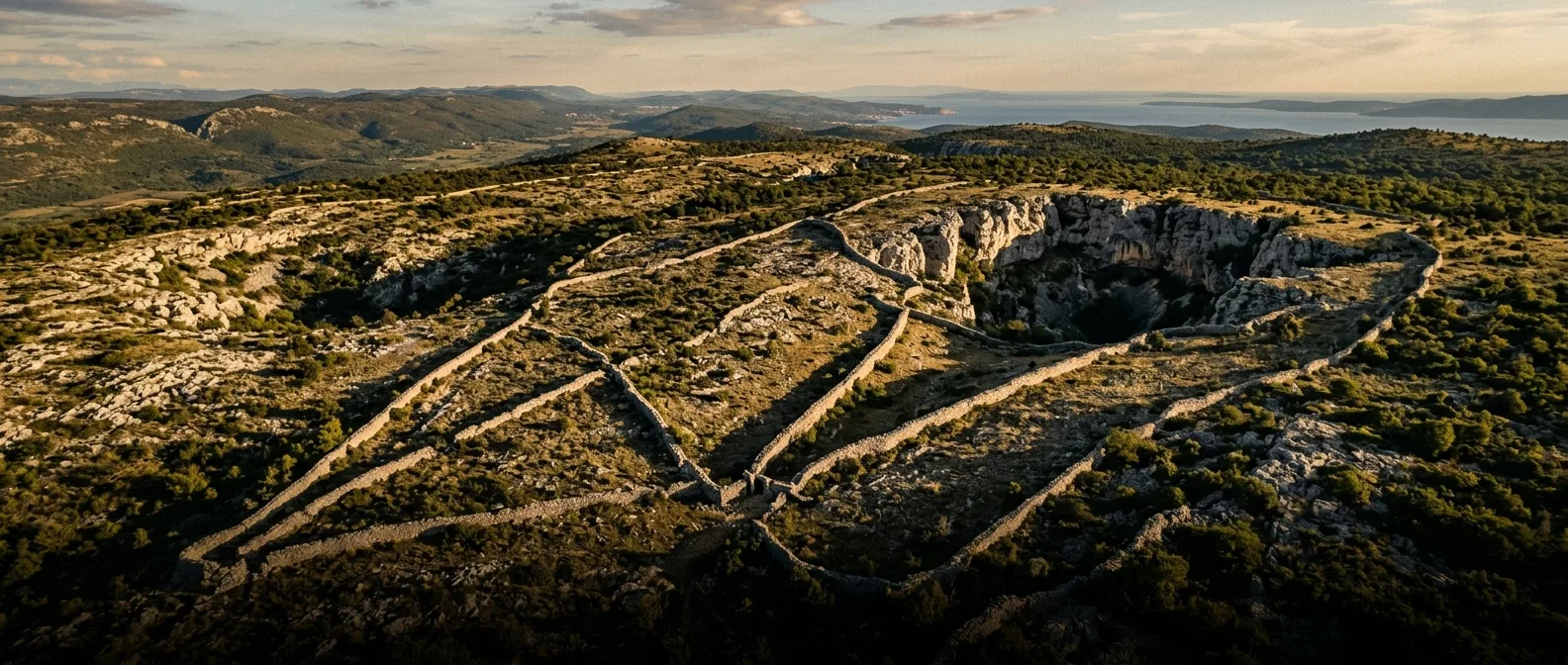
Stone walls stretch for miles across barren hills. Massive funnels carved with mathematical precision. Hidden beneath Slovenia's Karst plateau, between the borders with Italy, lay some of Europe's first large-scale constructions. Not temples. Not palaces. Hunting traps that would make 2026 engineers jealous.
📖 Read more: Europe's Stone Age Chefs: Complex Cooking 8,000 Years Ago
🏗️ When Prehistory Becomes Architecture
The aerial laser scanner swept across the Karst plateau when University of Ljubljana researchers started seeing patterns that shouldn't exist. Limestone walls stretching up to 3.5 kilometers. Geometries resembling funnels, all leading toward hidden pits beneath sheer cliffs.
First reaction was skepticism. How could prehistoric hunters build something this extensive? But the evidence was undeniable — four massive stone megastructures, hidden beneath millennia of vegetation.
The Numbers Behind the Mystery
The largest of the four hunting traps required over 5,000 hours of labor — that's 40 people working two hours daily for two months. The stone walls, now just 50 centimeters tall, originally stood nearly a meter high and were completely invisible from a distance.
🦌 The Art of Large-Scale Trapping
Picture the scene. A deer herd moves across the rocky plateau. Sees an open valley ahead. Doesn't realize the "natural" stone formations are actually human constructions slowly guiding it toward a trap.
The walls narrow gradually. The herd continues, unaware its choices are being restricted. Until it reaches the end — a pit beneath a sheer cliff, with no escape.
Coordinated Survival Tactics
The strategy demanded absolute coordination. Dozens of hunters would position themselves at specific points. Some would make noise to direct the animals. Others would wait at the trap's end. The results would feed entire communities for weeks.
But why build something this massive when you can hunt with simpler methods? The answer lies in bones discovered in nearby caves. At Grotta dell'Edera and Pupićina, 90% of animal remains come from deer — evidence of intensive, seasonal hunting.
📖 Read more: Pharaoh Thutmose II Tomb Found: First Royal Discovery Since 1922
🏺 Parallels with Asia's "Desert Kites"
The Karst constructions match the "desert kites" — giant hunting traps found in the deserts of southwestern Asia and northern Africa. Those date back over 9,000 years and were used to trap gazelles.
Until now, such large-scale hunting structures hadn't been found in Europe. The Slovenian discovery changes this picture and raises questions about cultural contacts or parallel evolution.
Technology Beyond Its Time
To build these hunting traps, prehistoric engineers had to understand animal behavior, migration routes, and natural terrain features. They had to predict how a herd would react to a low wall and how to guide it without causing panic.
When you view the constructions from above, the similarity to modern traps is striking. Same logic, same exploitation of prey psychology.
⏰ Dating a Mystery
When exactly were these hunting traps built? Carbon dating showed they were abandoned by the Late Bronze Age — somewhere between 3,500 to 1,700 years ago. But this means they were constructed much earlier.
Paleoenvironmental data suggests the area began to forest around 4,000 years ago. So the traps were built when the terrain was more open — possibly during the Mesolithic, around 10,000 years ago.
Timeline
Likely construction: 10,000 years ago
Abandonment: 3,500-1,700 years ago
Discovery: 2025
Materials
Loosely stacked limestone
Wall width: 1-1.5 meters
Original height: ~1 meter
When Europe Had a Different Face
The Mesolithic was a transition period. Glaciers were retreating, but agriculture hadn't yet reached Europe. People still lived by hunting and gathering, but — as these constructions show — with far more sophisticated methods than archaeologists believed.
📖 Read more: 1,000-Year-Old Whale Trap Found on Norway's Seafloor
🧠 Redesigning Prehistoric Society
For decades, the classic image of prehistoric Europeans was small, family groups living in caves and hunting with primitive tools. The Karst constructions demolish this picture.
Five thousand hours of labor isn't something an extended family can achieve. It requires an entire community, planning, leadership, coordination. It requires the ability to convince dozens of people to work toward a common goal for months.
"These installations reveal critical dimensions of prehistoric life: coordination of communal labor beyond the domestic sphere, transformation of terrain into infrastructural systems, and connection of animal ecology with architectural foresight."
— University of Ljubljana Researchers
Social Organization Before Agriculture
These communities had developed complex forms of social organization without agriculture, metallurgy, or permanent settlements. They still lived off the wild, but had already learned to shape it.
This raises questions about when and how human civilization began. Maybe the capacity for collective action and environmental engineering was much older than we thought?
🔬 The Technology Behind the Discovery
Without aerial laser scanning (ALS), these hunting traps would have remained hidden forever. The technology allows archaeologists to "see" beneath vegetation and uneven terrain, revealing structures invisible from ground level.
Researchers mapped 870 square kilometers with centimeter precision. Every stone, every raised point, every depression in the ground was recorded three-dimensionally.
When Technology Meets History
The paradox is that it took 2025 technology to understand 8000 BC technology. Two completely different forms of intelligence — one based on digital processing, the other on deep understanding of the natural world — meet in a moment of revelation.
These stone hunting traps aren't just archaeological finds. They're messages from a lost world, reminding us that human intelligence and capacity for cooperation are older than historians believed. In Slovenia's rocky hills, somewhere between the clouds and silent stones, other secrets still hide, waiting to be revealed.