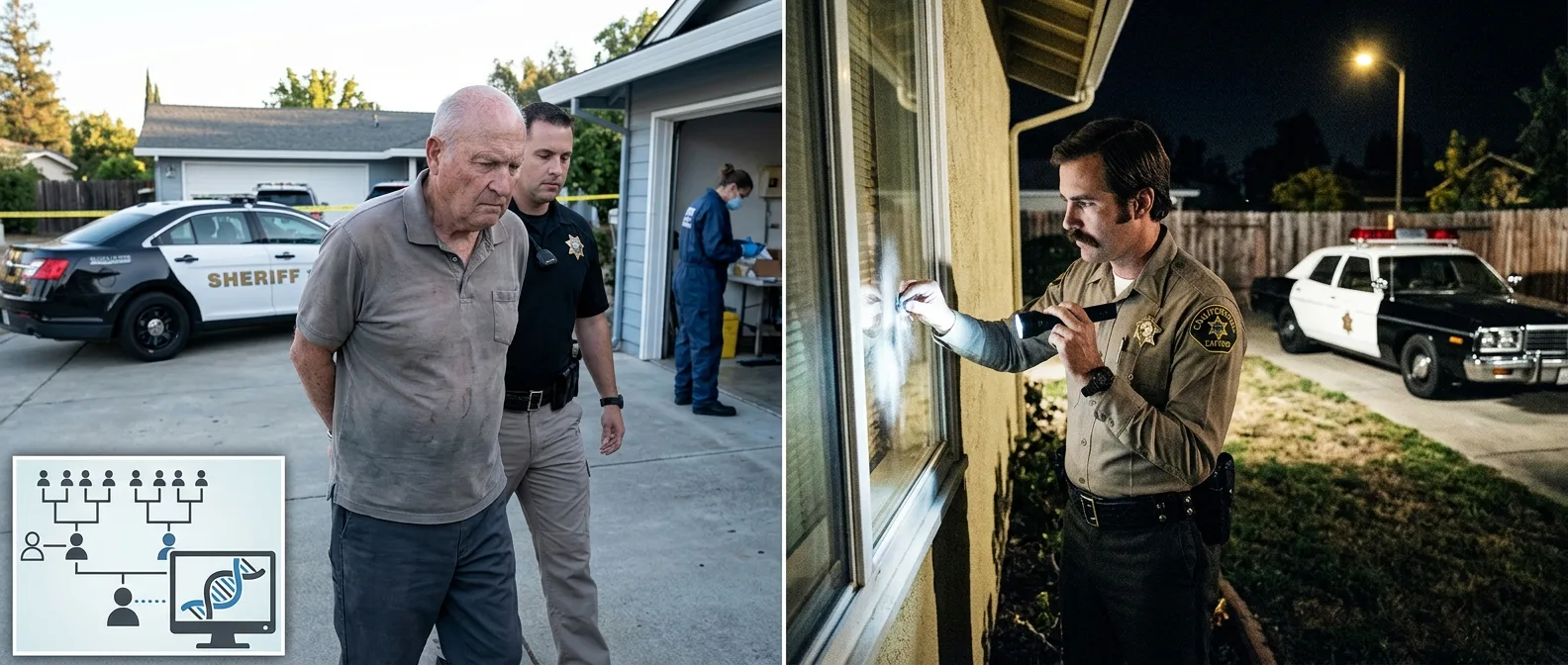
Golden State Killer: DNA Caught Him 40 Years Later
For over 40 years, the Golden State Killer was a ghost.
📖 Read more: The Family That Vanished While Their Home Remained Untouched
The invisible perpetrator
The story begins in 1974 in Visalia, a small city in central California. Someone starts breaking into houses — but he does not steal money or jewelry. He steals undergarments, rearranges objects, and leaves signs he was there. They call him the “Visalia Ransacker.” Over 20 months, he breaks into more than 120 homes. He wears gloves, leaves no fingerprints, and never appears on camera.
On September 11, 1975, the situation escalates: the intruder enters the home of Claude Snelling, a 45-year-old journalism professor, and tries to kidnap his 16-year-old daughter. Snelling runs into the yard to save her — and is shot dead with two bullets. It is the first murder.
Three months later, on December 12, 1975, Detective William McGowen sets up a stakeout in a garage near a home the prowler frequents. A masked figure appears. McGowen fires a warning shot — the masked man draws a revolver and fires at the detective's flashlight, shattering it next to his face, then vanishes into the darkness. No one knows yet that the perpetrator is a police officer — serving at the Exeter Police Department, just a few miles away.
The “East Area Rapist”
In 1976, DeAngelo relocated to Sacramento and his crimes escalated. The first recorded attack occurred on June 18, 1976, in Rancho Cordova. The perpetrator targeted homes near schools and creeks — locations that provided quick escape routes. They called him the “East Area Rapist.”
His methods were terrifyingly methodical. He studied victims for weeks in advance, learning their routines, their dogs' names, even how many children they had. Upon entry, he announced himself with a flashlight to the face. He bound men with shoelaces, stacked dishes on their backs, and threatened: “If I hear the dishes rattle, I'll kill everyone.” He then moved the woman to another room.
More than 50 attacks in three years. He phoned victims before and after attacks — heavy breathing, silence, sometimes death threats. During a 1978 assault, he murmured something chilling: “I hate you, Bonnie.” Bonnie Colwell was his ex-fiancée — she had broken off their engagement in 1971. DeAngelo had threatened her with a gun before they split.
In January 1978, someone called a counseling service and said: “I have a problem. I need help because I don't want to do this anymore.” After a few minutes, the caller said: “I believe you are tracing this call” — and hung up.
📖 Read more: The Somerton Beach Dead Man with No Identity
The “Original Night Stalker”
After July 1979, DeAngelo moved to Southern California — and began killing. Victims were now couples. On December 30, 1979, orthopedic surgeon Dr. Robert Offerman and clinical psychologist Dr. Debra Manning were found shot dead in his condominium in Goleta. The killer had eaten leftover Christmas turkey from the refrigerator before leaving.
In March 1980, attorney Lyman Smith and his wife Charlene were found murdered in their Ventura home — bludgeoned to death with a log from the woodpile beside their house. In August 1980, medical student Keith Harrington and his wife Patrice were killed in Dana Point — they had been married just three months.
Between 1979 and 1986, the perpetrator murdered 13 people. Police called him the “Original Night Stalker” — without knowing he was the same person as the “East Area Rapist.” The last known killing came in May 1986: 18-year-old Janelle Cruz was found dead in her Irvine home while her family was vacationing in Mexico. After that — silence.
Silence — 30 years
After 1986, the crimes suddenly stopped. The perpetrator vanished. No traces, no evidence, no suspects. The case slowly went cold.
In 2001, however, DNA analysis linked the “East Area Rapist” and the “Original Night Stalker” for the first time — they were indeed the same person. In June 2016, the FBI announced a $50,000 reward for information, in a final nationwide push. Still, nothing came of it.
Journalist Michelle McNamara devoted years to the case. In a February 2013 article for Los Angeles Magazine, she coined the name “Golden State Killer” — the official moniker that would stick forever. But she never lived to see the arrest — she died in April 2016, at 46.
I'll find him. It may take years. But I'll find him.
📖 Read more: Hinterkaifeck Farm: 6 Dead and the Killer Lived There
The DNA breakthrough
In December 2017, investigator Paul Holes, just weeks from retirement, and FBI attorney Steve Kramer took a DNA profile from a rape kit that had been stored for decades in Ventura County. They uploaded it to GEDmatch — a free, public genealogy database.
GEDmatch was never designed for criminal investigations. It existed for people seeking distant relatives. But the database flagged 10 to 20 individuals who shared the same great-great-great-grandparents as the perpetrator. Genealogist Barbara Rae-Venter, working with a team of five investigators, used those results to build approximately 25 different family trees — one tree alone contained nearly 1,000 people.
Branch by branch, generation by generation, they eliminated suspects based on age, sex, and location. Two names remained. One was ruled out by a relative's DNA test. The other was Joseph James DeAngelo.
DeAngelo was 72 years old, living quietly in a Sacramento suburb. Neighbors remembered him as “a quiet grandfather who yelled to himself in the yard” — but no one suspected anything serious.
The arrest
Before arresting him, investigators needed ironclad proof — direct DNA, not genealogical inference. On April 18, 2018, agents covertly collected DNA from the handle of DeAngelo's car door. Later, they recovered a tissue from his curbside garbage can. Both samples matched crime-scene DNA — a 100% match.
On April 24, 2018, DeAngelo was arrested in the side yard of his home. Left alone in the interrogation room, surveillance cameras recorded him talking to himself: "I didn't have the strength to push him out. He made me. I wanted a happy life. I did all those things. I destroyed all their lives." Prosecutors believe it was a manipulation tactic.
The revelation was staggering. DeAngelo had served as a police officer in Exeter (1973–1976) and Auburn (1976–1979) — meaning he was an active-duty cop while committing the Visalia Ransacker and East Area Rapist crimes. He was fired in 1979 after being caught shoplifting a hammer and dog repellent — items with an obviously sinister purpose. During his dismissal, he threatened to kill the chief of police.
He married Sharon Huddle in November 1973 and they had three daughters. His wife became a divorce attorney — she knew nothing. They separated in 1991. After being fired from the police, he spent nearly three decades working as a truck mechanic at a Save Mart Supermarkets distribution center in Roseville, from 1990 until his retirement in 2017. Neighbors reported frequent loud, profane outbursts — he once threatened a neighbor that he would “deliver a load of death” because of their barking dog.
I can't believe it. We saw him every day. He watered his flowers. He was... normal. My daughter considered him a grandfather.
The trial and the end
DeAngelo was charged with 13 counts of first-degree murder and 13 counts of kidnapping. The rapes could not be prosecuted — the statute of limitations had expired. In June 2020, he accepted a plea deal to avoid the death penalty: he pleaded guilty to all charges.
For days, victims and families addressed the court. One woman said: "Every night, for 40 years, I lock the door three times. Now maybe I can lock it just twice." DeAngelo's eldest daughter defended her father in a letter: “He is the best father I could have had.”
At the end, DeAngelo stood and spoke: "I've listened to all your statements, each one of them. I'm truly sorry to everyone I've hurt." On August 21, 2020, he was sentenced to multiple consecutive life terms without the possibility of parole. He is currently held at Corcoran State Prison, in protective custody.
The world after the Golden State Killer
DeAngelo's arrest was not just the end of a case — it was the beginning of a new era in forensic science. The genealogical DNA technique has solved dozens of cold cases since then. But it also raised questions nobody has fully answered: who owns your DNA? A distant relative who uploaded their profile to a genealogy website can inadvertently lead investigators to you. GEDmatch, following the case, changed its terms of service — users must now explicitly opt in to allow DNA use for law enforcement purposes.
Michelle McNamara never saw the arrest. But her book, “I'll Be Gone in the Dark,” was published in February 2018, two months before the capture, and became a bestseller. It was adapted into an HBO documentary series. On the final page, she writes to the killer: “A dataset is waiting for you.” She was right.