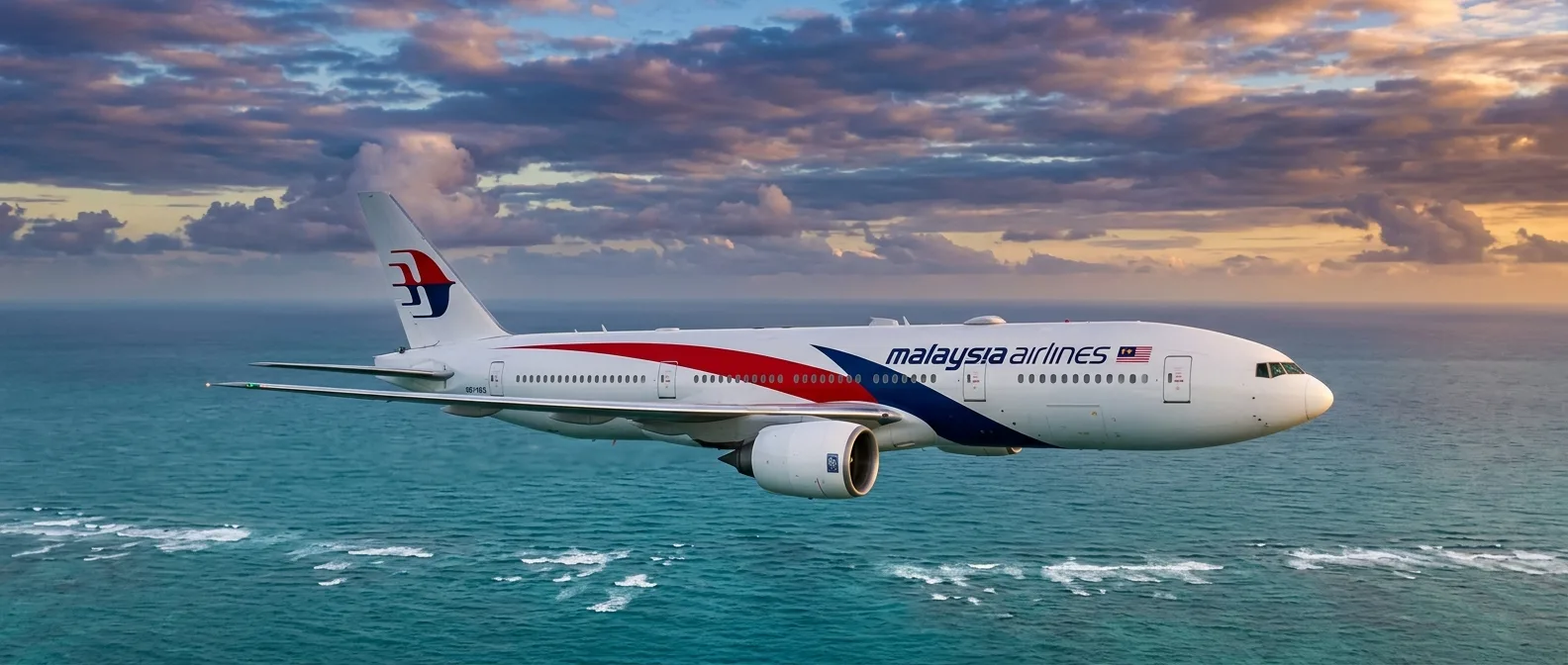
Flight MH370: Plane Vanished with 239 Passengers
A True Story
A legendary aircraft
The Boeing 777-200ER registered as 9M-MRO was one of the most reliable aircraft in the world. Delivered to Malaysia Airlines in May 2002, it had accumulated over 53,000 flight hours with no significant technical history. The Boeing 777 was widely considered one of the safest commercial aircraft ever built — in two decades of operation, not a single fatal accident had been attributed to structural failure.
The captain was Zaharie Ahmad Shah, 53 years old, an exceptionally experienced pilot with over 18,000 flight hours. The first officer, Fariq Abdul Hamid, 27, was on his first unsupervised flight on the 777 type. In the cabin, 227 passengers — the majority Chinese nationals — expected a routine six-hour flight to Beijing.
Captain Zaharie Shah was a well-known aviation enthusiast. He had built an elaborate flight simulator at his home, on which he practiced regularly. This detail would later take on enormous significance in the investigation.
A routine flight that wasn't
At 00:41 local time, Flight MH370 lifted off from Runway 32R at Kuala Lumpur International Airport. Everything was normal. The weather was clear, visibility excellent. Air traffic control confirmed the northeast heading toward Beijing.
At 01:01, the aircraft reached its cruising altitude of 35,000 feet. Communication with air traffic control was routine. Those first twenty minutes gave no indication whatsoever of what was about to unfold. No distress signal. No unusual behavior. Not the slightest hint that this flight would become the greatest aviation mystery in history.
"Good night, Malaysian Three Seven Zero"
At 01:19, the captain or first officer transmitted the last words ever heard from the cockpit: “Good night, Malaysian Three Seven Zero.” The phrase was a standard acknowledgment during the handoff from Malaysian to Vietnamese air traffic control. Nothing unusual. No tension in the voice. No distress call.
Two minutes later, at 01:21, the aircraft's secondary surveillance radar transponder was switched off. Flight MH370 vanished from civilian radar. No one noticed immediately — Vietnamese controllers waited for contact, while Malaysian controllers assumed the flight had already been handed off. Precious minutes were lost in the gap.
"Good night, Malaysian Three Seven Zero."
A deliberate course change
Although it disappeared from civilian radar, the aircraft continued to be tracked by Malaysian military radar. The data revealed something extraordinary: immediately after the transponder was switched off, the Boeing 777 executed a sharp 180-degree turn and flew back across the Malay Peninsula from east to west.
The route was not random. The aircraft flew precisely along the boundary between Thai and Malaysian radar coverage — a path that minimized the chances of detection. These maneuvers suggested that someone with deep knowledge of aviation and airspace boundaries was deliberately steering the plane. The autopilot alone could not have executed such movements without human intervention.
Malaysian military radar detected the aircraft in real time, but no one reacted. Radar operators assumed it was a routine flight or a friendly aircraft. This failure continues to haunt the Malaysian military authorities to this day.
The last radar contact
At 02:22 local time, military radar recorded the aircraft for the last time northwest of Malaysia, near Penang Island, heading toward the Andaman Sea. It was cruising at approximately 35,000 feet. After this point, the Boeing 777 vanished completely from every radar system.
However, one connection remained — a silent, automatic function that the captain, if indeed he was trying to hide the aircraft, could not or did not think to disable. The Inmarsat satellite communication terminal continued to exchange automatic “handshake” signals with the 3F1 satellite at regular intervals. These signals would become the only clue to the aircraft's probable final location.
Seven handshakes in the dark
Between 02:25 and 08:19 UTC, the Inmarsat 3F1 satellite recorded seven automatic “handshakes” with the aircraft's communication system. Each handshake was a simple electronic signal — like a pulse — confirming that the equipment was still active. No voice messages. No flight data. Just a silent “I am here” bouncing between the plane and the satellite.
Inmarsat engineers developed a pioneering method for analyzing these signals. By studying the time delay (ping timing) and the Doppler frequency shift of each handshake, they managed to calculate the aircraft's distance from the satellite at each point. The results formed concentric arcs on the map — and the final handshake at 08:19 placed the aircraft somewhere along an arc that crossed the southern Indian Ocean.
"We analyzed data that no one had ever thought to use this way. It was like trying to locate an aircraft from nothing but its shadow."
The largest operation in aviation history
The initial search focused incorrectly on the South China Sea — where the flight was expected to be. Hundreds of ships and aircraft from 26 countries scoured thousands of square kilometers of ocean. Nothing. Only after the satellite data analysis did the search shift to the southern Indian Ocean, thousands of kilometers from the original flight path.
The underwater search began in October 2014 under the direction of the Australian Transport Safety Bureau (ATSB). Specialized vessels equipped with side-scan sonar covered over 120,000 square kilometers of ocean floor — an area larger than all of England. The seabed there reaches depths of 6,000 meters, featuring underwater volcanoes, canyons, and rocky ridgelines. It was like searching for a needle in a dark, mountainous landscape the size of a country.
Cost: over $200 million — the most expensive search in aviation history. Result: nothing. No wreckage. No black boxes. No explanation.
A piece of wing on the shore
Sixteen months after the disappearance, a beach cleanup worker on Réunion Island — a French territory in the Indian Ocean, 4,000 kilometers west of the search area — discovered a fragment of aircraft wing, roughly two meters long, washed up on the beach. It was a flaperon — a movable section of the wing that controls lift.
The French prosecutor's office took charge of the examination. The identification was definitive: the flaperon belonged to the Boeing 777-200ER of Flight MH370. The serial number matched. It was the first physical evidence that the aircraft had been lost in the Indian Ocean. For the victims' families, it was simultaneously a small consolation and an unbearable confirmation.
After Réunion, dozens of debris fragments washed ashore in Madagascar, Mozambique, Tanzania, and South Africa over the following years. Fewer than 30 pieces were confirmed or considered likely to belong to MH370. Ocean currents had carried them thousands of kilometers.
What happened inside the cockpit?
The absence of clear evidence spawned dozens of theories. The most striking — and statistically most probable according to many analysts — is the theory of deliberate action by the captain. Zaharie Ahmad Shah, according to the Royal Malaysia Police investigation, was facing personal difficulties: his marriage was in crisis, he had political concerns, and the flight simulator at his home contained a flight path that ended in the southern Indian Ocean.
A second theory was hijacking — perhaps by a passenger or a third party who gained access to the cockpit. However, no convincing motive or evidence was found. A third theory involved mechanical failure — fire or decompression — that disabled communication systems and incapacitated the crew, leaving the plane to fly on autopilot until fuel exhaustion.
Each theory explains certain facts but leaves others unexplained. The deliberate course change, the radar avoidance, and the systematic disabling of equipment point to human intervention. But without the black boxes — the cockpit voice recorder and the flight data recorder — the truth remains buried kilometers beneath the Indian Ocean.
"Someone in that cockpit deliberately turned that aircraft. The question is not whether, but why."
120,000 square kilometers of nothing
In January 2017, Australia, Malaysia, and China jointly announced the suspension of the underwater search. Over 120,000 square kilometers of ocean floor had been scanned with precision. Nothing was found. The announcement was a devastating blow for the families — many of whom had never accepted the death of their loved ones without physical proof.
In January 2018, the private company Ocean Infinity took on a new search in the Indian Ocean under a “no find, no fee” arrangement — they would be paid only if they located the aircraft. Using cutting-edge autonomous underwater vehicles, they covered an additional 112,000 square kilometers in just a few months. Result: once again, nothing.
"The cause cannot be determined"
In July 2018, the Malaysian investigation team published its final report — 495 pages that concluded with a disarming admission: "the team is unable to determine the real cause for the disappearance of Flight MH370." The report confirmed that control of the aircraft was taken deliberately, that the course change was intentional, and that communication systems were manually disabled.
The report named no one responsible. It did not rule out the captain or a third party. It did not explain why the Royal Malaysian Air Force failed to respond when military radar detected an unidentified aircraft crossing its airspace. The criticism was fierce: families accused Malaysia of concealing evidence, inefficiency, and a lack of accountability.
"How can an aircraft with 239 people vanish in the 21st century and no one knows what happened? They owe us answers."
Technology refuses to give up
More than a decade after the disappearance, underwater scanning technology has advanced dramatically. Ocean Infinity, now equipped with next-generation autonomous underwater vehicles capable of scanning the seabed at record speed, has expressed interest in a new mission. Researchers have revised the probable impact zone based on improved ocean drift models and flight simulations.
New studies, based on detailed reanalysis of the Inmarsat data combined with drift models of the recovered debris, dramatically narrow the probable area. Some researchers believe the aircraft lies in a relatively small zone near the 33rd parallel south — an area that was never fully searched.
The Malaysian government has stated it will consider a proposal for a new search only if there is “credible new evidence” regarding the aircraft's location. Ocean Infinity maintains that it can find the plane — provided it receives authorization.
239 souls on the ocean floor
Somewhere on the floor of the Indian Ocean, perhaps four or five kilometers deep, lies a Boeing 777 carrying 239 people — mothers, fathers, children, lovers, workers on their way to their jobs. The black boxes contain the final moments of that flight, but no one can reach them yet.
Flight MH370 is not merely an aviation tragedy. It is proof that even in the 21st century — with satellites, radar, GPS, and real-time tracking — an entire aircraft can vanish as if it never existed. And 239 families continue to wait for an answer that may never come.