Flight 19: 5 Planes Lost in the Bermuda Triangle
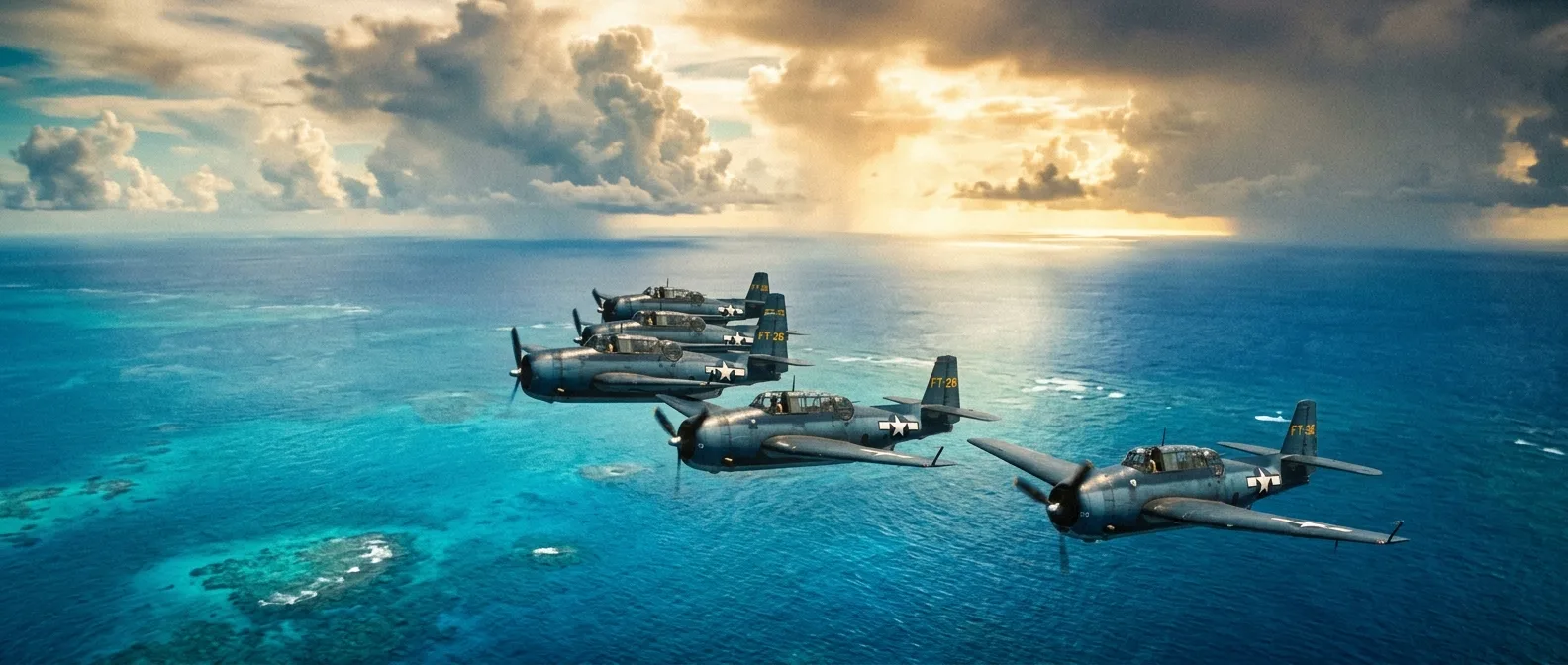
On December 5, 1945, five American TBM Avenger torpedo bombers lifted off from the Naval Air Station at Fort Lauderdale, Florida.
Fourteen men, five planes
Flight 19 consisted of five Grumman TBM Avenger torpedo bombers — each carrying a three-man crew, except for two aircraft where one crew member failed to report that morning. The reason was unclear — illness or simple oversight. This small detail meant that fourteen rather than fifteen men boarded the planes that afternoon.
The flight leader was Lieutenant Charles Carroll Taylor, a pilot with 2,509 hours of flight time. Taylor was experienced — he had flown combat missions in the Pacific during the war. But something was wrong that day. According to reports, he had requested to be relieved as flight leader — without giving a clear explanation. His request was denied. At 2:10 PM local time, the five Avengers taxied onto the runway and lifted into the air over the Atlantic.
The mission was simple: fly east over the Bahama islands, turn north, then turn southwest back to base. A triangular course of 312 nautical miles. Normally they would return before dark. The weather was good — clear skies, moderate winds, temperature around 70°F. Nothing hinted at disaster.
"We don't know where we are"
At 3:45 PM, an hour and a half after takeoff, the Fort Lauderdale control tower received a message no one expected. Instead of a routine position report, Lieutenant Taylor's voice came through agitated: “We cannot see land. It looks like we are lost. The compasses aren't working.”
The base asked for their position. Taylor's answer was alarming: he believed they were over the Florida Keys, south of Florida. If true, they should turn north to reach base. But they were not over the Keys. They were over the Bahamas — hundreds of kilometers to the northeast.
How could a pilot with thousands of flight hours become so disoriented? The most likely explanation: both compasses on Taylor's aircraft — the magnetic and the gyroscopic — had malfunctioned. Without a compass, over open ocean, every island looks like every other island. The seascapes from above are uniform, disorienting, merciless.
The control tower suggested Taylor turn west — if he didn't know where he was, west was always land. But Taylor refused. He believed he was over the Gulf of Mexico — that flying west would send them into open ocean. He was wrong. West was Florida, less than 100 miles away. Instead, he ordered a northeast heading — deeper into the Atlantic.
The compass that lied
The student pilots in the other four planes knew something was wrong. Some inter-plane radio communications were intercepted — not by the base, but by radio stations on unusual frequencies. In one of these, a student pilot was heard telling his companion: “If we just flew west we'd get home.” He was right. But Taylor was the flight leader — and in military protocol, the leader decides.
Time passed. The sun sank low on the horizon. The Avengers carried fuel for approximately five hours of flight — which meant they would run dry by around 8:00 PM. Taylor appeared to change his mind multiple times: east, north, west, east again. Every course change burned precious fuel and carried them farther from any possible coastline.
At 5:00 PM, the base urged Taylor to switch to the emergency frequency — a clear channel that would allow them to triangulate his position. Taylor refused. He feared that changing frequencies would cause him to lose contact with the other planes. It was a fatal decision. If he had switched, the tower could have located them within minutes.
The last words
As darkness fell over the Atlantic, radio communications grew more fragmented, more desperate. Taylor was heard telling the flight: "When the first man gets down to ten gallons of gas, we will all land in the water together." It was an order that meant: prepare yourselves, we are going down.
The last known transmission from Flight 19 was logged at 7:04 PM. It was broken, nearly impossible to decipher. After that — silence. Five planes, fourteen men, dozens of tons of metal and machinery, vanished as though they had never existed. The Atlantic Ocean swallowed everything without leaving so much as an oil slick on its surface.
The rescue that needed rescuing
As soon as contact was lost, two PBM Mariner flying boats launched from Banana River Naval Air Station. The Mariners were enormous aircraft — designed for long-range search missions over the ocean. But they had a well-known problem: imperfect fuel tank seals. Pilots called them “flying gas tanks.”
At 7:50 PM, a ship in the area — the SS Gaines Mills — reported a blinding explosion in the sky. Its crew observed a flame that illuminated the horizon for several seconds before going dark. Then, oil slicks on the sea surface. One of the two Mariners — Bureau Number 59225 — never responded again. Thirteen more men were lost.
The total climbed to twenty-seven: fourteen from Flight 19 and thirteen from the rescue aircraft. Six planes vanished in a matter of hours. It was the worst non-combat aircraft loss in U.S. Navy history up to that point.
Three hundred thousand square miles of nothing
The search that followed was the largest in Navy history. Three hundred thousand square miles of ocean were scoured — an area larger than all of Texas. Ships, aircraft, submarines, even aerial photography were deployed. The result: absolutely nothing. Not a crate, not a life vest, not a single piece of aluminum.
The Naval Board of Inquiry conducted an extensive investigation. The initial verdict attributed the accident to Lieutenant Taylor's error — disorientation caused by compass failure and inability to correctly estimate his position. Taylor's mother was outraged. She filed a formal protest and pressured the authorities. Eventually, the cause was amended to “reasons unknown.” It was the first time in Navy history that an aviation disaster was attributed to “reasons unknown.”
The birth of the Triangle
Flight 19 could have remained a forgotten wartime tragedy. Instead, it became the cornerstone of a myth. In 1964, writer Vincent Gaddis published an article in Argosy magazine titled “The Deadly Bermuda Triangle.” It was the first time the term was used. Flight 19 was the central story.
Ten years later, Charles Berlitz — grandson of the founder of the famous language schools — released the book “The Bermuda Triangle.” It became a worldwide bestseller. The book compiled dozens of alleged disappearances of ships and aircraft in a maritime zone between Miami, Bermuda, and Puerto Rico. Flight 19 was always the first chapter.
Theories multiplied: magnetic anomalies, alien abductions, space-time portals, supernatural phenomena, the lost city of Atlantis. None had any scientific basis. But Flight 19 — five planes, twenty-seven dead, zero wreckage — was dramatic enough to keep the myth alive for decades.
What really happened?
Modern analysis leaves little room for mystery — at least not the supernatural kind. Taylor became disoriented due to compass failure. He believed he was over the Florida Keys when he was actually over the Bahamas. Every corrective action he took was based on a wrong assumption — carrying him farther from land rather than closer to it.
TBM Avengers were not designed for water landings. They weighed over five tons empty. In rough seas — and the waves that evening were about five feet — an Avenger would sink in less than a minute. The pilots would have had mere seconds to escape. In darkness, in cold water, without life rafts, the chances of survival were near zero.
The wreckage was never found — but this is far less mysterious than it sounds. The ocean floor in the area reaches depths of over 15,000 feet. The Gulf Stream, one of the strongest ocean currents on Earth, crosses the region at speeds up to five miles per hour. Anything that falls into the sea there can be carried hundreds of miles in days. The ocean keeps its secrets.
As for the PBM Mariner — the explanation is more prosaic but equally tragic. Mariners had a documented problem with fuel leaks in their interior compartments. A single spark was enough to cause an explosion. The SS Gaines Mills' report of a flash in the sky fits this scenario precisely.
EpilogueFlight 19 did not vanish into some secret triangle. It vanished into a vast, indifferent sea, led by a disoriented pilot who trusted his instinct more than logic. But no one wants to hear that story. We want the mystery. We want the five planes to have disappeared into a rift in space-time, seized by something we cannot explain.
Eighty years later, the wreckage remains on the ocean floor — somewhere in the dark waters of the Atlantic, at depths where no light reaches. Fourteen young American airmen and thirteen rescue crew members are still there, on their final mission. The sea never returned them. It never will.