Dyatlov Pass: 9 Hikers Dead with No Explanation
A True Story
Nine people on the mountain
On January 23, 1959, ten young people — students and recent graduates of the Ural Polytechnic Institute — set out on a hiking expedition toward Otorten, a peak in the northern Ural Mountains of the Soviet Union. They were experienced mountaineers, trained in the extreme conditions of the Russian winter. Their leader, Igor Dyatlov, was 23 years old — calm, methodical, with a reputation as an exceptional expedition organizer. The group included seven men and two women. They had tents, a stove, three weeks' worth of food, and the kind of confidence that only youth can provide.
On January 28, one member — Yuri Yudin — turned back due to knee pain. He was the only one who survived. He would never understand why that decision saved him, while his nine friends died in a manner that no one has ever been able to fully explain.
The march toward Kholat Syakhl
The group of nine continued northwest, following a route along the Auspiya River. Their diaries and photographs — found later — show a normal expedition. They joke, pose for pictures, write about the weather and the snow. There is no sign of panic or worry. On January 31, they stored surplus equipment in a food cache in the valley, preparing for the final ascent.
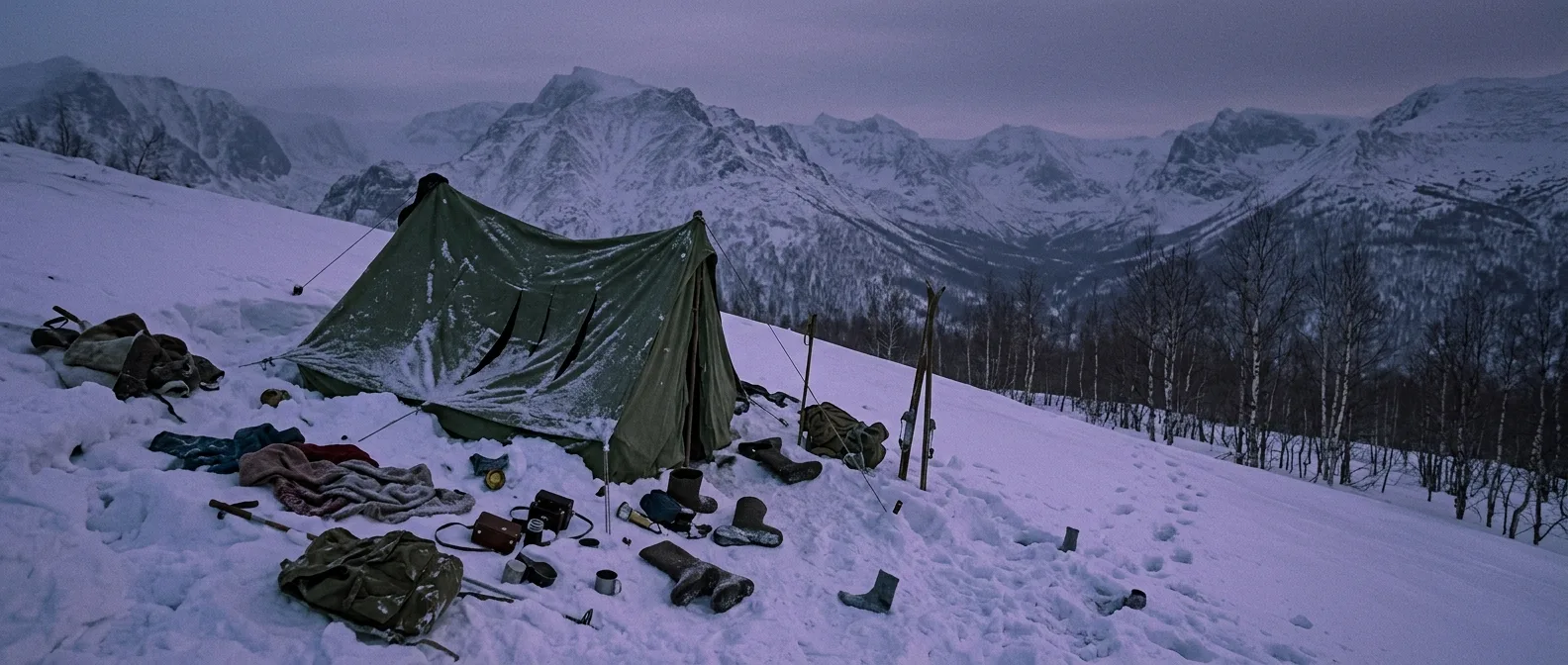
February 1, 1959The group begins the ascent toward the pass between Kholat Syakhl and a neighboring ridge. The weather worsens — strong winds and heavy snowfall. Instead of descending to the forest for shelter, Dyatlov decides to pitch the tent on the slope, at an elevation of approximately 1,079 meters. The location is exposed to the wind, with no cover.
The silence that raised the alarm
The group was expected to reach Vizhay — the nearest settlement — by February 12. They never appeared. At first, no one was particularly worried — delays in winter expeditions were common. By February 20, families were pressing for action. On February 26, a search party reached the slope of Kholat Syakhl.
What they found made no sense.
The tent was half-destroyed, ripped from the inside — with a knife or sharp object. The slashes were in the fabric and directed outward, meaning someone was desperate to get out. Inside the tent, searchers found shoes, clothing, the stove, and food. Most items were untouched, as if the hikers had abandoned everything in an instant.
The first bodies
Rescuers followed barefoot tracks in the snow. The footprints led downhill, away from the tent, toward a cedar forest approximately 1.5 kilometers away. The temperature that night is estimated to have been around -30°C, with winds reaching 60 kilometers per hour.
February 26, 1959The first two bodies are found — Yuri Doroshenko and Yuri Krivonischenko — under a large cedar tree at the edge of the forest. They are wearing only underwear. Beside them are the remains of a small fire. Their hands are torn — it appears they climbed the tree, breaking branches for kindling. Branches are snapped up to five meters high.
The four bodies in the ravine
The remaining four members were not found until months later. On May 4, 1959, they were discovered buried under four meters of snow, in a small ravine seventy-five meters deeper into the forest. They had constructed a makeshift shelter from branches and fabric — clear evidence they did not die immediately, but fought to survive.
The forensic examinations were shocking.
Lyudmila DubininaDeath from cardiac hemorrhage caused by multiple rib fractures. The force required for such fractures was immense — comparable to a car crash. There were no abrasions on the skin. And most disturbingly: her tongue was missing, along with her eyes and part of her lips.
The Soviet investigation
Prosecutor Lev Ivanov took charge of the case in February 1959. Initially, he examined the possibility of an attack by the Mansi tribe — the indigenous people of the region. The theory was quickly dismissed: there were no foreign tracks around the tent, the tribe had no reason for hostility, and the nature of the injuries did not match a human attack.
The possibility of an avalanche was also considered. However, the slope angle was only 15 to 25 degrees — too shallow for a classic avalanche. There were no signs of large snow flow around the tent. And if an avalanche were the cause, why did the group not take their shoes? Why did they not return once the danger had passed?
March 1959The investigation intensifies. Military personnel become involved. Clothing samples are tested for radioactivity — the clothing of three members shows unusually high levels of radioactive contamination. The origin of this finding was never fully explained.
The theories
The Dyatlov Pass case spawned dozens of theories, from the scientifically grounded to the utterly irrational. The fact that Soviet files remained sealed for decades fueled every kind of speculation.
Slab avalanche: The most widely accepted scientific theory today. In 2020, researchers from ETH Zurich — Johan Gaume and Alexander Puzrin — published a study in Communications Earth & Environment demonstrating that a small slab avalanche could have formed with a delay of several hours after the group dug into the snow for the tent. The cut in the snowpack destabilized a layer, and shifting winds deposited additional weight. The avalanche did not need to be massive — a block of snow weighing several tons falling onto the sleeping hikers was sufficient to explain the fractures without external wounds.
Military testing: Many researchers believe the area was used for ballistic missile tests or nuclear exercises. The elevated radiation levels on the clothing could be explained if the group was exposed to radioactive fallout. The rapid sealing of the case by Soviet authorities strengthens this theory.
Infrasound: Wind passing through specific rock formations can create low-frequency sound waves — inaudible, but capable of inducing panic, nausea, and feelings of dread. The topography of Kholat Syakhl could theoretically produce such conditions — explaining why the group abandoned the tent in a panic.
Paradoxical undressing: A well-documented medical phenomenon in hypothermia victims. As the body loses its battle against the cold, blood vessels near the skin dilate — the victim suddenly feels warm and begins removing clothing. This explains why many members were found half-naked.
Katabatic winds: Powerful downslope flows of cold air can reach hurricane speeds without warning. Such a wind could have flattened the tent and forced the group to flee.
The missing tongue
Of all the macabre findings, one detail dominated the public imagination above all else: Lyudmila Dubinina was found without her tongue, without her eyes, and without part of her lips. The image fed decades of conspiracy theories — from satanic rituals to extraterrestrial intervention.
The forensic reality is less dramatic. Dubinina was found in a stream with running water, three months after her death. Soft tissues — the tongue, eyes, lips — are the first to decompose in water or be consumed by small predatory animals and scavenging insects. It is a normal decomposition process, not a sign of torture.
But the rational explanation never stopped the myths. The image of a young woman without a tongue, buried under four meters of snow on a desolate mountain, was too powerful to be replaced by forensic explanations.
The science of 2020
In January 2021, the Gaume and Puzrin study was published and became the first rigorously mathematical approach to the case. Using data from cadavers employed in automobile crash experiments — along with finite element models — they demonstrated that a snow slab five meters in length could fatally injure sleeping mountaineers without leaving external marks. The hard snow surface beneath them acted as an “anvil” — the impact was absorbed internally.
The hours-long delay between setting up camp and the avalanche explained why the hikers were caught while sleeping. The panic from sudden burial explained why they slashed the tent instead of using the entrance. The pain and confusion of the injured explained why they did not return. And hypothermia explained the rest — the paradoxical undressing, the deaths between the tent and the cedar, the desperate attempts to light a fire.
The mountain that does not forget
The name “Kholat Syakhl” in the Mansi language means “Dead Mountain.” The pass was renamed “Dyatlov Pass” after the tragedy. Today it is one of the most famous dark tourism destinations in the world. Every year, dozens of hiking groups follow the same route. At the site of the tent stands a small memorial — a metal plaque with nine names.
The nine victimsIgor Dyatlov (23), Zinaida Kolmogorova (22), Lyudmila Dubinina (20), Alexander Kolevatov (24), Rustem Slobodin (23), Yuri Krivonischenko (23), Yuri Doroshenko (21), Nikolai Thibeaux-Brignolle (23), Semyon Zolotaryov (38). They were students, engineers, athletes. They loved the mountains. Their photographs show laughter, snowball fights, carefree faces. They were not reckless adventurers — they were nine young people who went on a hike.