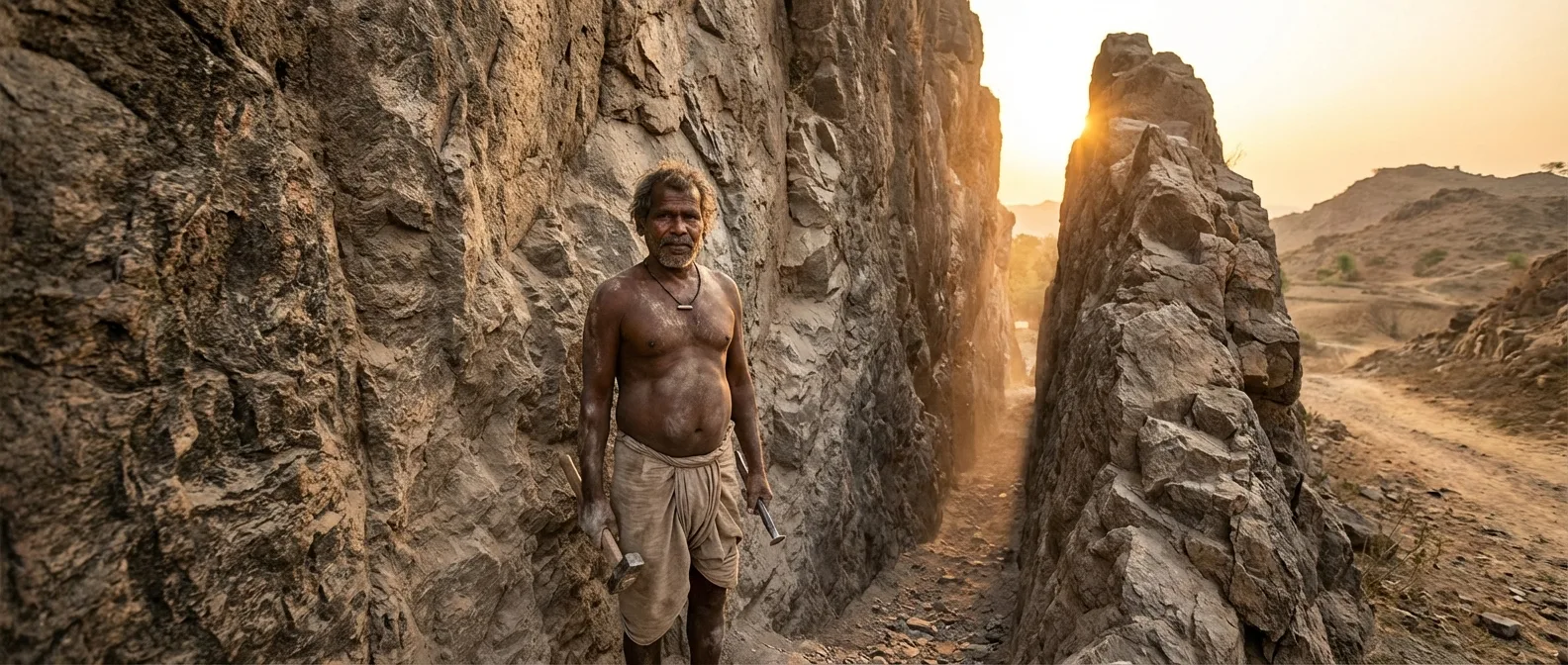
Dashrath Manjhi: Carved a Mountain Alone for 22 Years
A True Story
📖 Read more: 6 Months in a Cave with No Clock: The Siffre Experiment
A child of poverty
Dashrath Manjhi was born in 1934 in the village of Gehlour Ghati, in the Gaya district of Bihar — one of the poorest states in India. His family belonged to the Musahar caste, literally meaning “rat eaters” — the lowest rung in India's social hierarchy. Poverty was so extreme that many residents survived on roots and wild grasses gathered from the fields.
As a child, Dashrath left the village seeking work in the coal mines of Dhanbad. There he labored under grueling conditions for several years. Life in the mines was harsh, but it gave him something invaluable: experience in breaking rock. He learned how to use a hammer and chisel, how to find the weak points in stone, how to endure physically extreme conditions.
The Musahar caste was considered so low they were denied access to public wells or entry into Hindu temples. Social isolation was as brutal as the geographic kind.
Falguni Devi
In 1959, Dashrath returned to Gehlour Ghati and married Falguni Devi. For the first time in his life, he found a reason to stay in the village. Falguni was the most important thing in Dashrath's world — their love was genuine and deep, in an era when marriages in rural India were typically arranged and transactional.
The couple lived a simple life but they were happy. Dashrath worked the fields around the village while Falguni carried water and food every day across treacherous paths that climbed over Gehlour mountain. The mountain was a massive rocky barrier between their village and the nearest road, hospital, school, and market. The nearest town was just a few kilometers in a straight line — but 70 kilometers if one had to go around the mountain.
Every day my wife climbed the rocks to bring me food. Every day I looked at the mountain and knew how dangerous it was.
A fall that changed everything
One day in 1959 — just months after their wedding — Falguni slipped while climbing the rocky path of Gehlour mountain, carrying food for Dashrath. The fall was serious. She was badly injured and needed emergency medical care. But the nearest hospital was in the town of Wazirganj — 70 kilometers away by the route that went around the mountain.
Dashrath desperately tried to transport his wife. But the distance was impossible to cover in time. Falguni died before they reached the hospital. Her death wasn't caused by the severity of the injury — it was caused by the distance. The mountain killed her, not the fall.
📖 Read more: Antikythera Mechanism: A 2,000-Year-Old Computer
Dashrath was devastated. The pain was incomprehensible. But at some point, within the grief, something transformed inside him. Despair didn't lead him to resignation — it led him to a decision that would seem insane to anyone else. He decided to cut the mountain in half.
Falguni Devi was neither the first nor the last to die because of geographic isolation. Dozens of villagers had lost their lives on those same rocks, but no one had ever dared to challenge the obstacle's very existence.
Hammer versus mountain
In 1960, Dashrath Manjhi bought a hammer, a chisel, and a rope. He walked to the base of Gehlour mountain and started striking. The sound of metal on stone echoed through the valley — a rhythmic, solitary clang that would continue for two decades.
At first, nobody took him seriously. The villagers considered him mad. Some mocked him openly. Others pitied him. The idea that a single man could cut through a mountain sounded like a joke. Even his own family had doubts. But Dashrath never responded to the ridicule. He simply kept striking.
His routine was unshakable: he woke before dawn, walked to his work site, and broke rock until dusk. Every day, without exception. No days off, no holidays, no rest. His labor was a battle against time, but above all a battle against the indifference of a world that considered the poor expendable.
When I started cutting the mountain, people called me crazy. But what really mattered to me was the work.
Alone against rock
The first fifteen years were the loneliest and hardest. Dashrath worked entirely alone. He sold firewood to buy hammers — since the iron tools wore out quickly against the hard granite. It's estimated he consumed dozens of hammers and chisels over the course of the project. Each tool lasted only a few months before becoming useless.
Some days progress was impressive — when the rock was softer or had cracks. Other days, hours of work produced barely a few centimeters of dust. Dashrath endured extreme temperatures — in summer Bihar exceeds 45 degrees Celsius, while in winter the humidity and cold numbed his fingers to the point of uselessness.
His hands were covered in calluses so thick he could no longer feel anything with his palms. His back was permanently hunched. His knees creaked. But every morning he rose and went to the mountain. Time passed, years became decades, and Dashrath did not stop for a single day.
📖 Read more: Asch Experiment: Do You Lie Just to Fit In?
Local authorities ignored his pleas for help. He petitioned the government for funding to build a proper road, but was rejected. Nobody cared about the fate of a village of illiterate Dalits. Dashrath understood that if he wanted a road, he would have to build it himself.
Some villagers helped sporadically, bringing him water or food. But no one ever picked up a hammer to work beside him. The project remained essentially a one-man operation.
The world begins to notice
After about fifteen years of uninterrupted work, Dashrath's project became visible. A crack in the mountain that initially fit only a single body had widened into a small passage. The villagers who once laughed now stood beside him in silence. Some began bringing tools.
Local journalists visited Dashrath and wrote brief reports. The story of a poor Dalit who climbed into a mountain every day for decades was too remarkable to ignore. But the publicity didn't lead to government assistance. Politicians made promises but never delivered. Dashrath continued alone.
By this phase, his technique had been perfected. He had learned to read the rock — to find natural fracture lines, exploit cracks, use gravity in his favor. He knew that striking at a specific angle could detach entire sections of stone in one piece. It was a lesson in patience that no university could teach.
The mountain surrendered
In 1982, after 22 years of uninterrupted labor, Dashrath Manjhi completed his work. He had carved a passage 110 meters long, 9.1 meters wide, and 7.7 meters deep through the rocky hill. The distance from Gehlour Ghati to Wazirganj was reduced from 70 kilometers to just 1 kilometer.
This meant villagers could now reach the hospital, school, and shops in minutes instead of an entire day. Children could attend school without risking their lives on the cliffs. Patients could be transported in time. The life of an entire village changed fundamentally.
When I finished, my first thought wasn't triumph. It was sorrow. Because Falguni wasn't here to walk with me on the road I owed her.
The Bihar government, having ignored Dashrath for 22 years, finally acknowledged his achievement. However, the promise to pave the road remained unfulfilled for many more years. Dashrath continued to pressure authorities, traveling even to New Delhi to demand justice.
📖 Read more: Bermuda Triangle: What Really Happens There
The Mountain Man
After completing the passage, Dashrath didn't stop. He continued fighting for a proper paved road, for schools, for a hospital near the village. He traveled to New Delhi three times — alone, without money, walking much of the journey — to ask politicians to pay attention to his region.
Former Prime Minister Atal Bihari Vajpayee received him but made no concrete commitments. Bihar Chief Minister Nitish Kumar met him later and promised to pave the road. But Dashrath didn't live to see that promise fulfilled.
His story became nationally known through articles, documentaries, and eventually a Bollywood film. Director Ketan Mehta released “Manjhi: The Mountain Man” in 2015 starring Nawazuddin Siddiqui, introducing the story to millions of viewers worldwide. Dashrath Manjhi had become a symbol — a modern myth about the power of human will.
The Indian government named the road “Dashrath Manjhi Path” and installed a memorial at the site. The Anugrah Narayan Magadh Medical College hospital in Gaya was named partly in honor of his lifelong struggle.
Death of a hero
Dashrath Manjhi died on August 17, 2007, from gallbladder cancer at the age of 73. The Bihar state government gave him a funeral with state honors — an extremely rare distinction for a landless, lower-caste villager. Thousands of people attended the ceremony.
His death triggered a wave of recognition. Then-Prime Minister Manmohan Singh publicly expressed grief. India Post issued a stamp bearing his face. Schools across Bihar were named in his honor. Most importantly, the road he had demanded for decades was finally paved — after his death.
The power of one man
Dashrath Manjhi's story is not simply a tale of persistence or willpower. It is a story about the power of love, the cruelty of poverty, and the indifference of authority. An illiterate villager, belonging to the lowest social class, accomplished what an entire state apparatus refused to do.
Twenty-two years. Over eight thousand days of hammering. A mountain that surrendered to a pair of wounded hands. Falguni never got to walk that road. But thousands of others have passed through it — and still pass through it every day — thanks to a man who refused to accept the impossible.