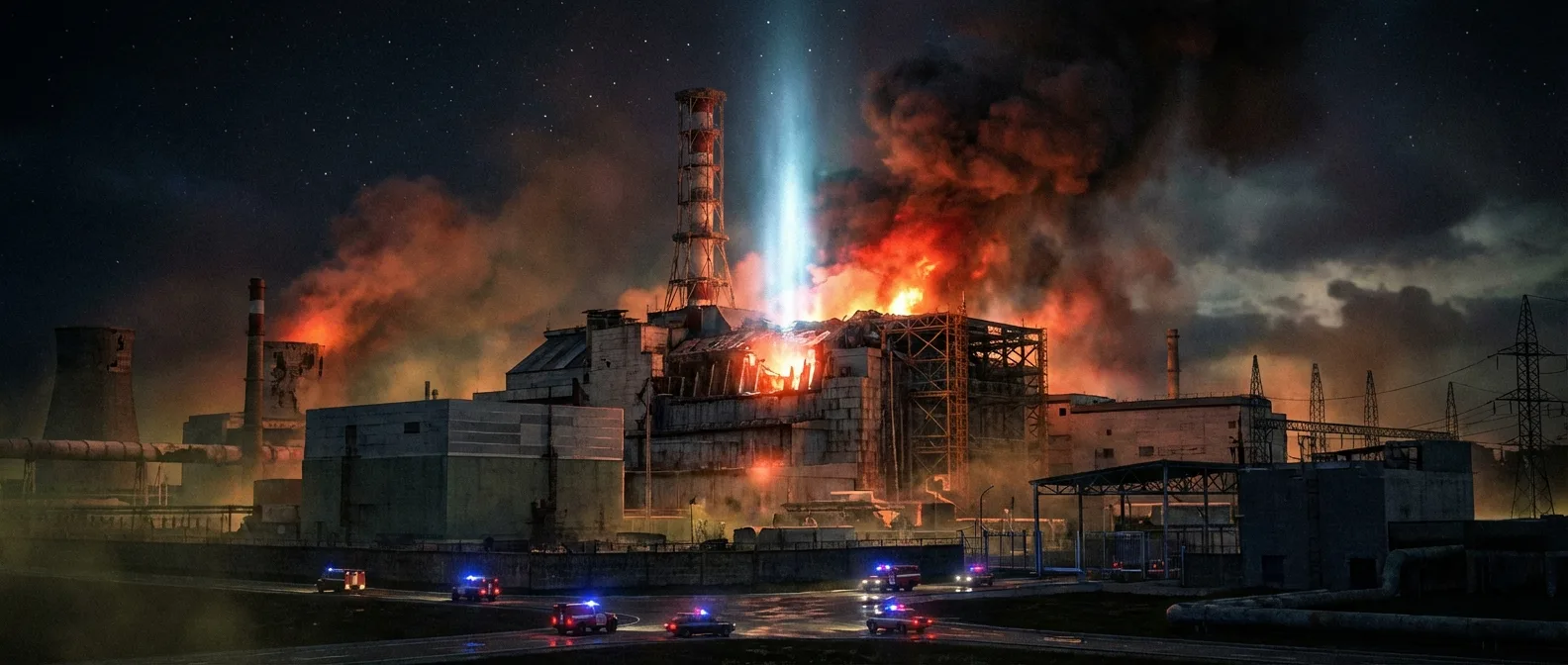
Chernobyl: The Night of the Worst Nuclear Disaster
A True Story
📖 Read more: Dyatlov Pass: 9 Hikers Dead with No Explanation
A fatally flawed design
The Chernobyl Nuclear Power Plant was located near the city of Pripyat, just 104 kilometers north of Kyiv. It operated RBMK-1000 reactors — a Soviet design that used graphite as a neutron moderator and water as a coolant. This design had a fatal flaw: at low power, the reactor became dangerously unstable.
Unlike Western pressurized water reactors, the RBMK exhibited a “positive void coefficient” — meaning that if the cooling water boiled and formed steam bubbles, the nuclear reaction didn't slow down but actually accelerated. During normal operation this was manageable. At low power, it was lethal.
Soviet engineers knew about the problem, but the information was classified. The plant operators were never fully briefed on the dangers inherent in the RBMK design.
An experiment that should never have happened
On April 25, 1986, the day shift crew began a scheduled safety test on Reactor 4. The goal was to determine whether the plant's turbines could generate enough electricity during shutdown to power the emergency cooling pumps until the diesel generators kicked in.
The test required reducing reactor power to low levels — precisely the condition in which the RBMK became most unstable. The test had been delayed for hours due to grid demand, and was ultimately carried out by the night shift — less experienced operators who had not been properly briefed.
"They told us to reduce power. Nobody explained what could go wrong. We were just following orders."
The night that changed the world
During the power reduction, the reactor plunged uncontrollably to 30 MW — far below the 700 MW required for the test. The operators withdrew control rods in a desperate attempt to raise power again, ignoring safety indicators. A condition called “xenon poisoning” had set in — a phenomenon that made the reactor extremely unstable.
At 1:23:04 AM, the shutdown command was given. The operator pressed the AZ-5 button — the emergency shutdown signal. The graphite-tipped control rods began entering the core. But due to a design flaw, the graphite tips initially increased reactivity rather than reducing it.
Power surged to 30,000 MW — one hundred times above normal operating capacity — in a fraction of a second. Steam ruptured the fuel channels. Two successive explosions blew the 1,000-ton reactor lid into the air. A pillar of radioactive fire rose kilometers into the sky.
The second explosion is believed to have been nuclear in nature — a small steam explosion that tore the core apart. Chunks of nuclear fuel, graphite, and radioactive material were scattered across the roof and the ground surrounding the plant.
Firefighters without protection
Within minutes of the explosion, the plant's fire brigade arrived on scene under the command of Lieutenant Vasily Ignatenko and Major Vladimir Pravik. The firefighters climbed onto the roof of the destroyed reactor to extinguish fires, unaware they were stepping on fragments of nuclear fuel.
Nobody had told them anything about radiation. They had no masks, no protective suits, no dosimeters. Within minutes, these men received lethal doses of radiation — many times above the fatal threshold. Their skin began deteriorating within hours.
Of the 134 workers and firefighters hospitalized with acute radiation syndrome, 28 died within the first weeks. Pravik died on May 11. Ignatenko died on May 13. His wife Lyudmila later described how his body was literally disintegrating as she sat beside him.
"They didn't know they were dying. They thought they were just putting out an ordinary fire. I watched them fighting the flames on the roof with their bare hands."
The first dosimeters found at the plant had a maximum scale of 3.6 roentgen per hour. Deputy chief engineer Anatoly Dyatlov declared that radiation levels were “normal” — based on this reading. In reality, the actual radiation at the blast site exceeded 15,000 roentgen — enough to kill a person in minutes.
The Soviet government immediately activated cover-up mechanisms. The first official statement referred to a “minor accident” with no danger. Phone lines were cut. The residents of Pripyat were not informed. Children played in the streets while radioactive ash drifted down on them like snow.
In the city of Pripyat, all 49,000 residents spent the entire first day after the explosion without any warning. Parents sent their children to school. Weddings were held as planned. The radio mentioned nothing.
The secret is exposed
Two days after the explosion, workers at the Forsmark Nuclear Power Plant in Sweden — 1,100 kilometers away — detected unusually high radiation levels on their clothing. They initially suspected a leak in their own facility. After thorough scans, they realized the radioactivity was coming from elsewhere.
The Swedish government demanded an explanation from Moscow. The Soviet Union initially denied everything. Only after meteorological data proved the radioactive cloud originated from the Chernobyl area did the USSR reluctantly admit that an “accident” had occurred. The TASS announcement on April 28 was brief, terse, and filled with understatements.
"We detected cesium and iodine isotopes on our shoes. The scale was unreal. Something massive had happened somewhere in Eastern Europe."
350,000 people uprooted
The evacuation of Pripyat began on April 27 — 36 hours after the explosion. More than 1,200 buses arrived to transport the 49,000 residents. They were told to pack belongings for only three days. Nobody ever returned.
In the weeks that followed, the exclusion zone expanded to a 30-kilometer radius. In total, over 350,000 people were displaced from villages and cities across Ukraine, Belarus, and Russia. Entire communities vanished overnight. Homes, schools, kindergartens, hospitals — everything was abandoned.
Residents' pets were not allowed on the buses. Special teams were later sent to put down the abandoned animals — dogs and cats that waited for their owners on doorsteps of houses that would never open again.
Many elderly residents refused to leave their homes. Dozens of aged villagers secretly returned to the exclusion zone in the following months, defying the ban. Some of these “self-settlers” lived there well into old age.
600,000 workers in the line of fire
To contain the radioactivity, the Soviet government mobilized an enormous force of cleanup workers — the “liquidators.” Approximately 600,000 soldiers, laborers, engineers, and volunteers were sent to Chernobyl during 1986 and 1987.
The liquidators performed the most dangerous tasks imaginable. Some climbed onto the roof of Reactor 3 — directly adjacent to the destroyed Reactor 4 — to shovel fragments of radioactive graphite. Each worker, nicknamed “bio-robots,” could work only 90 seconds before reaching their lifetime radiation dose.
Thousands of liquidators developed serious health problems in the following years — cancers, cardiovascular disease, psychological trauma. Many died young. The governments that succeeded the Soviet Union only fully acknowledged their sacrifice decades later.
"They gave us 90 seconds on the roof. We'd run, toss two shovelfuls of graphite, and climb back down. That was our job. Our lives were measured in seconds."
Burying the reactor
In record time — just 206 days — the Soviets constructed a massive structure of steel and concrete over the ruins of Reactor 4. They called it the “sarcophagus.” It was designed to entomb the 200 tons of radioactive material that remained inside the destroyed core.
📖 Read more: The Wrong Button That Nearly Started a Nuclear War
The sarcophagus was built under unbearable conditions. Workers labored in shifts counted in minutes, continuously replaced due to radiation exposure. The structure contained 400,000 cubic meters of concrete and 7,300 tons of metal. However, because of the construction conditions, the sarcophagus was not airtight — cracks and gaps allowed rainwater to seep in and radioactive dust to escape.
Beneath the destroyed reactor, a mixture of molten nuclear fuel, concrete, and sand formed what became known as the “Elephant's Foot.” It remains one of the most radioactive objects on the planet — a few minutes of exposure delivers a lethal dose.
The thyroid cancer spike
The most well-documented long-term consequence of Chernobyl was the dramatic increase in thyroid cancer, particularly among children. Radioactive iodine-131 released in the explosion accumulated in milk — and children who drank contaminated milk developed cancer at disproportionate rates.
In Belarus, which received 70% of the radioactive fallout, thousands of cases of thyroid cancer were recorded among children and adolescents throughout the 1990s. Before the accident, the disease was extremely rare in this age group. Major epidemiological studies estimate the total number of deaths attributable to the disaster in the long term ranges from 4,000 to tens of thousands — depending on the methodology.
Beyond cancer, the psychological toll was devastating. Hundreds of thousands of people were displaced, lost their homes, and lived with a permanent fear of illness. Rates of suicide, depression, and alcoholism skyrocketed in affected regions.
The largest movable structure on Earth
In November 2016, the installation of the New Safe Confinement was completed — a massive arched steel structure that was slid on rails to cover the aging sarcophagus. Measuring 162 meters long, 257 meters wide, and 108 meters tall, it is the largest movable structure ever built.
The structure cost over 1.5 billion euros, funded by the international community through the Chernobyl Shelter Fund. It was designed to last at least 100 years, providing time for the eventual dismantling of the reactor and management of the radioactive waste.
The New Safe Confinement was assembled at a safe distance from the destroyed reactor and then slid into position — an unprecedented engineering achievement. It was equipped with cranes and robotic systems for future dismantling operations.
Nature reclaims what was lost
Nearly four decades after the disaster, the 2,600-square-kilometer exclusion zone around Chernobyl has transformed into an unexpected wildlife sanctuary. Wolves, wildcats, bison, deer, foxes, and over 200 bird species now roam what were once cities and farmland.
Pripyat remains a ghost city — a haunting monument frozen in time. The Ferris wheel that never operated, schoolbooks rotting on desks, dolls in kindergartens — everything remains exactly where it was abandoned on that day in 1986.
The exclusion zone has become one of the world's most visited “dark tourism” destinations. Tens of thousands of tourists annually tour the ghost city, haunted by the silence of a place that died in a single night yet refuses to disappear.
"Nature doesn't understand radiation. It simply returns. And when humans leave, nature reclaims what always belonged to it."
The shadow that never fades
Chernobyl was not simply an industrial accident. It was the perfect convergence of flawed technology, human arrogance, and authoritarian secrecy. A system that refused to acknowledge its own defects — even when those defects destroyed the lives of hundreds of thousands of people.
Forty years later, the destroyed reactor remains entombed beneath thousands of tons of steel. Pripyat stands silent. Wolves run where children once played. And the radiation — invisible, soundless, relentless — will remain there for thousands of years to come.