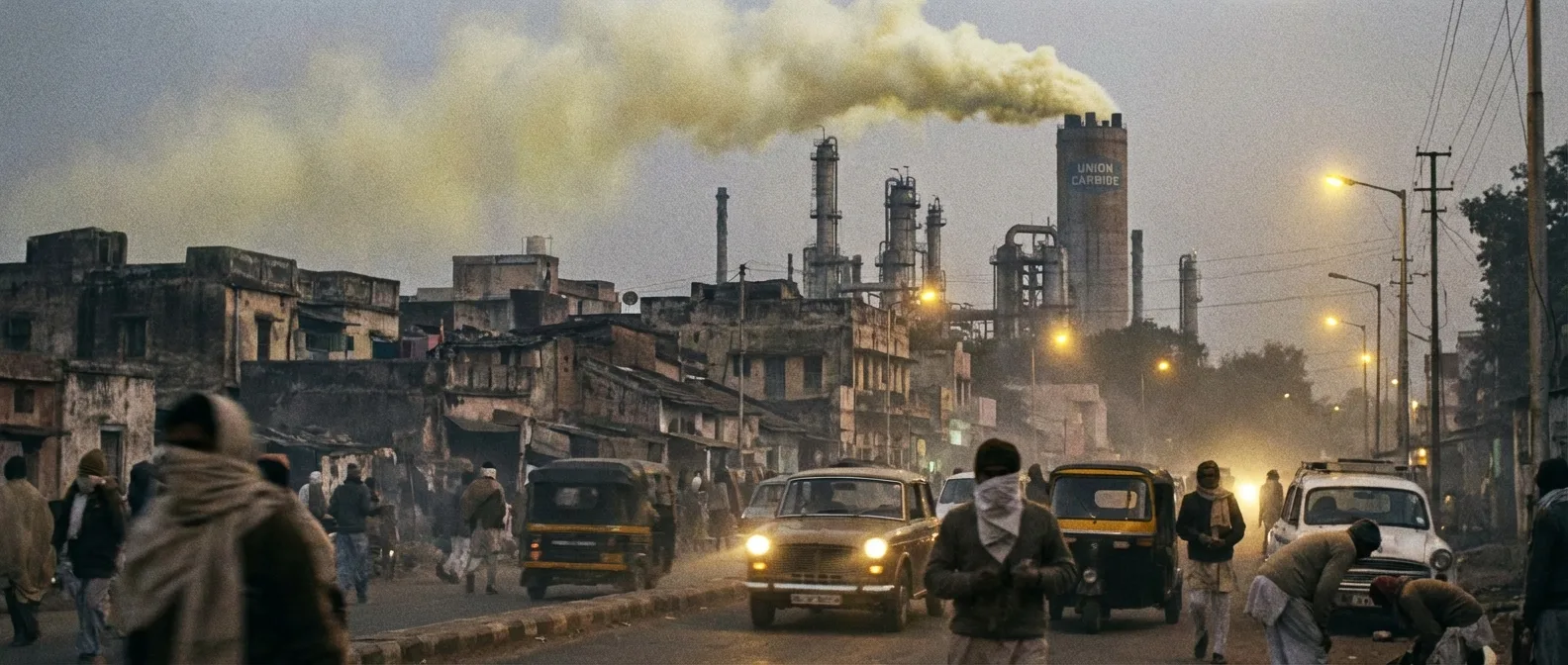
Bhopal Tragedy: The Worst Industrial Disaster
A True Story
📖 Read more: The Boston Molasses Flood: Sweet Death
The city that slept
Bhopal was a city of lakes. A city of mosques and Hindu temples, narrow alleyways and markets that smelled of spices. It sat in the heart of India — capital of Madhya Pradesh, home to more than 800,000 people in the mid-1980s. It was neither rich nor poor — just a city trying to grow. And part of that growth was a factory.
The Union Carbide India Limited plant stood on the northern edge of the city, next to densely populated neighborhoods. It produced Sevin — a pesticide widely used in agriculture. To make Sevin, you needed methyl isocyanate (MIC) — an extremely toxic and volatile chemical. In small quantities, strictly controlled, it was manageable. But inside that factory, nothing was strictly controlled anymore.
A factory dying slowly
Union Carbide — an American industrial giant headquartered in Connecticut — established the Bhopal plant. India needed pesticides for its agriculture and Union Carbide needed cheap production. Initially, the plant imported chemicals and mixed them locally. Later, on-site production of methyl isocyanate began.
The night of December 2, 1984
A worker in the MIC unit noticed pressure rising in tank E-610. The tank held approximately 42 tons of methyl isocyanate — far more than the permitted limit. Water had entered the tank — likely from poor pipe maintenance or an accident during cleaning. The chemical reaction between water and MIC began immediately: an explosive exothermic reaction, temperature spiking rapidly.
The city wakes to a nightmare
What followed were scenes from an apocalyptic film — except they were real. Thousands of people poured into the streets in panic, running barefoot through the darkness. Many did not even know what was happening — they thought a fire had broken out, or a war. The gas caused immediate pulmonary edema, blindness, vomiting, convulsions. Animals lay dead in the streets — dogs, cattle, birds. Trees turned yellow within hours.
Hospitals were overwhelmed. Doctors had not been informed about the nature of the gas — Union Carbide refused to reveal the chemical composition, citing “trade secrets.” Doctors treated thousands of patients without knowing what exactly had poisoned them. Some administered oxygen, some washed eyes with water, some simply watched people die without being able to do anything.
Morning of December 3, 1984When dawn broke, Bhopal was a city of the dead. Bodies everywhere — in the streets, inside homes, beside water taps where people had run seeking water. Estimates of the first night's death toll vary dramatically: the Indian government initially cited 3,800 dead. Independent investigations and organizations estimate that between 8,000 and 16,000 people died within the first 72 hours. Over 500,000 were exposed to the toxic cloud.
📖 Read more: The Triangle Fire: The Tragedy That Changed Labor Rights
The CEO who escaped
Warren Anderson — American, CEO of Union Carbide, one of the most powerful industrialists in the world — flew to India three days after the disaster. He was arrested at Bhopal airport on December 7, 1984. The charge: culpable homicide. His arrest was historic — never before had the CEO of a multinational been arrested for an industrial disaster.
But what followed was scandalous. Anderson was released on bail within hours. He boarded a government aircraft and was flown out of the state. Days later, he flew back to the United States. He never returned to India. He was never tried. The Indian government repeatedly requested his extradition — the United States refused. Anderson died in 2014, at his home in Florida, at the age of 92. A free man.
The mockery of compensation
The Indian government — without consulting the victims — reached an out-of-court settlement with Union Carbide. The compensation: $470 million. Sounds like a lot? Do the math: with over 500,000 victims, that worked out to roughly $500 per person. Five hundred dollars for destroyed lungs, for lost vision, for dead children, for a lifetime of illness. The settlement included full immunity for Union Carbide from criminal charges.
A disaster that never ended
What makes Bhopal uniquely tragic is not just the dead of that night. It is that the disaster continues. Forty years later, the generation born after 1984 is still paying the price. Children born to mothers exposed to the toxic cloud showed dramatically elevated rates of genetic abnormalities — cerebral palsy, Down syndrome, muscular dystrophy, severe cardiac defects.
Cancer rates in the neighborhoods around the factory are many times the national average. Chronic respiratory diseases — asthma, chronic obstructive pulmonary disease, pulmonary fibrosis — afflict tens of thousands. Blindness remains exceptionally high. Women report irregular periods, miscarriages, and infertility at rates that no medical study can explain otherwise.
And it is not just the air. The factory was abandoned but never cleaned up. Tons of toxic chemical waste remain on the site — heavy metals, chloroform, arsenic, mercury. Rain washes them into the ground. The water that surrounding neighborhoods drink has been found contaminated with toxic substances at levels dozens of times above safe limits. A second disaster — slow, silent, invisible — is happening every single day.
The fight for justice
Bhopal's activists — many of them victims themselves — fought for decades. They demanded three things: fair compensation, cleanup of the contaminated site, and criminal prosecution of those responsible. They received none of the three in full. Marches to New Delhi, hunger strikes, international campaigns — nothing shook Dow Chemical or the inertia of the Indian government.
📖 Read more: 33 Miners Trapped 69 Days Deep Underground
Dow Chemical: the company that refuses
Dow Chemical — today one of the largest chemical conglomerates in the world — bought Union Carbide knowing full well what it was inheriting. And it denied everything. It denied responsibility for the leak. It denied responsibility for the toxic waste. It refused to pay for the cleanup. It refused to appear before an Indian court when summoned.
Dow's argument was legally impeccable and morally outrageous: Union Carbide, as a separate legal entity, had already paid in 1989. Dow bought a company, not its sins. That argument ignored the fact that thousands of people were still dying. It ignored the fact that toxic waste remains in Bhopal. It ignored the fact that the compensation covered no one adequately.
In 2012, Dow Chemical was a sponsor of the London Olympic Games. Activists protested outside the Olympic Stadium holding photographs of children from Bhopal. The International Olympic Committee declined to comment. Money, in the end, always speaks louder than the dead.
Why Bhopal matters today
Bhopal is not a story that ended. It is a warning that keeps repeating. Forty years later, the same patterns appear in factories around the world: safety cuts to save costs, weak government regulation, corporate impunity. Union Carbide was not the exception — it was the norm, magnified to the point of horror.
At Rana Plaza in Bangladesh (2013), 1,134 garment workers died in a building collapse — the owners knew the building was dangerous. In Beirut (2020), 218 died from an ammonium nitrate explosion — authorities had known about the risk for years. The pattern is always the same: someone knows the danger, someone decides it costs too much to prevent it, and someone — always the most vulnerable — pays with their life.
Epilogue
In the neighborhoods around the abandoned Bhopal factory, children continue to be born with disabilities. Women continue to lose their pregnancies. The water continues to be contaminated. No one has come to clean up. No one was truly punished. Union Carbide no longer exists — absorbed into the records of Dow Chemical. Warren Anderson died in his bed. The $470 million — less than what a company spends on a single advertising campaign — was divided, if it was divided at all, into pieces that cannot buy even dignity.
But in Bhopal, every December 2, thousands of people take to the streets. They hold photographs of their dead. They chant two words: “Remember” and “Still.” We remember what happened. We are still waiting for justice. The night of December 2, 1984 never ended in Bhopal. Perhaps it never ended anywhere.