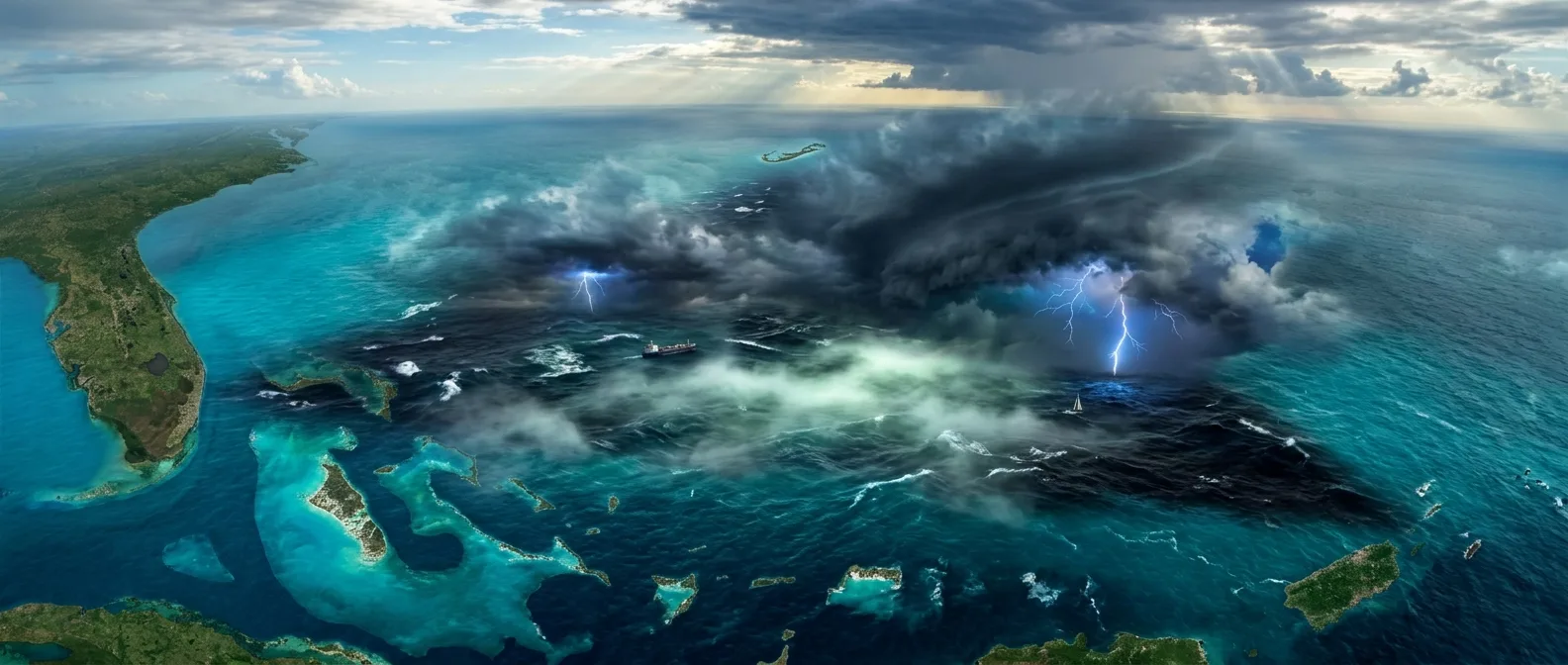
Bermuda Triangle: What Really Happens There
Between Miami, Bermuda, and Puerto Rico, an imaginary line traces a triangle of roughly 500,000 square miles across the Atlantic Ocean.
The birth of a myth
Before 1964, nobody had ever heard of the “Bermuda Triangle.” The area was one of the busiest maritime corridors in the world — cargo ships, cruise liners, airlines, military exercises. Yes, accidents happened. But that was expected in such a heavily trafficked zone.
American journalist Vincent Gaddis was the first to coin the term “Bermuda Triangle” in a 1964 article for Argosy magazine. Gaddis collected a series of maritime and aviation incidents, presented them together, and by leaving gaps in the narrative, manufactured a sense of unexplained mystery.
But the true architect of the myth was Charles Berlitz. In 1974, his book The Bermuda Triangle became a worldwide bestseller — selling over 20 million copies. Berlitz was neither a scientist nor a researcher. He was a linguist and the grandson of the founder of the Berlitz language schools. In his book, he mixed real incidents with exaggerations, omitted critical details, and added hints of extraterrestrial forces and lost civilizations.
"The power of the Triangle myth lies precisely in the fact that nobody bothered to check the claims. The word 'mystery' was enough to sell millions of copies."
Flight 19 — the story that lit the flame
On December 5, 1945, five TBM Avenger torpedo bombers took off from the Naval Air Station at Fort Lauderdale, Florida, for a routine training mission. Fourteen crew members. The flight leader, Lieutenant Charles Taylor, was experienced but unfamiliar with the area — he had recently transferred from Miami.
During the flight, Taylor's compasses malfunctioned. He believed he was over the Florida Keys when in reality he was over the Bahamas. Instead of turning west toward land, he led the aircraft deeper over the open ocean. Fuel ran out. Radio communications faded. No aircraft was ever found.
A PBM Mariner flying boat was sent to search for them — and it too was lost. But this tragedy had a clear explanation: PBM Mariners were notorious for fuel leaks. The crew of a nearby ship observed an explosion in the sky that evening. Yet in the hands of mystery writers, Flight 19 was transformed into “a mystery without a solution.”
The ships that vanished
The USS Cyclops was a massive naval collier — 542 feet long, 309 crew members, carrying 10,000 tons of manganese ore. In March 1918, it departed Brazil bound for Baltimore and never arrived. No distress signal was sent, no wreckage was found.
Impressive? Perhaps. But several critical details are routinely omitted. The ship was overloaded. Its captain, Lieutenant Commander George Worley, was known for alcoholism and erratic behavior. One engine was already out of service. And the route passed through an active zone of German submarine warfare — it was the middle of World War I.
The case of the Ellen Austin is even more intriguing. The story goes that this American schooner encountered an unmanned derelict ship in the Triangle, placed a prize crew aboard, but the ship vanished again. Compelling — if it were true. Researcher Larry Kusche, in his book The Bermuda Triangle Mystery — Solved (1975), demonstrated that the story is a repeated retelling of an original rumor, with no primary source material to confirm it.
"In every case I examined, I found the myth was constructed the same way: the details that explained the incident were removed, and details that didn't exist were added." — Larry Kusche
The planes that never landed
On January 30, 1948, a British South American Airways Avro Tudor IV aircraft — named Star Tiger — vanished during a flight from the Azores to Bermuda. Thirty-one people on board, no distress signal, no trace.
A year later, on January 17, 1949, the sister flight Star Ariel was lost on the route from Bermuda to Jamaica. Same aircraft type, same result.
Mystery writers presented these incidents as incomprehensible. The reality was less mysterious. The Avro Tudor IV was an aircraft with known design flaws — particularly in its heating and cabin pressurization systems. British South American Airways soon withdrew them from service. Flying over the Atlantic in the 1940s was inherently dangerous — radar was primitive, weather forecasts unreliable, and navigation systems relied on celestial observations.
What the data actually says
If the Bermuda Triangle were truly a zone of heightened danger, one would expect the insurance industry to reflect it. The records of Lloyd's of London — the world's largest maritime insurance market — have shown exactly the opposite for decades.
According to Lloyd's data, the Triangle area does not exhibit a higher rate of ship or aircraft losses compared to any other equivalent stretch of ocean. Insurance premiums for vessels crossing the region are not higher. No insurance company in the world considers the Bermuda Triangle a high-risk zone.
The U.S. Coast Guard has published an official position stating that "the number of incidents in the Triangle does not exceed what would be expected in an area with such heavy maritime and air traffic." NOAA (the National Oceanic and Atmospheric Administration) reached the same conclusion.
"There is no evidence that mysterious disappearances occur with any greater frequency in the Bermuda Triangle than in any other comparable area of ocean." — U.S. Coast Guard
Science explains
If the incidents are not supernatural, then what causes them? The answer lies in a combination of well-known physical phenomena, geographical peculiarities, and human factors.
Heavy traffic zone: The area between Florida, Bermuda, and the Caribbean is one of the busiest maritime and aviation corridors on the planet. The more vessels and aircraft that cross a region, the more accidents will occur — in absolute numbers.
The Gulf Stream: This powerful ocean current moves at speeds of up to 2.5 meters per second. It can sweep wreckage tens of miles away within hours, explaining why in many cases no debris was found.
Sudden storms: This tropical region is known for swift and violent storms that can form in minutes. Waterspouts, hurricanes, and microclimates can strike a small vessel without any warning.
Methane hydrates: One theory proposed that methane gas eruptions from the seabed could reduce water density, sinking ships. Laboratory experiments proved this is theoretically possible, but geologists maintain there is no evidence of such active eruptions in the region for the last 15,000 years. The theory is interesting but does not explain the actual incidents.
Compass variations: The Triangle was one of the rare areas where a magnetic compass points to true north rather than magnetic north. This “agonic line” could confuse inexperienced navigators, though modern GPS has eliminated this issue entirely.
Human error: Many of the “mysterious” incidents involved small private boats or aircraft with inadequate equipment, inexperienced operators, insufficient fuel, or disregard for weather warnings. In many cases, the explanation was so mundane it barely warranted a news report.
How a mystery is manufactured
Larry Kusche, a librarian and pilot, spent years tracking down the primary source documents for every incident cited in Triangle literature. His findings, published in The Bermuda Triangle Mystery — Solved, were revelatory.
In many cases, the “mysterious” incidents had not even occurred within the Triangle at all. Some took place in the Pacific Ocean or the Mediterranean Sea. In others, clear explanations existed in official records — bad weather, mechanical failure, human error — that mystery writers either had not researched or deliberately omitted.
Berlitz, for example, claimed the weather was “fine” on the day Flight 19 disappeared. Meteorological records show conditions deteriorated dramatically that afternoon, with gale-force winds and heavy seas in the search area. In another case, he presented a Japanese freighter as “mysteriously lost” when it had sunk in a typhoon — a fact well documented by Japanese authorities.
The technique was always the same: selective presentation of data. Keep the dramatic elements, strip away the mundane explanations, add an air of mystery — and sell books.
"If you applied the same criteria anywhere else — the North Sea, the Gulf of Mexico, the Sea of Japan — you could construct an equally impressive 'mystery.'"
The Bermuda Triangle is not a zone of supernatural forces, nor a portal to another dimension. It is a busy stretch of ocean in the western Atlantic, with typical hazards: storms, currents, human mistakes. The myth was born from the imagination of commercial writers, fed by the public's appetite for mysteries, and sustained by repetition.
Today, hundreds of ships and aircraft cross the region every day without any particular concern. Nautical charts mark no unusual dangers. GPS, modern radar, and satellites have eliminated most of the hazards that once contributed to accidents.
The truth behind the Triangle is no less interesting than the myth — it is simply different. It shows us how easily the human need for mystery can transform ordinary events into legends. And how difficult it is to uproot a myth, even when the data is crystal clear.