700 Meters Down
33 souls, 69 days, one way out
📖 Read more: The 4 Children Who Survived 40 Days in the Jungle
On August 5, 2010, shortly before two in the afternoon, the sound was like a bomb going off. 700,000 tons of rock collapsed inside the San José mine, near the city of Copiapó, in Chile's Atacama Desert. An access tunnel vanished in seconds. And 33 miners found themselves trapped 700 meters below the surface.
The mine extracted copper and gold. It had a history of accidents. It had been shut down before. But no one expected this: a total collapse that cut off every route to the surface. The 33 ended up in a small emergency refuge, designed for 48 hours. It would have to hold them for 69 days.
The San José mine had accumulated dozens of safety violations in the preceding years. In 2007, a miner was killed in a collapse and the mine was temporarily shut down. It reopened just a year later without meaningful improvements to its safety systems. The owner, San Esteban Mining Company, was already in financial difficulty and had cut maintenance expenditure to the bare minimum.
— 1 —The refuge was a chamber of 50 square meters at a depth of 700 meters. The temperature was 35°C, humidity 90%. The air barely circulated. Water was scarce. And the food? Two cans of tuna, one can of salmon, some crackers, powdered milk. Supplies for 48 hours, designed for 10 people.
Luis Urzúa, the shift supervisor, took control. He divided the food under a regime of iron discipline: two spoonfuls of tuna every 48 hours per miner. One cup of milk. Half a cracker. Nothing more. Nobody knew how long they'd have to last.
They organized the space into zones: sleeping, eating, working, toilet. José Henríquez, an evangelical preacher, took charge of “morale.” Prayers every evening. Mario Sepúlveda, brimming with energy, kept spirits high. Edison Peña decided to run through the tunnels — up to 5 kilometers a day.
The miners had no idea if anyone was looking for them. Above, their families had set up “Campamento Esperanza” — Camp Hope — a makeshift village of tents, flags, and candles.
On the surface, no one knew if they were alive. The rescue drills worked non-stop, but the bore holes kept failing one after another. The rock was too hard. The depth too great. The pressure on the rescue teams unbearable.
Seventeen days. At first, the government didn't want to say there was hope. Statistically, in an accident at that depth, the probability of survival was virtually zero. But the drills didn't stop.
On August 22 — day 17 — a thin drill probe broke through the rock and reached the refuge. When they pulled the drill bit back, they found a note tied to it. Written in red marker, on a scrap of paper:
"Estamos bien en el refugio, los 33″
— “We are fine in the shelter, all 33 of us” — Note by José OjedaIt was the moment all of Chile exhaled.
— 3 —With the bore hole open, communication began. Through narrow tubes — the “palomas” (pigeons) — the miners could now receive food, water, medicine, and letters. Later came a telephone line. A camera. Even a projector so they could watch football.
📖 Read more: Donner Party: The Settlers Who Resorted to Cannibalism
NASA was sent to Chile as a consultant. Specialists in space psychology helped manage the confinement — the constant darkness, high temperatures, no horizon. The miners had created their own small society: rules, roles, routine. Urzúa was the “mayor.” Henríquez the “priest.” Sepúlveda the “entertainer.”
But not everything was rosy. Tensions grew. The youngest miner, 19-year-old Jimmy Sánchez, showed signs of anxiety. Yonni Barrios discovered that both his wife and his mistress had turned up together at Campamento Esperanza — both there to wait for him.
— 4 —Sending food through a tube was one thing. Getting 33 people out from 700 meters underground was something else entirely. The government launched three parallel drilling plans — Plan A, B, and C — using different drills and techniques.
Jeff Hart, an American drilling specialist, was flown in from Afghanistan. His mission: to open a hole wide enough to fit a rescue capsule. The rock was granite. The process would take weeks.
In the end, Plan B's drills — a T-130 machine — succeeded first. On October 9, the drilling was completed. A nearly perfect cylindrical tunnel, 66 centimeters wide, now connected the 33 to the world. Only a few days of testing remained. The entire operation cost more than $20 million. Equipment and specialists arrived from the United States, Canada, Australia, and South Africa — an unprecedented international mobilization for a mining rescue.
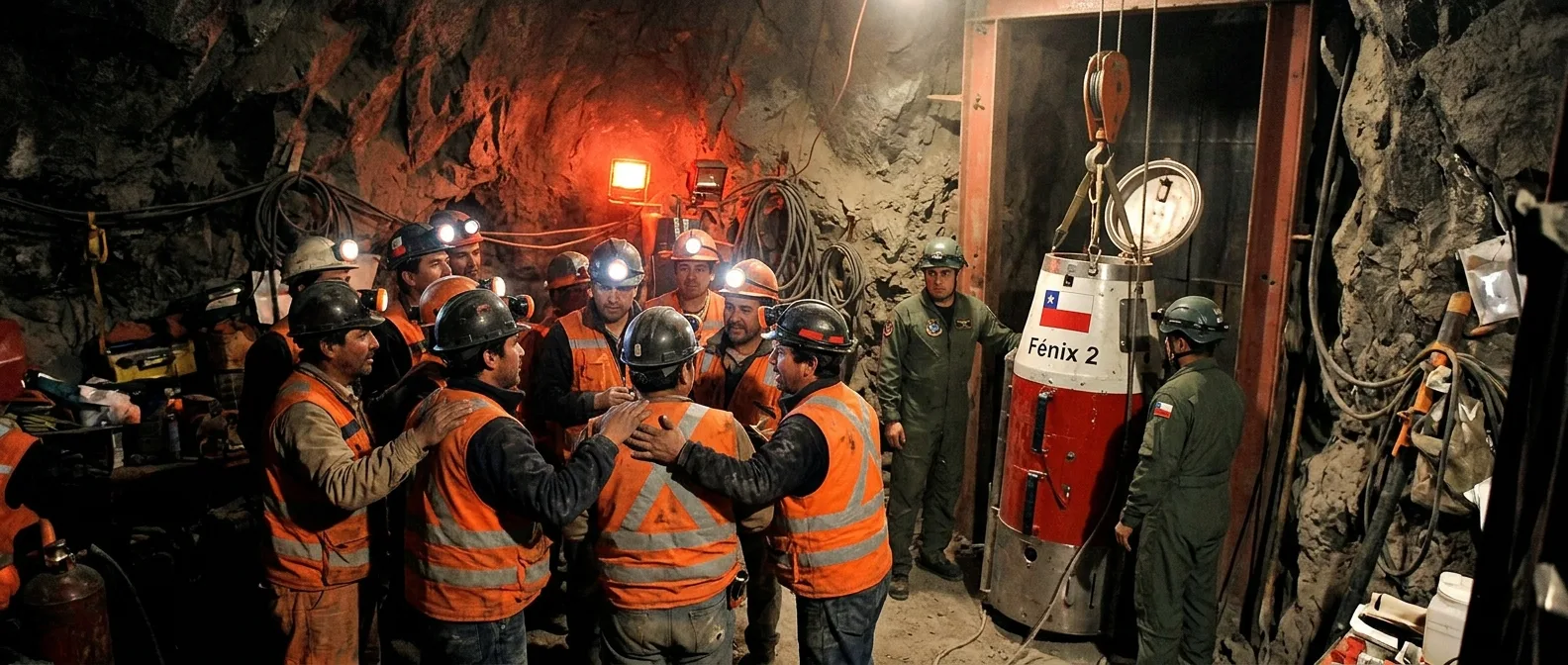
— 5 —The capsule was named “Fénix” — Phoenix. Designed by the Chilean navy in cooperation with NASA engineers. It was painted in the colors of the Chilean flag: red, white, blue. Just 53 centimeters wide — a grown man's shoulders nearly filled it completely.
Each miner would enter wearing a special suit, sunglasses (after 69 days in darkness, natural light could damage their eyes), and a “bio-harness” designed for astronauts that monitored heart rate, breathing, and temperature.
The ascent would take 15 minutes per miner. 700 meters inside a cylindrical tube. Alone. Silence. And the pressure in the ears — like surfacing from the deep ocean floor.
The Fénix capsule weighed 420 kilograms and stood 3.95 meters tall. Inside it were oxygen bottles, a camera, communications equipment, and emergency brakes in case of failure.
On October 12, shortly after 11:15 PM local time, the operation began. First to descend was a technical specialist, Manuel González, to inspect the shaft. Then the ascents began.
The first miner to reach the surface was Florencio Ávalos — chosen because he was the fittest. He arrived at 00:10 on October 13. His family was there. President Sebastián Piñera was there. Thousands of people were there. They embraced. The crowd chanted “Chile! Chile!”
One by one, the miners ascended. Mario Sepúlveda brought a bag of rocks from the depths — souvenirs. Omar Reygadas knelt on the ground clutching a Bible. Esteban Rojas, after 25 years together, proposed to his partner — live, in front of a billion viewers.
📖 Read more: The Challenger Explosion: 73 Seconds of Horror
— 7 —Luis Urzúa was the last. The leader. The one who kept his 32 colleagues alive during those first 17 days of silence. He emerged at 9:55 PM on October 13 — nearly 22 hours after Ávalos. He embraced the President. And said:
"The 70 days that we fought so hard were not in vain. We had strength, we had spirit, we wanted to fight — for our families."
— Luis Urzúa, upon exiting the mine, October 13, 2010Piñera replied: "I congratulate you because you did your duty, leaving last like a ship's captain. You are not the same, and the country is not the same after this."
Below ground, the 6 rescue workers held up a banner: “Misión cumplida” — mission accomplished.
— 8 —After the Phoenix
All 33 miners were taken to hospital in Copiapó. All had severe dental infections. Some had eyesight problems. One was diagnosed with pneumonia. But their condition was far better than doctors had expected.
Life after the mine wasn't easy. Many suffered from post-traumatic stress. Some divorced. Others couldn't find work again. The promised compensation from the state was slow in coming. The San José mine never reopened.
In 2015, the film "The 33″ starring Antonio Banderas as Mario Sepúlveda brought the events to the big screen. Edison Peña, who had jogged through the tunnels, was invited to run the New York City Marathon that November — and finished it to a standing ovation.
But that night, in October 2010, something happened that doesn't happen easily. A billion people watched live as 33 strangers ascended from the bowels of the earth. And every time the Fénix capsule reached the surface, every time a miner embraced his wife, his children, his father — the world paused to breathe.
Piñera said later: "I hope from now on the world will associate Chile with this rescue — not with the years of dictatorship." He promised changes to mining safety standards. Some were made. Many were not.
The story of the 33 remains one of the greatest rescue achievements in human history. Not because the technology was perfect, but because 33 people decided they would survive — together.