1918 Flu: The Pandemic That Killed 50 Million
A True Story
📖 Read more: Mass Hysteria: How a Town Gets Sick for No Reason
"Patient Zero" in Kansas
The disease had already been observed in Haskell County, Kansas, as early as January 1918. Local physician Loring Miner, alarmed by the severity of the cases, warned the U.S. Public Health Service — but no one listened.
On March 4, 1918, army cook Albert Gitchell reported to the hospital at Camp Funston, Kansas — a massive training ground for the American Expeditionary Forces. He had a 104°F fever, sore throat, and headache. By noon, 100 more soldiers had the same symptoms. Within a week, 522 men were sick. By March 11, the virus had reached Queens, New York.
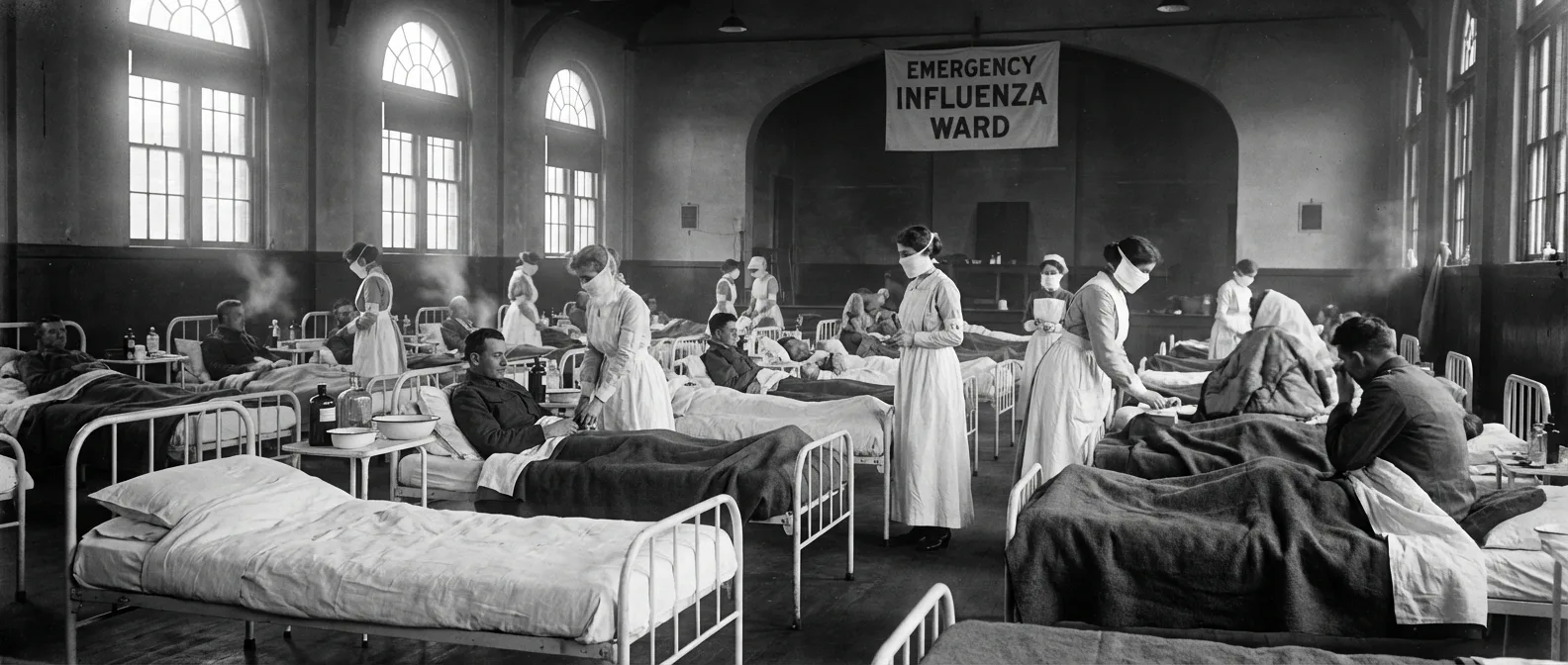
The virus spread like fire through the densely packed military camps — where thousands of young men slept side by side in tents with minimal ventilation.
Why “Spanish Flu”? Spain was neutral in the war — and the only country that didn't censor the news. When King Alfonso XIII fell ill, newspapers reported it freely. So the first reports came from there — but the disease didn't originate in Spain at all.
The first wave — a “hidden prologue”
The first wave was relatively mild. Most patients recovered within a few days. Doctors weren't particularly worried — it seemed like ordinary flu. In the United States, roughly 75,000 flu-related deaths were recorded in the first six months — a figure that didn't stand out dramatically from previous years.
But the virus didn't disappear. It traveled with the troops — on ships, trains, through ports across the world. From the USA to France, from France to Britain, from Britain to India. The military toll was staggering: three-quarters of French troops, half of all British forces, and over 900,000 German soldiers fell ill. Within months, the virus was everywhere.
The second wave — death strikes
In August, the virus returned through the port of Brest — most likely carried by ships transporting American soldiers or French naval recruits. This time it was different. It had mutated. It was extraordinarily lethal.
In Philadelphia, on September 28, the Liberty Loans Parade was held to promote war bonds — 200,000 people packed the streets, despite doctors' warnings. Within 72 hours, every hospital bed in the city was full. Within a week, 4,597 dead. Within a month, more than 12,000. Coffins ran out. Gravediggers fell sick themselves. Mass graves were dug by steam shovels.
"The bodies were piling up in every house. There were no coffins. There were no gravediggers. The city smelled of death."
The month when young people died
October 1918 was the deadliest month of the entire pandemic. In the United States, nearly 292,000 people died between September and December — eleven times more than the same period three years earlier.
The most chilling feature of this flu: it killed primarily young adults — aged 20 to 40. Unlike every other flu, which targets the elderly and children. Ninety-nine percent of deaths occurred in people under 65, and nearly half were between 20 and 40 years old.
Scientists today believe the cause was an excessive immune response — a “cytokine storm.” The strong immune systems of young people turned against them, destroying their lungs within hours. They fell ill in the morning. They died by evening. First, two mahogany spots appeared on the cheekbones, then the entire face turned blue — so-called “heliotrope cyanosis” — followed by death from asphyxiation.
"We open the bodies and find lungs full of fluid — as if they drowned from the inside."
Masks, quarantines, and censorship
As the world recognized the severity, measures came — but late. In some cities, masks became mandatory. Schools closed. Churches stopped services. Theaters went dark. In San Francisco, anyone caught without a mask faced a fine.
But in many countries, military censorship blocked the news. Governments didn't want panic — the war was still ongoing. Philadelphia, which refused to cancel the parade, paid a terrible price. St. Louis, which swiftly closed schools, theaters, and public gatherings, had far fewer deaths. The Armistice celebrations of November 11, 1918 triggered mass gatherings — which led to new outbreaks in cities like Lima and Nairobi.
📖 Read more: The Disappearance of Amelia Earhart in the Pacific
The Philadelphia vs. St. Louis comparison became a classic case study in epidemiology: rapid action saves lives. Lessons that resurfaced during COVID-19, more than 100 years later.
India, Africa, and the forgotten
While the world remembers mainly Europe and the USA, most deaths occurred elsewhere. India lost at least 12 million people — perhaps as many as 17 million — roughly 5% of its population. Bombay alone saw 15,000 deaths in under two months, out of a population of 1.1 million. It was the only decade (1911–1921) in recorded history that India's population actually declined.
In Iran, the death toll was estimated between 900,000 and 2.4 million — up to 22% of the population — compounded by famine. In Bristol Bay, Alaska, the death rate reached 40%, and entire Inuit villages were wiped out. In Western Samoa, 90% of the population was infected — 30% of adult men and 22% of women perished.
The pandemic was indiscriminate. It struck Arctic communities, tropical islands, densely populated cities, and isolated villages. In South Africa, an estimated 300,000 people — 6% of the population — died within six weeks. There was nowhere to hide — except perhaps American Samoa, which managed to avoid a single death through strict maritime quarantine.
Third wave — and slow retreat
In the winter of 1918–1919, the third wave arrived. Less lethal than the second, but still devastating. The world was exhausted — mentally and physically. In England, the third phase peaked in early March; in France, in February. In the United States alone, 160,000 deaths were recorded in the first six months of 1919.
Gradually, the pandemic receded. By summer 1919, cases dropped dramatically. The virus didn't vanish — the population simply developed herd immunity. How many died? Estimates vary: 50 million according to conservative studies. More recent analyses, like historian John M. Barry's, put the total well above 100 million.
The great forgetting
The strangest part? The world forgot. After the war and the pandemic, society wanted to move on. There were no memorials, no anniversary ceremonies. The 1918 flu became “the forgotten pandemic” — in the words of historian Alfred W. Crosby.
Even President Woodrow Wilson fell ill with the flu during the peace negotiations in Paris in April 1919 — but his illness was hushed up. Historians believe the pandemic was overshadowed because it coincided with the war — and the war “won” the memory. But the numbers speak for themselves: the flu killed three times more people.
"The 1918 flu killed more people in 24 weeks than AIDS killed in 24 years."
The virus revives — in the lab
In 2005, a team of scientists accomplished something almost unthinkable: they reconstructed the 1918 virus in the laboratory. Pathologist Johan Hultin had recovered tissue samples from an Inuit woman buried in the permafrost of Brevig Mission, Alaska — the same village that had lost 90% of its residents in five days in 1918.
Dr. Terrence Tumpey at the CDC used those samples to synthesize the RNA segments of H1N1 and reconstruct infectious virus particles. They discovered the virus had avian origins — it passed from birds to humans, likely without an intermediate host. Animal experiments confirmed the cytokine storm mechanism. The discovery was vital: it helped understand how pandemics are born — and how they can be fought in the future.
The pandemic that taught the world — if it wants to listen
The 1918 flu showed what a virus can do to an unsuspecting humanity. It demonstrated the importance of rapid response, transparency, and public health. The lesson was simple: truth saves lives — censorship kills.
A hundred years later, when COVID-19 arrived, many asked: did we learn anything? The answer, unfortunately, wasn't always positive. But the history is there — written in blood and silence — for those who want to read it.