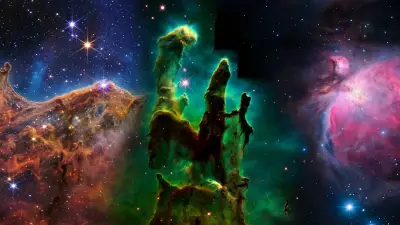
Nebulae are, perhaps, the most visually stunning objects in the universe. Vast clouds of gas and dust stretching across tens or even hundreds of light-years, bathed in colors that defy imagination. Stars are born here, stars die here — and beauty is found at every phase of this cycle.
📖 Read more: Galaxies: How Far Away Are They and How Do We Know?
🌫️ What Is a Nebula
Nebulae (singular: nebula) are enormous regions of gas — primarily molecular hydrogen (H₂) — and cosmic dust scattered throughout the interstellar medium. Some are stellar nurseries, where gravity compresses sparse gas into new stars. Others are the shells of dead stars — their cosmic heirlooms.
Their sizes range from a few light-years to hundreds. The nearest major star-forming nebula, the Orion Nebula, lies just 1,344 light-years from us.
☀️ Emission
Ionized gas glows from UV radiation of nearby stars. E.g. Orion Nebula (M42).
🪞 Reflection
Dust reflects light from nearby stars, producing a blue tint. E.g. Pleiades (M45).
🌑 Dark
Dense dust blocks background light. E.g. Horsehead Nebula.
💀 Planetary
Gas shells from dying stars. E.g. Ring Nebula (M57).
⭐ Emission Nebulae
Emission nebulae glow because ultraviolet radiation from young, hot stars ionizes the surrounding gas. As electrons recombine with ions, they emit photons at specific wavelengths.
The iconic Orion Nebula (M42) is visible even to the naked eye as a fuzzy patch in Orion's “sword.” Hundreds of new stars are forming within it. The Eagle Nebula (M16) hosts the famous “Pillars of Creation” — towering columns of gas that were imaged by both Hubble and JWST.
🪞 Reflection and Dark Nebulae
Reflection nebulae don't glow on their own — they reflect light from nearby stars through dust particles. Because dust scatters blue light more efficiently (just like Earth's atmosphere), these nebulae tend to appear blue. The Pleiades (M45) are the classic example.
📖 Read more: JWST Discovers Organic Molecules in Ancient Galaxies
Dark nebulae, by contrast, neither emit nor reflect light — their dust is so dense it completely blocks the light behind them. The Horsehead Nebula in Orion is a striking example of a dark nebula silhouetted against a bright emission nebula background.
💀 Planetary Nebulae
Despite their misleading name, planetary nebulae have nothing to do with planets. They are the gas shells ejected by small stars at the end of their lives — a final “sigh” before becoming white dwarfs.
The Ring Nebula (M57), the Cat's Eye Nebula (NGC 6543), and the Helix Nebula (also known as the “Eye of God”) are some of the most impressive. Each reveals a different shape depending on the viewing angle, the mass of the original star, and its magnetic fields.
🎨 Why Do They Have Colors?
The colors of nebulae aren't painted — they're the result of physics. Each chemical element, when ionized, emits photons at very specific wavelengths:
- Red (Hα): Hydrogen — the most common emission line in nebulae, at 656.3 nm
- Green: Ionized oxygen (OIII) — at 500.7 nm
- Blue: Ionized helium and dust scattering
📸 Pillars of Creation: The iconic “Pillars of Creation” were first photographed by Hubble (1995) and later by JWST (2022). The comparison is remarkable: Hubble captured visible light revealing dense gas, while JWST “pierced” the dust with infrared light, revealing newborn stars hidden inside the pillars.
🔭 Supernova Remnants
Supernova remnants are a distinct type of nebula — the expanding debris of an exploded star. The Crab Nebula (M1) is what remains from the supernova of 1054, with a pulsar at its center spinning 30 times per second.
The Veil Nebula in the constellation Cygnus is the remnant of a supernova that exploded 10,000-20,000 years ago. The deadly violence of a supernova creates something ethereal — proof that in the universe, death and beauty often coexist.