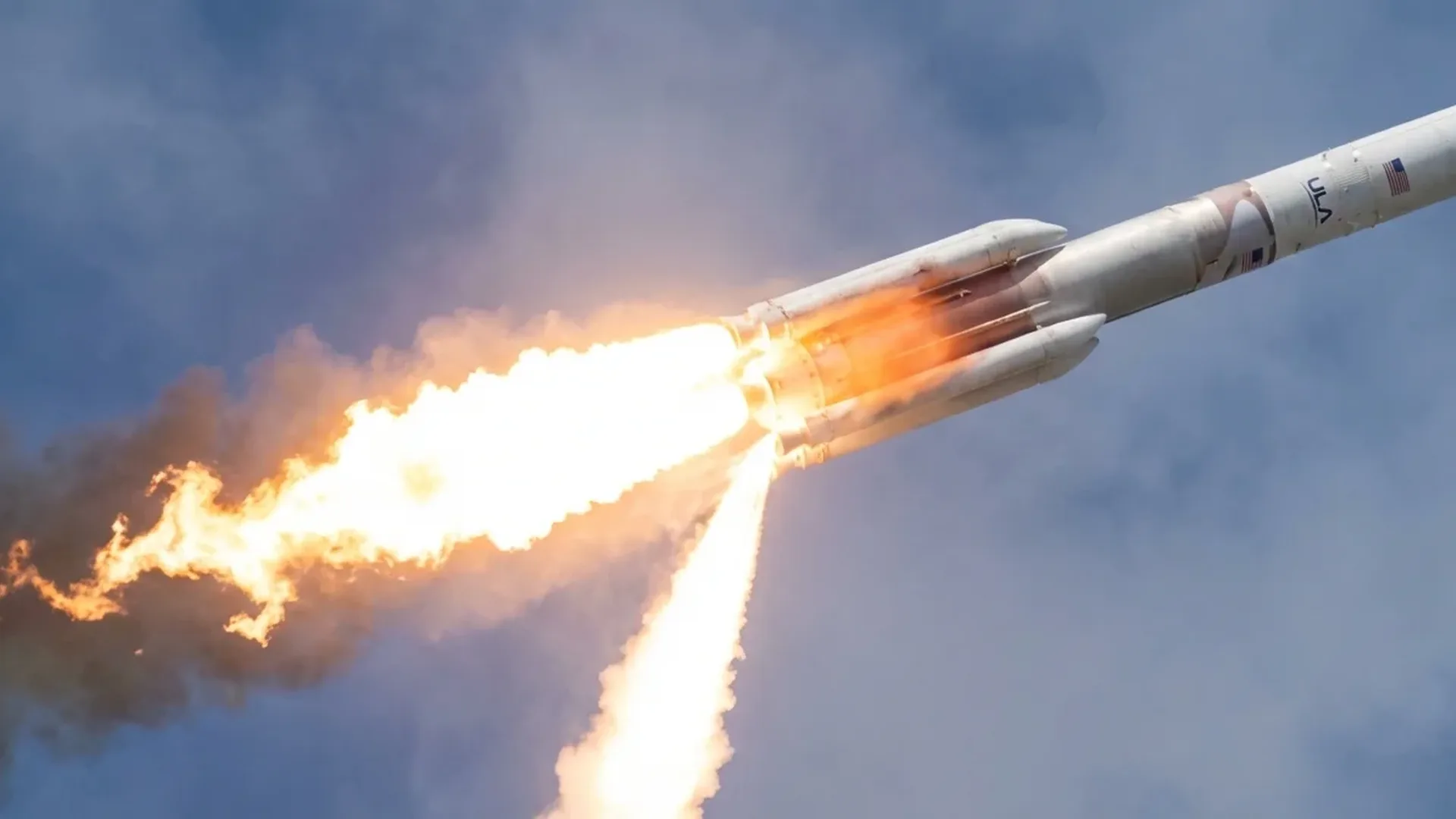
United Launch Alliance's Vulcan rocket was supposed to seamlessly replace two of America's most reliable launch vehicles — the Atlas V and Delta IV. But the path to certification is proving rockier than expected, with recurring booster problems plaguing recent flights. In an ironic twist, the Blue Origin BE-4 engines — once considered the weak link — appear to be the ones saving the rocket from failure.
📖 Read more: Space Tourism in 2026: How Much Does It Cost?
⚠️ Another Booster Problem in Flight
During a recent launch, ULA's Vulcan rocket suffered a significant anomaly with one of its solid rocket boosters (SRBs) manufactured by Northrop Grumman. The malfunction of the GEM 63XL booster could have had catastrophic consequences on any other rocket. However, the main BE-4 engines built by Blue Origin responded, compensating for the lost thrust and saving the mission from failure.
This was not an isolated incident. The Vulcan has now experienced booster problems on multiple occasions, raising pointed questions about the reliability of a rocket that is specifically designed to carry America's most sensitive and expensive national security payloads into orbit.
Critically, the problems are not related to the BE-4 engines — quite the opposite. The BE-4s proved to be the saving grace. Despite years of development delays and widespread skepticism, the Blue Origin-made engines performed flawlessly under pressure, demonstrating their ability to handle unexpected in-flight anomalies and keep the mission on track.
🔧 Vulcan's Technology
What sets the Vulcan apart from its predecessors is primarily its first-stage engine: the BE-4 by Blue Origin. Instead of the Russian-built RD-180 that powered the Atlas V, the Vulcan relies on two BE-4 engines burning liquefied natural gas (LNG) and liquid oxygen (LOX). This propellant combination is cheaper, easier to handle, and — crucially — eliminates dependence on Russian technology, a pressing concern given the current geopolitical landscape.
Vulcan's upper stage, known as Centaur V, is equipped with two RL10 engines — an evolved version of the classic engine that has powered American upper stages for decades. The Centaur V offers increased propellant capacity and greater mission flexibility compared to its predecessor, enabling longer coast phases and more complex orbital insertions.
The GEM 63XL solid rocket boosters by Northrop Grumman provide additional thrust during the first seconds of flight. The Vulcan can be configured with 0, 2, 4, or 6 of these boosters depending on mission requirements. However, it is precisely these boosters that have experienced the problems — putting manufacturing quality and inspection procedures under scrutiny.
🛡️ National Security at Stake
The reason Vulcan's problems generate such intense concern goes beyond engineering — it is fundamentally strategic. The Vulcan was designed to take over National Security Space Launch (NSSL) missions for the United States, meaning it would carry military and intelligence satellites for the Pentagon, CIA, and the National Reconnaissance Office (NRO).
These missions demand the highest standards of reliability. A payload worth billions of dollars — such as a next-generation spy satellite — cannot be lost due to a faulty booster. NSSL certification requires a series of successful flights without anomalies, and the recurring booster issues are complicating that process considerably.
📖 Read more: Do All Galaxies Have Supermassive Black Holes at Center?
The first certification flight (Cert-1) took place in January 2024, carrying the Peregrine lunar lander. The second (Cert-2) followed in October 2024 with Sierra Space's Dream Chaser cargo vehicle. But additional problems mean additional delays to full certification — while competitor SpaceX continues launching Falcon 9 missions for military payloads without interruption.
🏛️ The Atlas & Delta Legacy: The Vulcan replaces two legendary names in American spaceflight. The Atlas V completed over 100 launches without a single failure, while the Delta IV Heavy was the most powerful active American rocket, carrying the nation's most classified payloads. ULA — a joint venture between Boeing and Lockheed Martin — was specifically created to ensure guaranteed access to space for the U.S. government.
🏭 The Role of the BE-4
The story of the BE-4 engine is full of twists. Blue Origin, Jeff Bezos's space company, developed the BE-4 with the goal of replacing the Russian RD-180. Development was painfully slow — years behind the original schedule — and many questioned whether Blue Origin could deliver a reliable engine at all.
The irony is that the BE-4 has turned out to be Vulcan's crowning achievement. During the booster anomaly, the two BE-4 engines responded automatically, increasing their thrust output and compensating for the reduced performance from the malfunctioning SRB. In essence, the Blue Origin engines saved the rocket from failure — a dramatic demonstration of capability that is reshaping the engine's reputation entirely.
The BE-4 is an oxygen-rich staged combustion engine burning LNG and LOX. It produces approximately 250 tonnes of thrust per engine. Beyond the Vulcan, the BE-4 also powers Blue Origin's own New Glenn rocket, which ensures a higher production rate and continuous improvement through lessons learned across both programs.
"Vulcan's Blue Origin-made BE-4 engines appear to have saved the rocket from failure" — in the moment of crisis, the technology that was once doubted proved to be Vulcan's shield.
— Ars Technica, February 2026🔮 What Happens Next
ULA finds itself at a critical crossroads. NSSL certification requires a string of successful flights without anomalies, something the recent booster problems make significantly harder to achieve. Northrop Grumman must thoroughly investigate the root causes of the GEM 63XL issues and implement corrective measures before the next flights can proceed.
Meanwhile, competition is intensifying. SpaceX dominates the launch market with Falcon 9 and Falcon Heavy, while Starship promises to rewrite the rules entirely. Blue Origin, with its New Glenn — powered by the very same BE-4 engine — is preparing to enter the market as a competitor to the Vulcan itself. ULA must prove that the Vulcan can fly reliably and frequently — only then will it earn the trust inherited from the Atlas and Delta programs.
The situation reveals a deeper truth about spaceflight: developing a new rocket is never easy. Even companies with decades of experience face unexpected problems. For the Vulcan, the question is not whether it will fly — but whether it will fly reliably enough for the United States to entrust its most valuable payloads to it. The answer depends on the next launches.