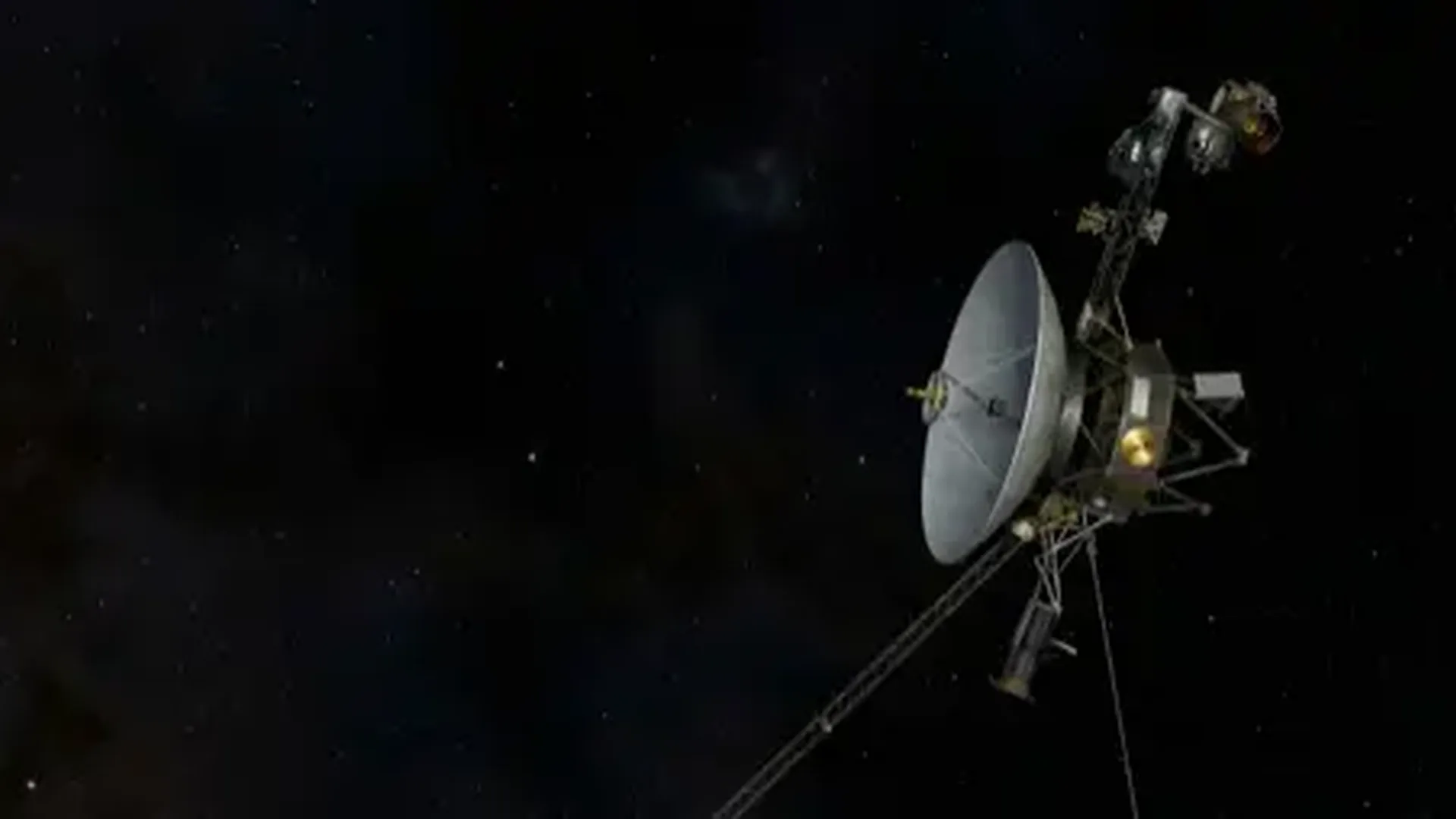
On September 5, 1977, NASA launched a 722 kg spacecraft called Voyager 1. Its mission: to fly past Jupiter and Saturn, using their gravity to gain speed in what scientists called the Grand Tour. Nobody expected it to still be functioning and communicating nearly 50 years later, now traveling through interstellar space — the first human-made object to do so.
Current Status: As of 2025, Voyager 1 is more than 24 billion kilometers from Earth. At the speed of light, a signal takes ~22 hours to reach it. It travels at ~17 km/s (61,000 km/h) relative to the Sun.
The Grand Tour: Jupiter and Saturn
Voyager 1 reached Jupiter in March 1979, discovering Io's volcanoes, Europa's smooth ice surface, and observing Jupiter's complex weather systems including the Great Red Spot in unprecedented detail. After Saturn's flyby in November 1980 (revealing ring structure and discovering Titan's dense atmosphere), mission planners chose to route Voyager 1 out of the ecliptic plane, sacrificing Uranus and Neptune for the trajectory that would take it furthest from the Sun — a decision that ultimately led to its historic exit from the solar system.
The Pale Blue Dot
On February 14, 1990, at the request of Carl Sagan, NASA commanded Voyager 1 to turn its cameras back toward Earth from a distance of ~6 billion km. The resulting image showed Earth as a tiny, barely visible blue dot in a ray of sunlight. Sagan's iconic reflection remains one of the most quoted passages in science: «Our planet is a lonely speck in the great enveloping cosmic dark.»
«That's here. That's home. That's us. On it everyone you love, everyone you know, everyone you ever heard of, every human being who ever was, lived out their lives.»
— Carl Sagan, Pale Blue Dot, 1994Crossing the Heliopause
The heliopause is the boundary where the solar wind is overwhelmed by the interstellar medium. On August 25, 2012, Voyager 1 crossed this boundary, becoming the first human artifact to enter true interstellar space. Scientists confirmed this by detecting a sudden increase in plasma density and the dominance of interstellar cosmic rays over solar particles. Voyager 2 crossed the heliopause in November 2018, but in a different direction.
Power and Communication
Voyager 1 is powered by three Radioisotope Thermoelectric Generators (RTGs) using plutonium-238. These generate ~4 W of electrical power as of 2025 (down from 470 W at launch). To cope with declining power, NASA has been progressively shutting down instruments since 2020. The spacecraft is expected to maintain communication until approximately 2030, when power becomes insufficient.
- NASA JPL – Voyager Mission Status
- Gurnett et al. – Science 2013: In situ observations of interstellar plasma
- Sagan et al. – Science 1990: Pale Blue Dot photograph analysis
- NASA – Voyager Golden Record
Related Articles
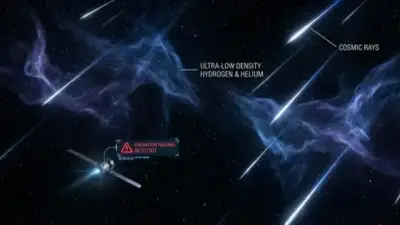
Interstellar Space: Empty but Not Void
Voyager 1 is now in interstellar space. What does it find there?

Alien Civilizations: Will We Meet Them?
Voyager carries the Golden Record — our message to the stars.
Pluto: Why It's Not a Planet
The Kuiper Belt, Eris, and the IAU decision that divided astronomers.
Betelgeuse: Will We Witness a Supernova?
Voyager won't reach Betelgeuse for 300,000 years — if it had gone that way.
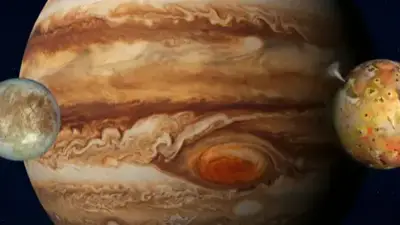
Jupiter's 95 Moons
Voyager 1 gave us our first close look at Io and Europa.
Gravitational Waves: How LIGO Hears the Universe
A completely different way to observe the cosmos.