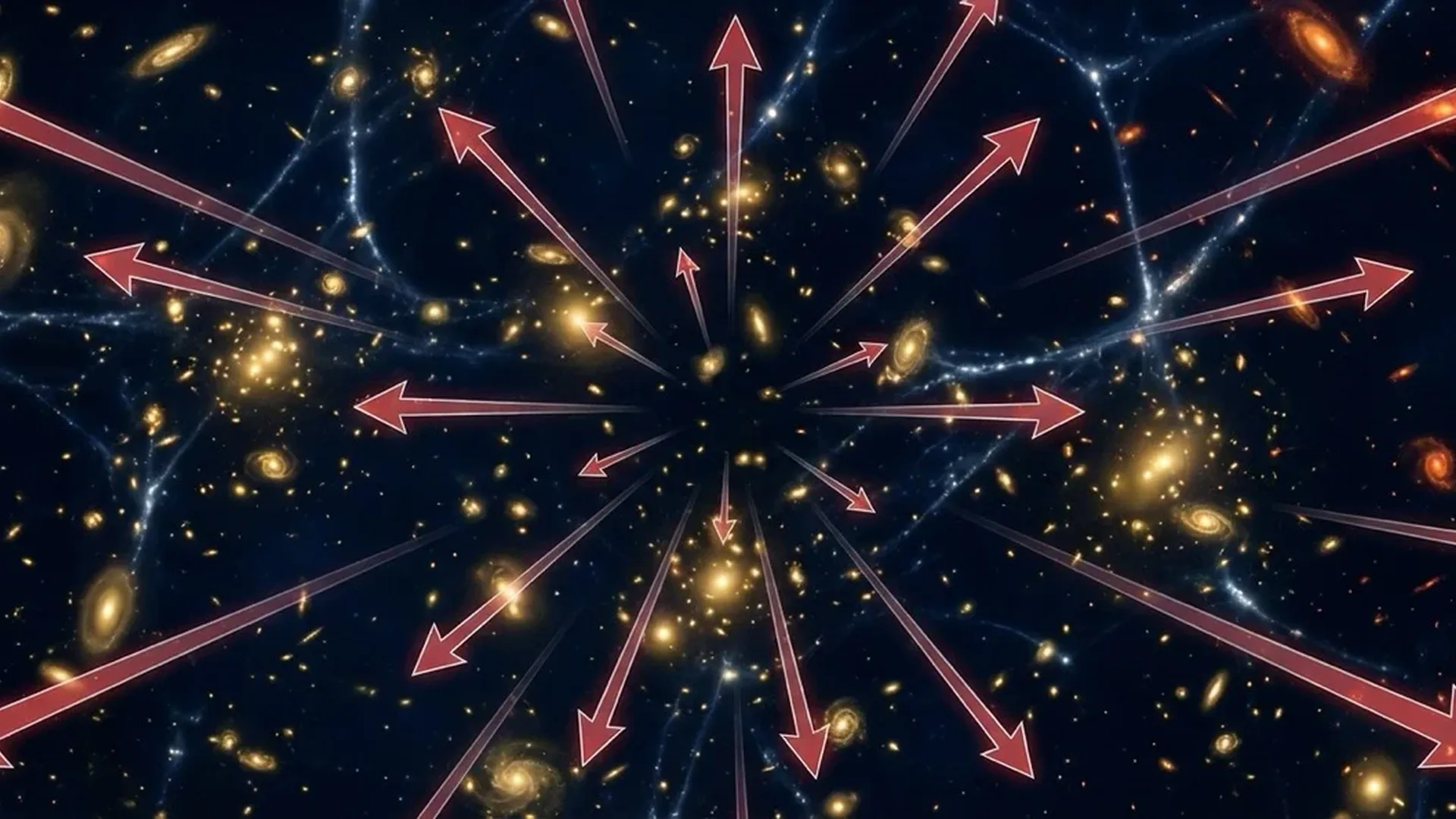
The universe is expanding — we've known that for decades. But how fast? The two best measurement methods give different answers, and every new measurement deepens the mystery. This disagreement is called the Hubble Tension and is considered one of the most significant open questions in modern cosmology.
📖 Read more: Dark Energy: The Force That's Tearing the Universe Apart
🔭 The Hubble Constant: Speedometer of the Universe
The Hubble constant (H₀) measures how fast galaxies recede from each other due to the expansion of space. It's expressed in km/s/Mpc: for every megaparsec (about 3.26 million light-years) of distance, galaxies move apart an additional H₀ km/s. Two approaches dominate:
🔭 Two Methods, Two Answers
The first method uses "standard candles" — Type Ia supernovae and Cepheid variable stars. The SH0ES team of Adam Riess (Nobel Prize in Physics 2011) measures distances in the local universe and finds H₀ ≈ 73 km/s/Mpc.
The second method analyzes the Cosmic Microwave Background (CMB) — the light emitted 380,000 years after the Big Bang. ESA's Planck satellite analyzes temperature fluctuations and finds H₀ ≈ 67.4 km/s/Mpc. The ~8% difference is statistically above 5σ — extremely unlikely to be due to chance.
"It's important to obtain an independent measurement of the Hubble constant to resolve the current Hubble tension. Our method is an innovative way to enhance the accuracy using gravitational waves."
📖 Read more: How Will the Universe Die? The 5 Theories
🔭 New Methods: Gravitational Waves and DESI
In February 2026, a team from the University of Illinois and the University of Chicago published in Physical Review Letters a new method: the stochastic siren. Instead of measuring individual black hole collisions, they use the gravitational-wave background — the collective “hum” from thousands of undetectable collisions.
Meanwhile, DESI (Dark Energy Spectroscopic Instrument) is analyzing millions of galaxies and suggests that dark energy may vary over time — something that would overturn the standard ΛCDM model.
💡 Why It Matters
If the discrepancy is real, it could mean new physics is needed: early dark energy, dark matter-neutrino interactions, or evolving dark energy dynamics. Each scenario would transform our understanding of the universe's structure.
📖 Read more: Dark Matter & Dark Energy: What Holds the Galaxy Together?
🔭 JWST Enters the Game
The James Webb Space Telescope has provided independent Cepheid distance measurements in remote galaxies with much greater accuracy than Hubble. The first results confirmed the SH0ES measurements — ruling out systematic error as the cause of the Tension.
Additionally, measurements using gravitationally lensed supernovae ("time-delay cosmography") yield H₀ ≈ 72–74, agreeing with the local universe. Every new independent method confirming the high value strengthens the case for new physics.
🌟 Standard Candles (SH0ES)
Cepheids + Type Ia Supernovae. Measure distances in the local universe. Result: H₀ ≈ 73.
📡 CMB (Planck)
Cosmic microwave background radiation from the early universe. Predicts current H₀ ≈ 67.4 using ΛCDM model.
🌊 Stochastic Siren (New)
Gravitational-wave background from black hole collisions. Independent method — places H₀ in the Tension region.
🔭 What This Could Mean
If the Hubble Tension is definitively confirmed, it would mean the Standard Model of Cosmology (ΛCDM) needs modification. Possible explanations include early dark energy, new particles, or even modifications to General Relativity. In the coming years, data from DESI, Euclid, and the next generation of LIGO-Virgo-KAGRA will determine the outcome.
📚 Sources
- Phys.org — “Physicists develop new method to measure universe’s expansion rate” (February 2026)
- Cousins et al. — "Stochastic Siren: Astrophysical gravitational-wave background measurements of the Hubble constant", Physical Review Letters (2026)
- NASA — “New Hubble Constant Measurement Adds to Mystery of Universe's Expansion Rate”
- ESA — “Planck and the cosmic microwave background”