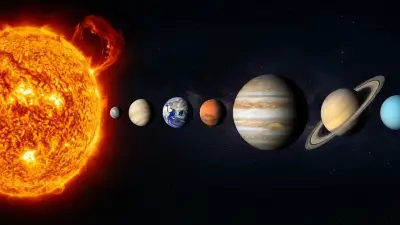
Our solar system is an incredibly diverse place: from Mercury's scorching surface to Neptune's frozen winds. Eight planets, dozens of moons, asteroids, comets, and dwarf planets have been orbiting our Sun for 4.6 billion years.
📖 Read more: 'Oumuamua: The Interstellar Mystery That Baffled Scientists
☀️ The Sun
The Sun is a medium-sized star (yellow dwarf, type G2V) containing 99.86% of the solar system's total mass. Its surface temperature is ~5,500°C, while its core reaches 15 million degrees. It converts 620 million tons of hydrogen into helium every second through nuclear fusion. It will continue shining for another ~5 billion years.
🪨 Rocky Planets
Mercury: The smallest and closest planet to the Sun. 88-day orbit, extreme temperatures from -180°C to +430°C. No atmosphere.
Venus: The hottest planet in the solar system (462°C) due to a runaway greenhouse effect. Atmosphere 96% CO₂. Its rotation (243 days) is longer than its orbit (225 days).
Earth: The only known planet with life. 1 AU from the Sun (150 million km). Liquid water, nitrogen-oxygen atmosphere, magnetic field.
Mars: The Red Planet, with a thin atmosphere. Home to Olympus Mons — the tallest volcano in the solar system (22 km). 2 moons: Phobos and Deimos.
Mercury
-180°C to +430°C
0 moons
Smallest planet
Venus
462°C (hottest!)
0 moons
Retrograde rotation
Earth
15°C average
1 moon
Life!
Mars
-63°C average
2 moons
Olympus Mons
📖 Read more: The Expanding Universe: What Does Hubble's Law Tell Us?
🪐 Gas Giants
Jupiter: The largest planet. Its iconic Great Red Spot is a storm larger than Earth that has been raging for 350+ years. 95 known moons. It protects Earth from asteroids with its immense gravity.
Saturn: Famous for its spectacular rings of ice and rock. 146 known moons. It's the least dense planet — it would float in a large enough bathtub!
🧊 Ice Giants
Uranus: Tilted 98° on its side — it essentially rolls along its orbit. An ice giant with 27 moons, discovered in 1781.
Neptune: The farthest planet with the strongest winds in the solar system: 2,100 km/h. 14 moons, with the largest being Triton.
☄️ Dwarf Planets and Belts
Pluto, demoted in 2006, is the most famous dwarf planet. Others include Eris, Ceres, Haumea, and Makemake. The Asteroid Belt lies between Mars and Jupiter, the Kuiper Belt beyond Neptune, and the Oort Cloud at the outermost boundary of the system.
🤯 Did you know? Saturn would float on water! With a density of 0.687 g/cm³ (less than water), it's the only planet in the solar system that would float in a large enough bathtub. Of course, no such bathtub exists in the universe.
🔭 Exploration
Every planet has been visited by spacecraft. Voyager 2 is the only one to have visited all 4 outer planets. Juno is studying Jupiter, Perseverance is on Mars. Future missions target Europa, Enceladus, and Titan — moons with potential interest for life. Our solar system, 4.6 billion years after its birth, continues to surprise us.