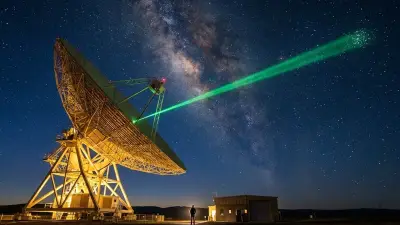
Humanity has wondered for millennia: are we alone in the universe? In 2026, that question is no longer philosophical — it's scientific. With telescopes analyzing exoplanet atmospheres, rovers digging into Mars, and radio telescopes scanning the sky for signals, the search for extraterrestrial life has reached an unprecedented intensity. Let's explore exactly where we're looking.
🔴 Mars: The Prime Suspect
The Red Planet remains the primary target. NASA's Perseverance rover is exploring Jezero Crater — an ancient lake bed that was once filled with water. It's collecting rock samples that will be sent back to Earth via the Mars Sample Return (MSR) mission, aiming to detect biosignatures: microscopic structures or chemical traces that could indicate ancient microbial life.
Jezero was chosen because its sedimentary rocks — formed by water — are ideal for preserving microfossils. Meanwhile, underground water lakes beneath Mars' south pole, detected by radar, represent potential refuges for life today — although their existence is still debated.
🌊 Ocean Worlds: Europa, Enceladus, and Beyond
Beneath the frozen crusts of outer solar system moons lie vast oceans of liquid water. Europa, a moon of Jupiter, has an ocean dozens of kilometers deep beneath a layer of ice. NASA's Europa Clipper mission, launched in 2024, will make dozens of close flybys to analyze the ice composition and detect water plumes.
Saturn's moon Enceladus ejects geysers of water vapor into space — Cassini detected organic molecules and hydrogen in them, signs of hydrothermal activity on the ocean floor. ESA's JUICE mission, en route to Jupiter, will study Ganymede, yet another moon with a subsurface ocean.
🔭 Exoplanets: What JWST Is Revealing
The James Webb Space Telescope (JWST) has changed the game. By analyzing light passing through exoplanet atmospheres during transits in front of their host stars, it can detect biosignature molecules: oxygen, methane, dimethyl sulfide (DMS). The simultaneous presence of oxygen and methane in an atmosphere is considered strong evidence of biological activity, since these gases react with each other and cannot coexist without continuous replenishment.
Exoplanet K2-18b, a “super-Earth” in a habitable zone, showed indications of DMS in its atmosphere — a molecule that on Earth is produced almost exclusively by marine plankton. If confirmed, it would be the first evidence of biology beyond Earth. The number of known exoplanets now exceeds 5,700, with dozens in habitable zones.
📡 SETI — Signals from Civilizations
The search isn't just about microbes. The SETI program (Search for Extraterrestrial Intelligence) looks for signals from technological civilizations. Breakthrough Listen, funded with $100 million, is scanning 1 million nearby stars using the world's largest radio telescopes. The SETI Institute's Allen Telescope Array continuously monitors the sky, while China's FAST telescope — 500 meters in diameter — is the largest radio telescope on Earth.
Beyond radio signals, scientists are searching for "technosignatures": artificial lighting on the night side of planets, Dyson structures around stars, or industrial gases in atmospheres. If a civilization is using energy on a massive scale, perhaps we can detect it.
🧮 The Drake Equation and the Fermi Paradox: Astronomer Frank Drake created an equation to estimate the number of communicating civilizations in our galaxy. Depending on the parameters, the result ranges from 1 (just us) to millions. Conversely, physicist Enrico Fermi asked: “If they exist, where are they?” — the famous Fermi Paradox. Possible explanations: civilizations self-destruct, distances are too vast, or we don't recognize their signals.
🧪 Where Else? Venus and Extremophiles
In 2020, the detection of phosphine in Venus's atmosphere caused a stir — on Earth, phosphine is primarily produced by microorganisms. The discovery was hotly contested but not fully dismissed. New missions to Venus (DAVINCI+, VERITAS) will shed light on the planet's atmospheric mysteries.
On Earth, extremophile organisms prove how resilient life can be: bacteria living in boiling water, nuclear waste, frozen poles, and kilometers underground. If life can survive in these conditions here, why not elsewhere?
🤔 When Will We Find It?
Many astrobiologists believe the first detection of life beyond Earth — most likely microbial — will happen within the next two decades. The tools exist: JWST, Europa Clipper, MSR, missions to Enceladus. If life is found in even one form, it will mean that biology is not a unique phenomenon — and that the universe is very likely teeming with life.
The discovery won't just be scientific — it will change how we see ourselves. Our place in the universe will no longer be unique. And that, perhaps, is the most profound change science can bring.