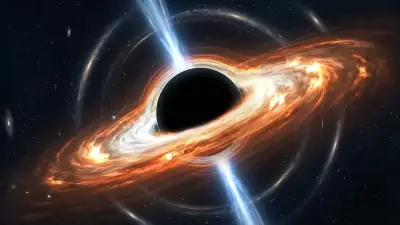
In the depths of the universe lurk objects so enormous they defy all human comprehension. Phoenix A, the largest known black hole, has a mass of approximately 100 billion solar masses — a number so vast that its gravitational influence extends beyond entire galaxy clusters. How was this cosmic monster created, and what does it mean for our understanding of the universe?
🕳️ Phoenix A — The Largest Known Black Hole
Phoenix A sits at the center of a galaxy within the Phoenix galaxy cluster, approximately 5.8 billion light-years from Earth. It was discovered and measured in 2022 through the study of stellar dynamics — astronomers observed how stars orbit around an invisible center of mass at speeds indicating incomprehensible gravitational pull.
With a mass of ~100 billion solar masses (10¹¹ M☉), Phoenix A surpasses every other known black hole. It belongs to the category of “ultramassive” black holes — those exceeding 10 billion solar masses, a category that until recently was considered almost theoretical.
📏 How Large Is It?
The event horizon of Phoenix A — the point beyond which nothing, not even light, can escape — extends approximately 600 billion kilometers, or about 4,000 astronomical units (AU). For comparison, Pluto's orbit around the Sun is only ~40 AU. This means Phoenix A's event horizon could swallow our entire solar system — many times over.
If we placed Phoenix A where our Sun is, the event horizon would extend far beyond the Kuiper Belt, trapping every planet, dwarf planet, and millions of asteroids within the “point of no return.”
🏆 The Top 5 Black Holes
- Phoenix A: ~100 billion solar masses — the absolute champion, in the Phoenix galaxy cluster.
- TON 618: ~66 billion solar masses — a quasar 10.4 billion light-years away, with astonishing luminosity.
- Holm 15A*: ~40 billion solar masses — at the center of galaxy cluster Abell 85.
- M87*: ~6.5 billion solar masses — the first black hole ever photographed (2019, Event Horizon Telescope).
- Sgr A*: ~4 million solar masses — “our” black hole, at the center of the Milky Way.
🔮 Scale in Objects: If our Sun were a marble 2 centimeters across, Sgr A* would be a basketball. M87* would be like a two-story house. And Phoenix A? It would be like an entire city — tens of kilometers in diameter.
🔬 How We Measured Its Mass
Measuring a black hole's mass can't be done directly — since it emits no light. Instead, astronomers use indirect methods. The primary one is stellar dynamics: by measuring the velocities and orbits of stars near the galaxy's center, we can calculate the mass of the invisible object controlling them.
Other methods include gas kinematics — studying how gas rotates around the black hole — and reverberation mapping, where we measure how long it takes for light from the accretion disk to “echo” off nearby gas clouds.
📈 How It Grew So Large
A black hole of 100 billion solar masses wasn't created in a day. Ultramassive black holes increase their mass through two main mechanisms: gas accretion — devouring enormous quantities of matter falling into them — and mergers with other black holes during galaxy collisions.
A major mystery remains: how were the first “seeds” of these monsters formed? One theory suggests that in the early universe, massive gas clouds collapsed directly into black holes without first passing through the star stage — so-called “direct-collapse black holes.”
❓ Can It Get Even Bigger?
Theoretically, there are physical limits to how large a black hole can grow. As it accretes matter, the radiation emitted by the heated accretion disk creates radiation pressure that pushes back incoming material — this is the feedback mechanism. The so-called Eddington limit sets a maximum accretion rate.
However, black hole mergers are not subject to this limit — two black holes can merge regardless of radiation. In a universe 13.8 billion years old, enough such mergers in galaxy clusters can create monsters like Phoenix A. If the universe continues evolving for trillions more years, who knows how large they might become?