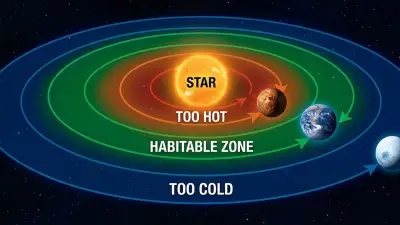
In the search for life beyond Earth, scientists focus on a specific region around every star: the habitable zone, also known as the “Goldilocks Zone.” It is the area where conditions allow liquid water to exist on the surface of a rocky planet — and according to Kepler estimates, 40 billion Earth-sized planets may reside in this zone, in our galaxy alone.
📖 Read more: Is There Life Elsewhere in the Universe?
🌍 What Is the Habitable Zone
The habitable zone (HZ) is the region around a star where liquid water could exist on the surface of a rocky planet. The nickname “Goldilocks” comes from the fairy tale where Goldilocks chose the porridge that was neither too hot nor too cold — but “just right.”
The width of the zone depends on the star type. For dim red dwarfs, the zone lies very close to the star. For bright O-type stars, it extends to much greater distances. Earth sits within the Sun's habitable zone.
☀️ Sun-like Star
HZ: 0.95 – 1.67 AU. Earth at 1 AU sits right in the middle. Large zone, stable energy output.
🔴 Red Dwarf
HZ: 0.08 – 0.24 AU. Very close to the star. Risk of tidal locking and stellar flares.
⭐ Binary Star System
Complex zone with variable radiation. Planets in circumbinary orbits can still be habitable.
📖 Read more: Tatooine-Like Exoplanets: Worlds Orbiting Two Suns
🔴 Mars and Venus
Mars sits at the outer edge of the Sun's habitable zone. Evidence suggests it once had flowing water on its surface — perhaps 3-4 billion years ago, when it had a thicker atmosphere. Today, its thin atmosphere does not allow liquid water.
Venus, on the other hand, sits at the inner edge. It may once have been habitable, but a runaway greenhouse effect transformed it into an inferno with temperatures of 460°C and pressure 90 times that of Earth. These two examples show that the habitable zone does not guarantee life — it is necessary but not sufficient.
🪐 Exoplanets in the Zone
The TRAPPIST-1 system, 40 light years away, has 7 rocky planets — 3-4 of them sit in the habitable zone. Proxima Centauri b, the nearest exoplanet to Earth (4.24 light years), also orbits within its star's zone. Kepler-442b is considered one of the best candidates for habitability.
📖 Read more: alien-life-probability-statistics-universe
💧 Beyond the Zone
The habitable zone is not the only place where life could exist. Europa, a moon of Jupiter, has a subsurface ocean beneath a frozen shell — far outside the zone. Enceladus, a moon of Saturn, shoots jets of water into space from its subsurface ocean. In these cases, energy comes from tidal heating, not the Sun.
Chemosynthesis — life powered by chemical reactions rather than sunlight — has already been found in the depths of Earth's oceans, near hydrothermal vents. This shows that life can thrive even without sunlight.
💡 Remarkable number: According to Kepler estimates, approximately 40 billion Earth-sized planets reside in the habitable zone of our galaxy alone. This number makes the statistical probability of life existing elsewhere extraordinarily compelling.
🔭 Searching for Life
The James Webb Space Telescope (JWST) has already begun analyzing the atmospheres of exoplanets in the habitable zone. It searches for biosignatures such as oxygen, methane, and ozone — gases that on Earth are linked to biological processes.
The next generation of telescopes, such as NASA's Habitable Worlds Observatory, will be able to directly observe Earth-like exoplanets and photograph their atmospheres. The answer to the question “are we alone?” may lie in one of those 40 billion “Goldilocks” zones.