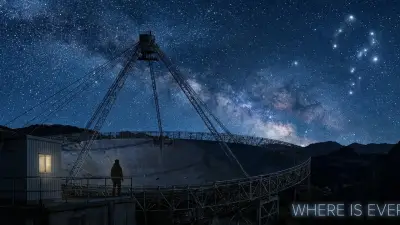
The universe is unimaginably vast. Billions of galaxies, trillions of stars, countless planets orbiting within habitable zones. And yet, despite decades of searching, we have found not a single sign of extraterrestrial life. This silence — this terrifying silence — lies at the heart of one of science's greatest enigmas: the Fermi Paradox.
❓ The Fermi Paradox
In 1950, during a casual lunch at Los Alamos National Laboratory, Italian physicist Enrico Fermi — Nobel laureate and one of the architects of the nuclear age — posed a deceptively simple question to his colleagues: "Where is everybody?"
The question was anything but rhetorical. Fermi had been doing quick calculations on his napkin. Our galaxy is roughly 13.6 billion years old. Even if a civilization traveled at just 1% of the speed of light, it could colonize the entire Milky Way in a few million years — an astronomically insignificant span of time. If there are billions of habitable planets, some civilization should have reached us by now. And yet, nothing.
This contradiction between the enormous probability of extraterrestrial civilizations and the complete absence of evidence became known as the Fermi Paradox. For over 75 years, it has remained one of the most fundamental questions in astrophysics, philosophy, and the search for extraterrestrial intelligence.
🔢 The Drake Equation
In 1961, astronomer Frank Drake attempted to give mathematical form to the question: how many civilizations could be communicating with us right now in the Galaxy? The result was the famous Drake Equation:
N = R* × fp × ne × fl × fi × fc × L
Each variable represents a stage in the “journey” from a star to a civilization emitting signals:
- R* — Rate of star formation in the Galaxy (~1–3 per year)
- fp — Fraction of stars with planetary systems (today we know it's ~100%)
- ne — Average number of planets per system in the habitable zone (~1–5)
- fl — Fraction of those where life develops (completely unknown)
- fi — Fraction where intelligence develops (completely unknown)
- fc — Fraction that develops communication technology
- L — Average lifetime of a technological civilization
Depending on the estimates, N ranges from zero (we are alone) to millions of civilizations. The uncertainty is enormous — especially in the later factors. But even Drake himself estimated there should be at least several thousand civilizations. So why don't we hear anything?
🚫 The Great Filter
One of the most unsettling answers to the Fermi Paradox is the Great Filter theory, proposed by economist Robin Hanson in 1996. The idea is simple but terrifying: somewhere on the path from simple chemistry to spacefaring civilization, there exists a stage that is nearly impossible to pass — a “filter” that eliminates almost every form of life.
The critical question is: is the Great Filter behind us or ahead of us?
- If it's behind us, then something we already passed (e.g., the emergence of eukaryotic cells, multicellularity, or intelligence) is extraordinarily rare. We are the lucky ones.
- If it's ahead of us, then something catastrophic awaits every technological civilization: nuclear war, ecological collapse, artificial intelligence out of control, or something we cannot even imagine.
This is why astrobiologists argue that discovering simple microbial life on another planet would be simultaneously thrilling and alarming — because it would suggest the Great Filter most likely lies ahead of us.
🌲 The Dark Forest Theory
An alternative explanation, popularized by the science fiction trilogy Remembrance of Earth's Past by Chinese author Liu Cixin (2008), is the Dark Forest Theory.
The logic goes like this: the universe is like a dark forest full of armed hunters. Every civilization is a hunter hiding behind trees. They cannot know the intentions of others. The safest strategy is complete silence — because any signal could attract a superior civilization that will eliminate you preemptively.
According to this theory, alien civilizations exist but are hiding deliberately. And humanity, broadcasting radio signals for 100 years, is doing something extraordinarily dangerous.
The scale of the universe is incomprehensible: There are approximately 2 trillion galaxies, each with an average of 100 billion stars. That means roughly 200 sextillion (2×10²³) stars in the observable universe — more than the grains of sand on every beach on Earth. And in this ocean of stars, we have not found a single signal.
👀 The Zoo Hypothesis & Other Theories
Beyond the Great Filter and the Dark Forest, there are dozens more possible explanations:
- The Zoo Hypothesis: Aliens know about us but observe us without interfering, like we watch animals in a nature reserve. Perhaps they are waiting for us to reach a certain level of maturity.
- The “Early Bird” Hypothesis: Perhaps we are simply one of the first civilizations to emerge. The universe, on a cosmic scale, is still young.
- Self-Destruction: Every technological civilization destroys itself before developing interstellar capability — through war, pollution, or technological collapse.
- The Rare Earth Hypothesis: The combination of conditions that allows complex life (large moon, magnetic field, tectonic plates, Jupiter as a “shield”) is extraordinarily rare.
- Different communication methods: Perhaps aliens use technology we cannot detect — quantum communications, neutrinos, or gravitational waves.
The research community remains divided. Astronomer Michael Hart and physicist Frank Tipler argued that the absence of evidence means we are alone — the so-called “Hart-Tipler Conjecture.” Physicist John von Neumann proposed that a civilization could send self-replicating probes (von Neumann probes) that would spread exponentially throughout the Galaxy. The fact that we see no such probes deepens the paradox even further.
🔭 What Can We Do
The search has never stopped — quite the opposite, it is intensifying. The SETI program (Search for Extraterrestrial Intelligence) has been operating since the 1960s. Today, it uses networks of radio telescopes around the world to scan for signals of technological origin.
In 2015, entrepreneur Yuri Milner launched Breakthrough Listen — the largest scientific search for extraterrestrial intelligence in history, with a budget of $100 million. The program surveys millions of stars and dozens of nearby galaxies. So far it has found nothing definitive, but each year the tools become more sensitive.
Meanwhile, new telescopes like the James Webb Space Telescope can now analyze the atmospheres of exoplanets, searching for chemical “signatures” of life — oxygen, methane, phosphine. If life leaves traces, we may find them within the coming decades.
The cosmic silence may mean many things. Perhaps we are alone. Perhaps someone is listening but not answering. Perhaps we are searching in the wrong way. But what makes the Fermi Paradox so captivating is that every possible answer fundamentally changes our place in the universe.