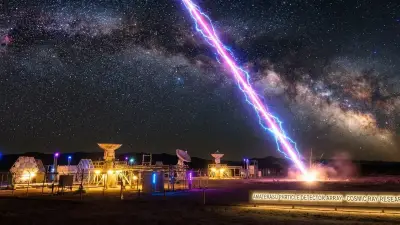
In November 2021, the Telescope Array in the Utah desert detected a particle carrying 244 EeV of energy — the second most energetic cosmic particle ever recorded. Named “Amaterasu” after the Japanese sun goddess, the mystery of its origin remains unsolved.
📖 Read more: Neutrinos: The Ghost Particles That Pass Through Everything
⚡ What Is Cosmic Radiation
Cosmic rays are high-energy particles — mostly protons and atomic nuclei — traveling through space at nearly the speed of light. They continuously bombard Earth, and their energy spectrum spans an enormous range. Most originate from the Sun and supernovae, but the most energetic ones — known as UHECRs (Ultra-High-Energy Cosmic Rays) — remain a mystery.
When a cosmic ray hits the atmosphere, it creates an “air shower” — billions of secondary particles that reach the ground across an area of several kilometers. This shower is what ground-based detectors actually measure.
☀️ The Amaterasu Particle
On November 27, 2021, the Telescope Array detector in Utah, USA recorded an event that left scientists speechless. A single particle carried energy of 244 EeV (2.44 × 10²⁰ eV) — energy 40 million times greater than what CERN produces.
The particle was named “Amaterasu” in honor of the Japanese sun goddess. The announcement was made in 2023, after data analysis was completed. To grasp the scale of energy: a subatomic particle carried the energy of a bowling ball traveling at 100 km/h.
😱 “Oh-My-God” — The Predecessor
Amaterasu is not the first such particle. In 1991, the Fly's Eye experimental observatory in Utah detected the famous “Oh-My-God” particle, with energy of 320 EeV — the most energetic ever recorded. Its name came from the scientists' reaction when they saw the data.
Amaterasu, at 244 EeV, ranks second. Both exceed by far the theoretical GZK limit — something that should not be possible according to known physics.
💡 GZK Limit: The Greisen–Zatsepin–Kuzmin limit (approximately 50 EeV) is the maximum energy a cosmic particle traveling great distances should have, due to interaction with the cosmic microwave background (CMB). Both the Oh-My-God and Amaterasu particles exceed this limit by 5-6 times!
📖 Read more: Dark Matter: The Invisible Force Shaping the Universe
❓ Where Did It Come From?
The most disturbing element is the arrival direction. Amaterasu appears to have come from a region of the sky that is... empty. There is no known galaxy, no active galactic nucleus (AGN), no known source. Only a cosmic void — a vast region with minimal matter.
This makes the mystery even deeper. At the highest energies, particles are not significantly deflected by magnetic fields, so the direction should point nearly toward the source. But there is nothing there.
🔭 How We Detect Cosmic Rays
The Telescope Array in Utah covers 700 square kilometers with 507 ground-based particle detectors and fluorescence telescopes that track the light emitted by particle showers in the atmosphere.
The Pierre Auger Observatory in Argentina is the world's largest cosmic ray detector, covering 3,000 square kilometers — roughly the size of Rhode Island. It uses 1,660 water tanks that detect Cherenkov light from secondary particles in air showers.
🔬 What It Means for Physics
Amaterasu raises open questions that challenge known physics. If the GZK limit holds, how do these particles reach Earth with such high energy? Possible explanations include new physics beyond the Standard Model, unknown acceleration mechanisms, or even the decay of exotic dark matter.
The fact that the origin points toward a cosmic void makes things even more puzzling. Either there is an unknown source we have not yet discovered, or the particle was deflected by some unknown mechanism, or we need entirely new physics to explain it. Amaterasu reminds us that the universe still hides deep mysteries.