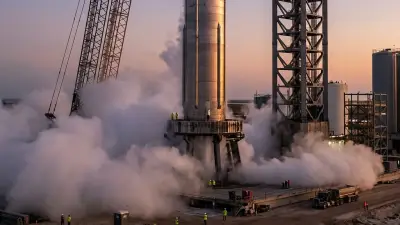
SpaceX has successfully completed four days of cryoproof testing on its next-generation Super Heavy booster at Starbase in Boca Chica, Texas. This critical milestone brings the most powerful rocket ever built one step closer to its next flight — and ultimately, to the Moon.
📖 Read more: History of Space Exploration: A Complete Timeline
🧊 What Is Cryoproof Testing?
Cryoproof testing is a critical verification process in which a rocket's propellant tanks are filled with cryogenic fluids at extremely low temperatures. The purpose is straightforward but vital: to confirm that the structure can withstand the extreme thermal conditions it will face during an actual flight.
Liquid oxygen (LOX), one of Starship's two cryogenic propellants, is stored at -183°C (-297°F), while liquid methane sits at -162°C (-260°F). At these temperatures, metals contract, sealing materials are pushed to their limits, and every weld must prove it can hold. The fact that the new Super Heavy booster passed this test over four consecutive days means its structural integrity has been verified and it can advance to the next pre-flight stages.
This is no mere formality. Each new generation of booster incorporates design changes, manufacturing improvements, and upgrades to the Raptor engines. The cryoproof test serves as the first major hurdle that a booster must clear before it can be mounted on the launch pad.
🚀 The Biggest Rocket Ever Built
SpaceX's Starship / Super Heavy system is the tallest and most powerful rocket ever constructed in human history. When fully stacked, it stands at 120 meters (394 feet) tall — taller than the Statue of Liberty. The vehicle consists of two primary stages: the Super Heavy booster (first stage) and the Starship spacecraft (upper stage).
The Super Heavy booster is powered by 33 Raptor engines burning methane and liquid oxygen, generating a combined thrust of approximately 7,590 tonnes — nearly double that of the Saturn V rocket that carried Apollo astronauts to the Moon. The upper stage, Starship itself, features 6 Raptor engines: 3 optimized for sea-level operation and 3 designed for the vacuum of space.
In expendable configuration, Starship can deliver over 100 tonnes of payload to low Earth orbit (LEO), while in reusable mode it exceeds 50 tonnes. These figures make it by far the most capable space transportation system ever designed.
🏗️ Starbase in Texas
All of this is happening at Starbase, SpaceX's sprawling facility at Boca Chica Beach on the southernmost tip of Texas, near the Mexican border. Starbase is not merely a launch site — it is a full-scale rocket manufacturing plant, a testing platform, and an innovation hub rolled into one. Boosters and Starships are built here, tested here, and launched here.
SpaceX follows a philosophy of rapid iteration that is rarely seen in the aerospace industry. Rather than spending years on design and simulations, the company builds, tests, and learns from failures. This approach led to multiple test flights throughout 2024-2025, with each one providing invaluable data to improve the system.
📖 Read more: Cosmic Radiation: The Invisible Threat to Astronauts
🏆 Milestone: SpaceX achieved one of the most spectacular moments in spaceflight history: catching the Super Heavy booster during landing using the launch tower's mechanical “chopsticks,” known as Mechazilla. This technique eliminates the need for heavy landing legs, reducing weight and increasing reusability potential.
The ability to catch a 70-meter booster mid-air represents a massive technological leap. It means the same booster could theoretically be repositioned on the launch mount, refueled, and launched again within hours rather than weeks or months.
🌙 Why This Takes Us to the Moon
The success of the cryoproof test is not just about Starship as a system — it is directly tied to NASA's Artemis program. SpaceX has been selected to build the Human Landing System (HLS) for the Artemis III mission, which will return astronauts to the lunar surface for the first time since the Apollo program.
However, using Starship as a lunar lander requires an additional and critical step: orbital refueling. Due to Starship's massive size and the fuel requirements for a lunar journey, multiple refueling flights in orbit will be needed before the HLS Starship can head to the Moon. This means SpaceX must demonstrate it can transfer propellant from one Starship to another while both are orbiting Earth.
Every successful test, like this cryoproof campaign, brings the moment closer when NASA can entrust the system with human missions. The reliability of every component — from tanks to engines — must be proven again and again.
🔮 What Comes Next
Following the successful completion of the cryoproof test, SpaceX is turning its attention to the next steps. Orbital refueling demonstrations are expected to be among the most critical phases, as propellant transfer technology has never been proven at this scale.
Notably, according to reports, Elon Musk appears to be pivoting his focus from Mars toward the Moon. SpaceX has already shifted its emphasis to building a self-growing city on the Moon — a vision that would require dozens, if not hundreds, of Starship launches.
To make this a reality, SpaceX is aiming for an unprecedented launch cadence: multiple launches per week, if not per day, from multiple launch sites. Full reusability of both the Super Heavy booster and Starship is the key to this goal — and today's cryoproof test is part of that journey.
Space exploration stands at an inflection point. With the tallest and most powerful rocket ever built passing its tests one by one, the era when humanity returns to the Moon — and stays there — looks closer than ever.