The year 2026 marks a new era in travel history: space is no longer the exclusive domain of government agencies. From suborbital flights lasting mere minutes to orbital stays around Earth, space tourism is becoming reality — albeit at astronomical prices. Which companies offer tickets, how much do they cost, and when will the average person be able to see Earth from above?
📖 Read more: Crew-12: ISS Gets a Full Crew After Emergency Return
🎈 Suborbital Flights
Blue Origin and its New Shepard vehicle offers suborbital flights reaching above the Kármán line (100 km), lasting approximately 11 minutes. Passengers experience several minutes of weightlessness and views of Earth's curvature. Cost: $200,000–$300,000 per seat.
Virgin Galactic with SpaceShipTwo offers a similar experience — flight to the edge of space (~86 km) with a few minutes of microgravity. Cost: ~$450,000 per ticket. The experience includes astronaut training and departure from a conventional airport.
Space Perspective offers a gentler alternative: a high-altitude balloon reaching ~30 km (stratosphere). The goal isn't microgravity but the view. Cost: ~$125,000 — the most affordable option available.
📊 Suborbital Flight Comparison:
🔵 Blue Origin: $200–300K | 100+ km | 11 minutes | Microgravity
🟣 Virgin Galactic: ~$450K | ~86 km | 90 minutes | Microgravity
🎈 Space Perspective: ~$125K | ~30 km | 6 hours | No microgravity
📖 Read more: New Glenn: Blue Origin's Giant Reusable Rocket
🛸 Orbital Flights
For the complete space experience, SpaceX offers orbital flights aboard Crew Dragon. The 2021 Inspiration4 mission was the first all-civilian orbital flight, opening new frontiers. The Polaris program (Dawn and Dusk missions) continues this tradition.
Axiom Space organizes missions to the ISS, costing $55 million per seat. Private astronauts stay at the Station for 8–14 days, participating in scientific experiments and experiencing life in space.
📖 Read more: SpaceX Starship: Super Heavy Aces Cryoproof Testing
🏨 Space Hotels
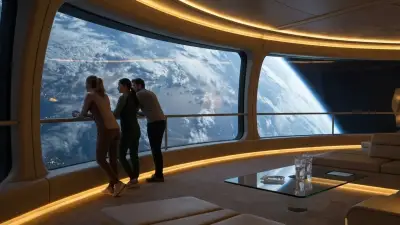
The future of space tourism extends beyond flights. Vast is developing Haven-1, the first commercial space station capable of hosting private visitors. Orbital Assembly is designing the Voyager Station — a true space hotel with artificial gravity through rotation, resembling a cruise ship more than a space station.
Even if these plans sound futuristic, the first commercial modules are expected to operate within the decade, paving the way for an entirely new hospitality industry.
📖 Read more: Starlink: SpaceX's Global Satellite Internet Revolution
🚀 The Future: Starship and Beyond
SpaceX's Starship promises to fundamentally change the economics of space. With full reusability and massive capacity, it could dramatically reduce the cost per kilogram to orbit. SpaceX has even presented the concept of point-to-point Earth travel via Starship — London to Sydney in 30 minutes.
🎈 Suborbital
Minutes in space, Earth views, microgravity
🛸 Orbital
Days in orbit, ISS, full astronaut experience
🌙 Lunar
Fly around the Moon, Starship, future plans
🏨 Hotel
Stay at a commercial station, artificial gravity
📖 Read more: Vulcan Rocket: ULA's Troubled Path to Orbit
💰 Is It Worth the Cost?
The first space tourist, Dennis Tito, paid $20 million in 2001. Since then, over 40 private individuals have traveled to space. The trend is clear: costs are declining, options are multiplying, and access is broadening. In 10–15 years, a suborbital trip may cost as much as a luxury cruise.
📉 Cost Trend: In 2001, a ticket to the ISS cost $20M. Today, Space Perspective offers stratospheric views for $125K. Within a decade, we may be talking about tens of thousands of dollars — a historic cost reduction.