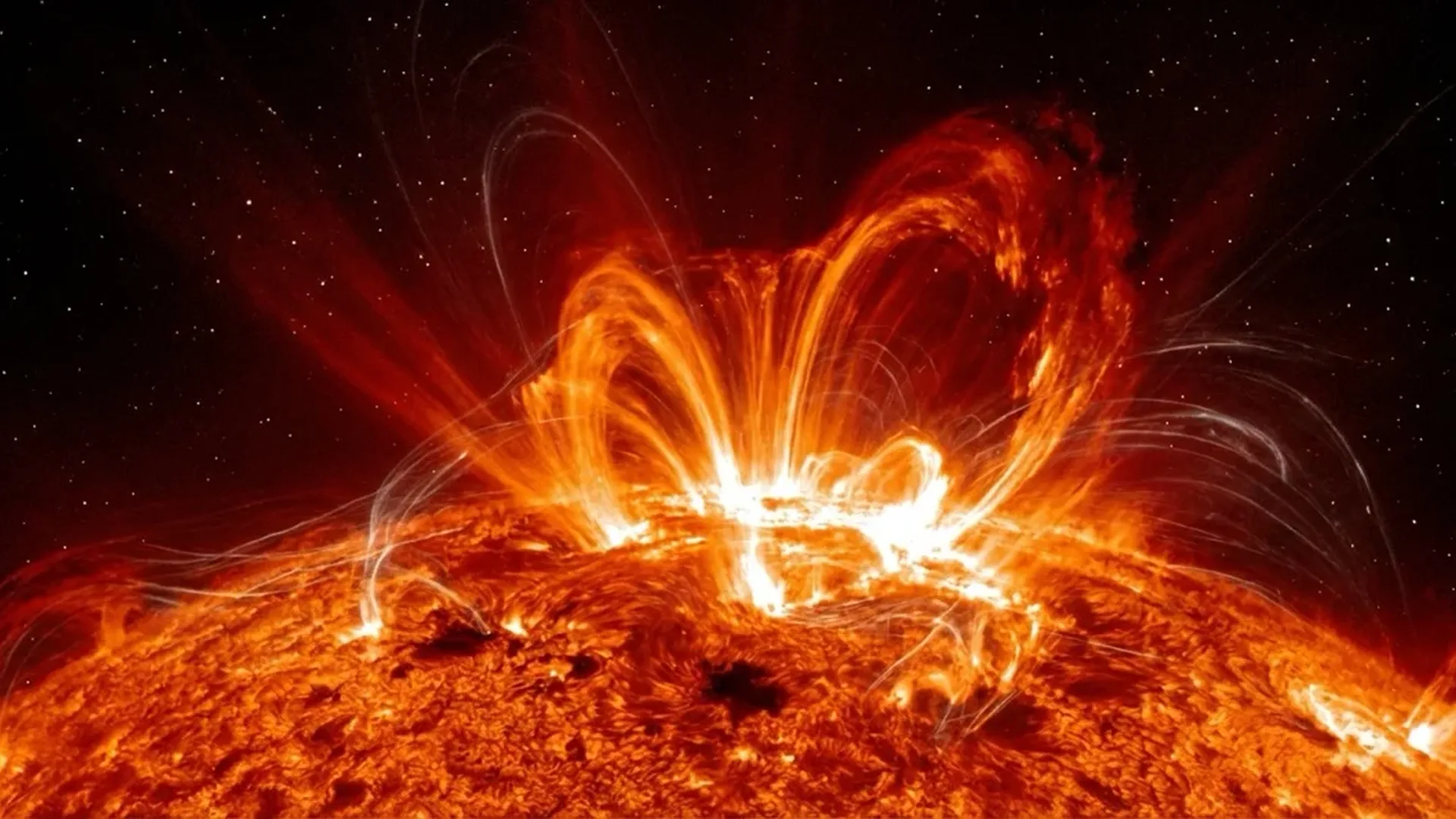
Solar storms are among the most serious natural threats to modern technology — from GPS and communication satellites to power grids and astronauts in space. Researchers are now using artificial intelligence and deep learning to predict geomagnetic storms up to 24 hours in advance — a massive improvement over the 30-60 minutes that older methods could provide.
📖 Read more: Solar Flares and Storms: The Sun's Invisible Dangers
🔭 What Are Solar Storms?
The Sun continuously emits a stream of charged particles known as the solar wind. Periodically, violent eruptions on its surface — called solar flares — and massive plasma blasts known as Coronal Mass Ejections (CMEs) send billions of tons of magnetized plasma hurtling toward Earth at speeds exceeding 1,000 km/s.
When these particles reach Earth's magnetosphere, they can trigger geomagnetic storms: electrical currents in the upper atmosphere that affect everything from telecommunications to navigation and power distribution networks.
🔭 The Problem: Too Little Warning Time
Until recently, solar storm prediction relied mainly on coronagraphs — satellites monitoring the Sun in real time. CMEs take 1-3 days to reach Earth, but information only became reliable 30-60 minutes before impact, when particles passed the DSCOVR satellite at the L1 Lagrange point.
That time window is woefully inadequate for infrastructure protection: activating safeguards on satellites or power grids requires far more lead time. Both NASA and ESA have long recognized that space weather prediction is a critical priority.
"Space weather can affect modern technological infrastructure worldwide — timely prediction isn't a luxury, it's a necessity."
🔭 The Solution: AI and the DAGGER Model
NASA researchers developed DAGGER (Deep Learning Geomagnetic Perturbation), a deep learning model that analyzes real-time solar wind data and predicts geomagnetic disturbances 30 minutes to 24 hours before they reach Earth. Unlike traditional models, AI recognizes complex patterns in the data that human analysts cannot detect.
The system was trained on decades of historical data from the ACE, DSCOVR, and SDO spacecraft. It can produce global predictions in under one second, covering the entire terrestrial magnetosphere instead of individual points — something impossible for previous models.
💡 Why AI Makes the Difference
Traditional prediction models use MHD (magnetohydrodynamics) physics equations that require enormous computing power and hours of runtime. Deep learning neural networks deliver results in real time, making continuous monitoring and automatic alerts to satellite and grid operators feasible.
🔭 What's at Risk Without Prediction
The consequences of a powerful geomagnetic storm without warning can be devastating:
Satellites: Charged particles damage electronic circuits, cause disorientation, and can even destroy satellites permanently. In February 2022, a geomagnetic storm destroyed 40 SpaceX Starlink satellites during launch.
Power grids: Geomagnetically induced currents (GIC) can overload high-voltage transformers. The March 1989 storm caused a total blackout in Quebec, Canada, leaving 6 million people without power for 9 hours.
Aviation and GPS: The ionosphere distorts, causing GPS errors of several dozen meters and radio communication “dead zones” on polar routes.
🛰️ Observation Satellites
DSCOVR, SDO, and ACE provide real-time solar wind data. New missions like NASA's ESCAPADE will study space weather between Earth and Mars.
⚡ The Carrington Event (1859)
The most powerful recorded solar storm. Today, an equivalent event would cause trillions of dollars in damage to satellites and power grids worldwide.
🔄 Solar Cycle 25
The current solar cycle is approaching its maximum, increasing the frequency of CMEs and solar flares. Prediction has never been more critical.
🔭 What's Next — The Future of Prediction
NASA is building a comprehensive space weather system combining AI, multi-point satellites, and data from missions across the solar system. The ESCAPADE mission will study how the solar wind interacts with Mars — critical for future Artemis missions and eventual crewed flights to the Red Planet.
Meanwhile, NASA's Space Umbrella Project — a citizen science initiative — invites volunteers to analyze magnetosphere data from the MMS mission, helping map Earth's magnetic shield. Solar storm prediction is entering a new era: from reaction to prevention.
📚 Sources
- NASA Heliophysics Division — Space Weather Research & Missions
- NOAA Space Weather Prediction Center — Official Space Weather Forecasts
- NASA — “ESCAPADE Ready to Study Space Weather from Earth to Mars” (2026)
- Universe Today — “Map the Earth's Magnetic Shield with the Space Umbrella Project” (February 2026)