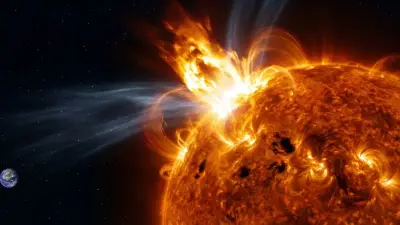
The Sun may appear calm and steady from Earth, but its surface is a battlefield of magnetic forces producing immense eruptions of energy — solar flares. These flares, along with Coronal Mass Ejections (CMEs), represent the most violent expressions of space weather and can seriously impact our technology-dependent civilization.
☀️ What Are Solar Flares
Solar flares are sudden bursts of light and radiation emanating from the Sun's surface. They are classified into five categories based on X-ray intensity: A, B, C, M, and X. Class A flares are the weakest, while X-class flares are the most powerful — each category is ten times stronger than the previous one.
Coronal Mass Ejections (CMEs) are a separate phenomenon altogether. These are massive bubbles of plasma and magnetic fields ejected from the solar corona into space. While a solar flare travels at the speed of light and reaches Earth in 8 minutes, a CME takes 1-3 days. When a CME is directed toward Earth, it can trigger geomagnetic storms that wreak havoc on our technological infrastructure.
⚡ The Carrington Event — 1859
The strongest recorded geomagnetic storm occurred in September 1859 and is known as the “Carrington Event,” named after British astronomer Richard Carrington who observed the solar flare. The CME that followed reached Earth in just 17.6 hours — extraordinarily fast.
The consequences were dramatic: aurora appeared at tropical latitudes, even in Cuba and Colombia. Telegraph lines caught fire, and some telegraph operators reported being able to send messages even without power — the geomagnetic energy was sufficient. If such an event occurred today, the consequences would be catastrophic for our interconnected world.
🌍 May 2024 — The G5 Storm
In May 2024, Earth experienced the strongest geomagnetic storm since 2003. It was classified as G5 — “extreme” on the NOAA scale — following multiple powerful CMEs launched from an active sunspot region.
The aurora (northern and southern lights) was visible at unusually low latitudes around the world: in Mexico, Southern Europe, and even North Africa. Millions of people saw the aurora for the first time in their lives. Fortunately, power grids and satellites experienced only minor disruptions, but the event served as a stark reminder of our vulnerability.
💰 Estimated cost of a Carrington-level event today: $1-2 trillion, with months of recovery time. Power grids, telecommunications, GPS, and thousands of satellites would all be at risk.
⚠️ Dangers to Earth
Solar storms affect multiple systems on Earth. Satellites can suffer damage or total loss — in February 2022, SpaceX lost approximately 40 Starlink satellites due to increased atmospheric drag from a geomagnetic storm. GPS can lose accuracy, affecting navigation, precision agriculture, and financial transactions.
Power grids are particularly vulnerable: in March 1989, a geomagnetic storm caused a blackout across Quebec, Canada, leaving 6 million people without power for 9 hours. Radio communications, especially HF frequencies, can be completely disrupted. Astronauts on the ISS face increased radiation risk, while flights over the poles are rerouted during strong solar events.
🛡️ Space Weather Forecasting
Space weather forecasting is critical for protecting our infrastructure. NOAA's Space Weather Prediction Center (SWPC) continuously monitors the Sun and issues warnings for solar flares and CMEs. The ESA also maintains its own space weather service in Europe.
However, forecasting remains challenging. While we can detect a solar flare almost immediately, predicting whether a CME will hit Earth is only possible 1-3 days in advance. In July 2012, a massive CME — equivalent to the Carrington Event — passed through Earth's orbit but missed us by just 9 days. It was pure luck.
🚀 Parker Solar Probe
To better understand the Sun, NASA launched the Parker Solar Probe in 2018. This spacecraft has approached the Sun to within just 7.3 million kilometers — closer than any other human-made object in history. It travels at speeds exceeding 600,000 km/h.
The Parker Solar Probe studies the solar wind, magnetic fields, and the mechanisms that heat the solar corona to millions of degrees — far hotter than the surface itself. ESA's Solar Orbiter complements the mission, studying the Sun's poles for the first time. Their combined data is significantly improving space weather prediction models, offering hope for better protection in the future.