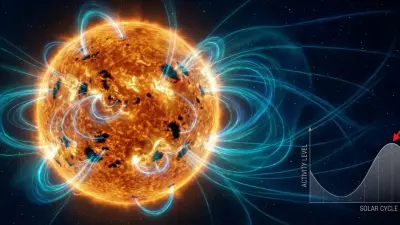
The Sun follows a rhythmic cycle of activity that affects everything — from satellites to the northern lights. Solar Cycle 25 has proven far stronger than predictions, delivering surprises as it peaks through 2025-2026.
📖 Read more: AI Predicts Solar Storms 24 Hours Before They Hit Earth
☀️ What Is the Solar Cycle
The solar cycle is a period of approximately 11 years during which the Sun's activity rises and falls. It was discovered by German astronomer Heinrich Schwabe in 1843 through observation of sunspots. Every 22 years, the Sun's magnetic field completely reverses its polarity, making two 11-year cycles one complete magnetic cycle. During solar maximum, sunspot numbers peak, leading to more flares, CMEs, and aurora activity.
📈 Cycle 25 — Surprises
Solar Cycle 25 began in December 2019. NASA and NOAA initially predicted a weak cycle with a maximum sunspot number (SSN) of approximately 115. However, Cycle 25 has proven much stronger than expected. The sunspot count has significantly surpassed predictions, reaching SSN above 200 — nearly double the forecast. This unexpected surge has produced more frequent and intense solar flares, coronal mass ejections, and geomagnetic storms than scientists anticipated.
🌅 Aurora Everywhere
One of the most spectacular consequences of the strong solar maximum is aurora at low latitudes. In May 2024, the G5 storm made the aurora visible at tropical latitudes worldwide. Millions of people saw the aurora for the first time in their lives — in Greece, Italy, Mexico, and across the southern United States. As Cycle 25 remains strong through 2026, more opportunities for low-latitude aurora displays are expected, particularly during the remaining months near solar maximum.
⚠️ Impacts
Solar maximum means more solar flares, CMEs, and geomagnetic storms. Satellites experience increased atmospheric drag — the heat from solar activity expands the atmosphere to greater altitudes, slowing satellites in low orbit. GPS can lose accuracy, and power grids are vulnerable to surges. The Van Allen radiation belts become enhanced, increasing radiation exposure for astronauts on the ISS and passengers on polar flight routes.
🛰️ Starlink Losses: In February 2022, SpaceX lost approximately 40 Starlink satellites just one day after launch, due to a geomagnetic storm that expanded the atmosphere and increased drag. Cost: millions of dollars.
❄️ Maunder Minimum
The Sun hasn't always been this active. From 1645 to 1715, virtually no sunspots were observed — a period known as the Maunder Minimum. This period coincides with the “Little Ice Age” in Europe, characterized by extremely cold winters, frozen rivers, and crop failures. While the exact connection is still debated by researchers, the correlation is striking and highlights how solar activity can influence conditions on Earth.
🔮 What to Expect
Solar Cycle 25 is expected to begin declining toward late 2026. As we move toward solar minimum, solar flares and aurora will gradually decrease. Cycle 26 is expected to begin around 2030, but predictions for its intensity are still premature — as Cycle 25 demonstrated, the Sun can surprise us. In the meantime, the remainder of 2026 still offers opportunities for impressive aurora displays and strong solar activity before the quiet years ahead.