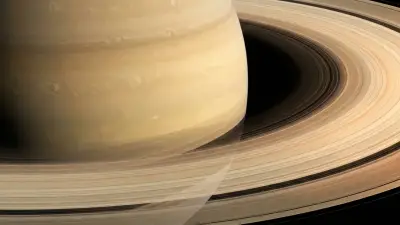
Saturn's rings are perhaps the most recognizable sight in our solar system. For centuries, astronomers assumed they had been there since the planet's birth, 4.5 billion years ago. The Cassini mission, which spent 13 years studying Saturn, upended that theory — and revealed that the iconic rings are young, temporary, and in a few hundred million years will disappear entirely.
📖 Read more: James Webb Maps Uranus Auroras in 3D for the First Time
💍 Anatomy of the Rings
Saturn's rings are composed of 90% water ice, with small amounts of dust and rock. They span 400,000 kilometers in width — roughly the distance from Earth to the Moon — but their thickness is astonishingly small: just 10 to 30 meters. If the rings were a sheet of paper, the ratio would be like an A4 page stretched across an entire football field.
The particles range in size from microscopic grains to house-sized boulders. Each particle follows its own orbit around Saturn, creating a dynamic system in constant motion. The main rings (A, B, C) are visible even with a small telescope, while fainter rings (D, E, F, G) were only detected by close-up missions.
🔬 The Cassini Revelation
The Cassini-Huygens mission, launched in 1997 and operational at Saturn from 2004 to 2017, radically changed our understanding. The most shocking discovery: the rings are young — only about 100 million years old. In planetary terms, that means they formed during the age of dinosaurs, not alongside Saturn.
📖 Read more: Hubble Space Telescope: 35 Years of Cosmic Discovery
This discovery was based on mass measurements during the Grand Finale — Cassini's final 22 dives between Saturn and its rings. By measuring gravitational effects, scientists calculated that the rings' mass is much lower than expected — a sign of youth. If they were ancient, they would have accumulated far more dust and would appear darker.
Cassini also discovered the phenomenon of "ring rain": material continuously falls from the rings into Saturn's atmosphere. This steady mass loss means the rings won't last forever.
🌙 Moons and Gaps
Hidden within the rings are tiny moonlets that shape their structure. Pan, just 28 km in diameter, orbits within the Encke Gap, creating “propeller” patterns in surrounding particles. Daphnis, even smaller at 8 km, carves wavy edges in the Keeler Gap as its gravity tugs on particles.
🅰️ A Ring
The outer visible ring. Contains the Encke Gap (325 km wide) and the Keeler Gap. Home to the tiny “shepherd” moons Pan and Daphnis.
📖 Read more: The Asteroid Belt: How Sparse Is It and What Does It Hide?
🅱️ B Ring
The densest and brightest ring. Contains the greatest mass of material and is nearly opaque to light — making it difficult to measure before Cassini.
🔵 C Ring
The most transparent inner ring. Faint and dark, visible only in close-up photos. It feeds the “ring rain” as material falls toward Saturn.
💎 F Ring
A narrow, bright ring outside the A ring. The moons Prometheus and Pandora “guard” it, creating fascinating spiral patterns.
⏳ The Rings Are Disappearing
Ring rain is not a slow process. Every second, thousands of kilograms of material fall from the rings into Saturn's atmosphere. At this rate, scientists estimate the rings will vanish completely in 100 to 300 million years.
📖 Read more: Voyager 1: The Farthest Human-Made Object in Space
This means we live in a remarkably lucky era. If an astronomer had observed Saturn 200 million years ago — or 300 million years from now — they would see no rings at all. Saturn without its rings would be just another gas giant, with nothing to visually set it apart.
🎬 Grand Finale — 22 Dives into the Unknown: In September 2017, after 13 years at Saturn, Cassini performed 22 dives between the planet and its rings — a zone no spacecraft had ever explored. These dives produced the most precise data on the rings' mass, composition, and age. In the end, Cassini deliberately plunged into Saturn's atmosphere, sending data until its very last moment.
🔭 Cassini's Legacy
In 20 years of operation (1997–2017), the Cassini-Huygens mission radically changed our understanding of Saturn and its moons. It discovered oceans beneath the ice of Enceladus, methane lakes on Titan, and revealed that the rings are young and temporary.
Although no successor mission is currently scheduled, Cassini's data continues to be analyzed and produce new discoveries. Saturn, with its 146 known moons — the most in the solar system — remains a system full of mysteries waiting to be revealed.