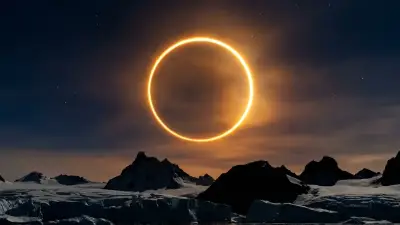
2026 will be an exceptional year for eclipse enthusiasts. Two major solar eclipses will occur within just a few months — an annular eclipse in February and a total eclipse in August. These cosmic spectacles remind us of the remarkable precision of celestial mechanics.
📖 Read more: Meteor Showers 2026: Your Complete Guide
🔥 What Is an Annular Eclipse
An annular solar eclipse occurs when the Moon is too far from Earth (near apogee) to fully cover the Sun. The result is a brilliant ring of light — the famous “ring of fire” — surrounding the Moon's dark silhouette. The Moon is 400 times smaller than the Sun but 400 times closer, creating an almost perfect match in apparent size. When the Moon is slightly farther away, it cannot completely cover the solar disk, and the annular ring appears.
🌑 February 2026 — Ring of Fire
On February 17, 2026, an annular eclipse will be visible from Antarctica, southern Argentina, the southern Atlantic, and parts of Africa. The Moon's shadow will sweep across these regions, creating a spectacular ring of fire in the sky. For those in these areas, it will be an unforgettable sight — provided they use proper solar filters.
📖 Read more: Total Lunar Eclipse March 2026: When and Where to See It
☀️ August 2026 — Total Eclipse
On August 12, 2026, a total solar eclipse will be visible from arctic Russia, Greenland, Iceland, Spain, and Portugal. The path of totality will pass through Valencia, Spain, making the country the prime tourist destination for eclipse chasers. During totality, the Moon completely covers the Sun, revealing the solar corona — the Sun's mysterious outer atmosphere. This will be the most accessible total solar eclipse for European observers in years.
💍 Diamond Ring Effect
One of the most stunning phenomena during a total eclipse is the “diamond ring” effect. It occurs just before and after totality, when a small beam of sunlight shines through the valleys on the Moon's limb. “Baily's beads” appear when multiple such beams of light are visible simultaneously. During totality itself, the solar corona radiates around the Moon, creating an ethereal halo that can only be seen during these brief moments.
⚠️ Safety Warning: Never look directly at the Sun without solar filters — even during a partial or annular eclipse. Only during totality is it safe to look with the naked eye. Use certified eclipse glasses (ISO 12312-2) at all other times.
📖 Read more: Comet ATLAS and the Most Spectacular Comets of Our Era
📅 How to Prepare
If you plan to watch the August 2026 total eclipse, Spain offers the best conditions: good weather, easy access, and excellent infrastructure. Book accommodations early, as demand will be enormous. Get certified eclipse glasses or solar filters for cameras and telescopes. Check the weather forecast a few days before and stay flexible with your location — a single cloud can ruin the view.
🔭 The Science Behind Eclipses
Eclipses are not just spectacles — they are invaluable scientific tools. During total eclipses, astronomers can study the solar corona without artificial blocking. The most famous scientific story involving eclipses is from 1919, when a total eclipse was used to confirm Einstein's General Theory of Relativity — stars near the Sun appeared displaced due to spacetime curvature. The 2024 total eclipse across North America attracted over 40 million people to the path of totality, proving that these cosmic events continue to captivate humanity.