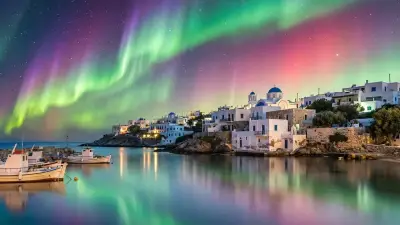
In May 2024, thousands of Greeks looked up at the sky and saw something that generations considered impossible: the northern lights above Greece. How did this happen? And will it happen again?
📖 Read more: S4 Solar Storm Hits Earth: The Strongest in 20+ Years
🌌 Northern Lights in Greece?
On May 10–11, 2024, a series of powerful coronal mass ejections (CMEs) slammed into Earth's magnetosphere. The result was the strongest geomagnetic storm in over 20 years — rated G5 (extreme), the highest level on the scale.
The aurora became visible across almost all of Europe, including Greece. Photographs from Thessaloniki, Macedonia, and Thrace showed pink, red, and purple colors on the northern horizon. The phenomenon was also visible from Turkey, Spain, and Italy.
🔬 How Auroras Form
The aurora borealis is created when charged particles from the Sun (mainly protons and electrons) strike Earth's magnetosphere. These particles are channeled along the magnetic field lines toward the poles, where they enter the upper atmosphere.
There, they collide with oxygen and nitrogen atoms, transferring energy to them. When these atoms return to their normal state, they emit light — and that light is the aurora. During powerful storms, the auroral oval expands toward the equator, making it visible even in the Mediterranean.
🎨 Colors of the Aurora
Each color reveals a different chemical element and altitude:
- Green: The most common color. Produced by oxygen atoms at ~100 km altitude.
- Red: Also oxygen, but at higher altitudes (>200 km). This is the color most commonly seen from Greece, as it's the highest and visible from the greatest distance.
- Purple/Blue: Produced by nitrogen atoms. Rarer and usually visible at the lower edge of the aurora.
☀️ Solar Cycle 25
The Sun follows an activity cycle of approximately 11 years. We are currently in Solar Cycle 25, which began in 2019 and is near its peak (solar maximum). This phase means more solar flares, more CMEs, and more frequent geomagnetic storms.
Cycle 25 has proven stronger than scientists predicted. This means that G4 and G5 events are possible in 2025–2026, providing more opportunities for aurora sightings in Southern Europe.
The Kp Index: Geomagnetic activity is measured by the Kp index (0–9). For the aurora to be visible in Southern Europe and Greece, a level of Kp7+ is needed. On May 10, 2024, the index reached Kp9 — the maximum possible.
📍 Where in Greece
Greece lies at latitudes 35°–41° N, far south of the usual aurora zones. For the best chances:
- Thessaloniki and Macedonia: The northernmost part of Greece, with an open horizon toward the north.
- Thrace: Exceptionally dark skies, ideal conditions.
- Other areas: Anywhere far from light pollution with a clear view to the north.
Important: the aurora in Greece is often not visible to the naked eye as it is in Scandinavia — it appears as a faint pink/red glow on the horizon, but cameras capture it much better.
📸 How to Photograph It
If the aurora appears over Greece again, here's how to capture it:
- Camera: DSLR or mirrorless with manual settings (or at least a smartphone with night mode)
- Lens: Wide-angle (14–24mm), wide aperture (f/2.8 or less)
- ISO: 1600–3200
- Exposure: 10–25 seconds
- Tripod: Essential for a stable image
- Direction: Face north, away from city lights
Monitor spaceweather.com and the Aurora Alerts app regularly for real-time notifications. With Solar Cycle 25 still near its peak, the chances of seeing aurora in Greece again are the highest they've been in decades.