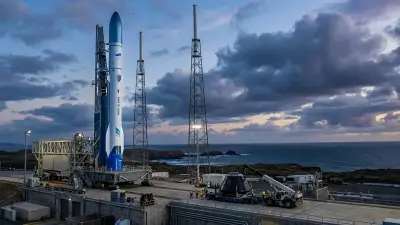
The New Glenn has arrived — Blue Origin's giant reusable rocket is reshaping the space launch industry. Standing 98 meters (320 feet) tall with 7 BE-4 engines and a first stage designed for at least 25 flights, New Glenn is Blue Origin's answer to SpaceX's Falcon 9. Beyond its impressive specifications, this rocket represents a new era of competition in orbital launches — an era where access to space becomes cheaper, more reliable, and more accessible than ever before.
🚀 A Giant at Cape Canaveral
New Glenn is named after John Glenn — the first American astronaut to orbit the Earth, in February 1962. It is one of the largest launch vehicles ever built: at 98 meters (320 feet) tall, it towers over the Falcon 9 and directly rivals the titans of modern rocketry. Its presence on the launch pad is nothing short of breathtaking — a towering metallic structure dominating the Florida skyline.
Blue Origin invested over $1 billion to completely rebuild Launch Complex 36 (LC-36) at Cape Canaveral Space Force Station. This marks the first full pad reconstruction at the Cape since the 1960s, when Atlas rockets launched from that very spot. The modern infrastructure includes a next-generation launch pad, service tower, and state-of-the-art payload processing facilities.
The rocket is manufactured at Blue Origin's facility in Exploration Park, near Kennedy Space Center — a location purpose-built for mass production of large launch vehicles. The engines are built at two facilities: Kent, Washington, where Blue Origin's primary development headquarters is located, and Huntsville, Alabama, near NASA's Marshall Space Flight Center.
🔧 BE-4 and BE-3U Engine Technology
At the heart of New Glenn are its BE-4 engines — seven massive powerplants on the first stage, each producing 640,000 pounds-force (2,850 kN) of thrust. They burn liquefied natural gas (LNG) and liquid oxygen (LOX), a propellant combination considered the future of rocket technology. Compared to traditional kerosene (RP-1), LNG is cleaner, more affordable, and leaves minimal soot deposits on engine components — a critical advantage for reusability. Deep throttle capability enables precise thrust control during both ascent and controlled first-stage landing.
Notably, the BE-4 engines aren't exclusive to New Glenn. United Launch Alliance (ULA) adopted them for the Vulcan rocket, replacing the Russian-made RD-180 engines that powered the Atlas V. According to Ars Technica, the BE-4 engines effectively “saved” Vulcan from failure during its second test flight — a remarkable testament to their reliability that significantly boosted confidence in the technology.
The second stage is equipped with two BE-3U engines, each producing 200,000 pounds-force of vacuum thrust. They run on liquid hydrogen (LH2) and liquid oxygen, delivering a higher specific impulse (Isp) for optimal performance in space. Crucially, they are fully restartable, enabling multiple orbital insertions in a single mission — ideal for complex missions requiring maneuvers across different orbital planes.
📦 What New Glenn Carries
One of New Glenn's greatest advantages is its 7-meter payload fairing — nearly double the internal volume of standard 5-meter class fairings used by most competitors. This means it can accommodate massive satellites, astronomical telescopes, or multiple payloads simultaneously on a single launch. Capacity reaches 45 metric tons to low Earth orbit (LEO) and over 13 metric tons to geostationary transfer orbit (GTO).
🛰️ Amazon Kuiper
The primary customer for New Glenn. Amazon plans to launch thousands of broadband internet satellites for global coverage, in direct competition with SpaceX's Starlink constellation.
🔴 NASA ESCAPADE
A scientific mission to Mars studying the red planet's magnetosphere and atmospheric escape processes.
📱 AST SpaceMobile
Direct-to-cell satellites providing mobile phone connectivity from space to standard handsets without any specialized equipment.
🛡️ US Military
National security payloads — New Glenn is certified for National Security Space Launch (NSSL) missions for the Department of Defense.
🌍 Why New Glenn Matters
Until recently, SpaceX held a near-monopoly on reusable orbital launches with the Falcon 9. New Glenn fundamentally changes that equation. It offers a larger fairing, greater payload capacity, and the same reusability philosophy — but at a significantly bigger scale. For launch customers, this means more options, more competitive pricing, and less dependence on any single provider. Healthy competition in the space industry ultimately benefits everyone — from governments to commercial companies and research institutions.
💡 Reusability: Each New Glenn first stage is designed to fly at least 25 times. After separation from the second stage, the first stage performs a controlled return and lands on a floating platform at sea, 1,000 kilometers (620 miles) downrange from Cape Canaveral. This approach dramatically reduces the cost of access to space, making frequent launches economically viable at an unprecedented scale.
Furthermore, New Glenn eliminates American dependence on Russian-made rocket engines — a critical geopolitical advantage in an era of rising international tensions. For decades, rockets like the Atlas V relied on Russian RD-180 engines. The BE-4 engines are entirely American-designed and manufactured, with production lines in Kent, Washington and Huntsville, Alabama — ensuring full autonomous access to space for the United States, both commercially and militarily.
🔭 Blue Origin's Next Act
Blue Origin isn't stopping with New Glenn. The company has already completed two successful orbital launches — the NG-1 and NG-2 missions — proving that the rocket is no longer a theoretical design but an operational reality. With each flight, the company collects critical data to optimize the vehicle and increase its reliability. Future variants, such as the New Glenn 9X4, are expected to further expand the rocket's capacity and capabilities.
Meanwhile, Blue Origin is actively competing for NASA's lunar lander contract under the Artemis program (Artemis V and beyond), putting it in direct confrontation with SpaceX and Starship. Jeff Bezos, Blue Origin's founder, has publicly expressed his lunar ambitions — and according to reports, he hasn't missed an opportunity to troll Elon Musk about Moon plans. The rivalry between the two billionaires is fueling a competition that benefits the entire space industry.
In January 2026, Blue Origin announced the permanent end of its New Shepard suborbital tourism program. The decision signals the company's decisive pivot from tourist flights to serious commercial and scientific spaceflight — with New Glenn standing at the absolute center of that transformation. This is no longer a company sending tourists to the edge of space, but a serious contender in the orbital launch business.
New Glenn isn't just a rocket. It's a statement of intent from a company that aims to become an equal player in the space launch industry — and perhaps, ultimately, change the rules of the game for good.