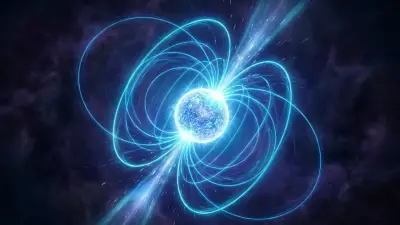
Imagine an object the size of a small city — just 20 kilometers across — that contains more mass than our Sun. This is a neutron star: the densest object in the universe after black holes, born from the wreckage of a dead star.
📖 Read more: Neutron Stars: Why Are They Called Zombie Stars?
🌟 Born from Death
Neutron stars form when a massive star (8 to 25 solar masses) exhausts its nuclear fuel and explodes as a supernova. The core, which survived the explosion, collapses under gravity into an unimaginably dense object. Protons and electrons are forced to merge, forming neutrons — hence the name.
What keeps a neutron star from collapsing further isn't thermonuclear fusion, but neutron degeneracy pressure — a quantum force that prevents neutrons from occupying the same quantum state.
💫 Pulsars — Cosmic Lighthouses
Many neutron stars spin at terrifying speeds — some hundreds of times per second. As they rotate, they emit beams of radiation from their magnetic poles. If Earth happens to be in the path of these beams, we detect regular pulses — like a cosmic lighthouse. These neutron stars are called pulsars.
The first pulsar was discovered in 1967 by Jocelyn Bell Burnell during her doctoral research. The pulses were so regular that it was initially designated “LGM-1” (Little Green Men). The fastest known pulsar, PSR J1748-2446ad, spins 716 times per second — its surface moves at 24% the speed of light.
🧲 Magnetars — The Strongest Magnets
Magnetars are a special class of neutron stars with extreme magnetic fields — approximately 1015 gauss, the strongest in the universe. For comparison, a typical refrigerator magnet measures about 100 gauss.
These fields are so powerful they can deform the star itself, causing “starquakes” that release enormous gamma-ray bursts. One such flare from SGR 1806-20 in 2004 was so powerful it affected Earth's ionosphere — from a distance of 50,000 light-years.
📖 Read more: Black Holes: How Are They Formed?
💥 Neutron Star Collisions
In August 2017, the gravitational wave detectors LIGO and Virgo recorded the signal GW170817 — the collision of two neutron stars 130 million light-years away. It was the first “multi-messenger” detection in history: gravitational waves AND electromagnetic radiation simultaneously.
This collision confirmed that neutron star mergers create heavy elements through the so-called “r-process” nucleosynthesis — gold, platinum, uranium, and many more.
🥄 A single teaspoon of neutron star material would weigh approximately 1 billion tonnes — the weight of a mountain. If you dropped it on Earth's surface, it would sink straight through the planet.
🔬 What Lies Inside
The internal structure of a neutron star remains a mystery. The pressure at the core is so extreme that physicists suspect neutrons may dissolve into their constituent particles — quarks — forming “quark matter.” Even more exotic is the hypothesis of “strange matter,” a form of matter containing strange quarks that may be the most stable form of matter in the universe.
❓ Open Questions
What is the maximum mass a neutron star can sustain before collapsing into a black hole? The answer depends on the “equation of state” of nuclear matter — a problem that remains unsolved. Each new gravitational wave detection brings us closer to the answer, but fully understanding these objects requires physics we haven't yet discovered.