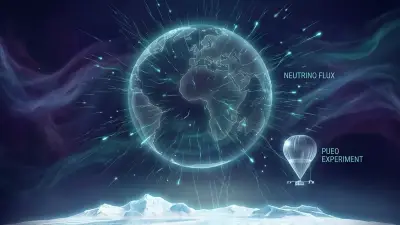
Every second, 65 billion neutrinos pass through every square centimeter of your body — without touching a thing. These “ghost particles” are the most enigmatic constituents of the universe — and simultaneously the key to fundamental mysteries of physics.
👻 What Are Neutrinos
Neutrinos are elementary particles with nearly zero mass and no electric charge. They do not interact with the electromagnetic force or the strong nuclear force — only with the weak nuclear force and gravity. This makes them effectively invisible.
There are three “flavors” of neutrinos: electron, muon, and tau. Each flavor is associated with its corresponding charged lepton: the electron, muon, and tau particle. The astonishing thing is that neutrinos can change flavor as they travel — a phenomenon known as neutrino oscillation.
Sources of neutrinos are everywhere: the Sun (nuclear fusion), supernovae, cosmic rays, the Big Bang (cosmic neutrino background), and even nuclear reactors on Earth.
🔄 Neutrino Oscillation
For decades, physicists believed neutrinos had no mass. In 1998, the Super-Kamiokande experiment in Japan proved that neutrinos oscillate — they change flavor as they travel. This is only possible if they have mass — even if extraordinarily small.
This discovery was awarded the Nobel Prize in Physics 2015, given to Takaaki Kajita (for Super-Kamiokande) and Arthur McDonald (for SNO in Canada). Neutrino oscillation was the first evidence of physics beyond the Standard Model — proving that the model is incomplete.
Super-Kamiokande uses 50,000 tons of ultra-pure water, surrounded by 11,000 photomultipliers. When a neutrino interacts with a water atom, it produces a charged particle that moves faster than light in water, emitting Cherenkov radiation — a faint blue glow.
🧀 IceCube — Hunting Ghosts
At the South Pole, buried 1.5–2.5 kilometers beneath the ice, lies IceCube — the largest neutrino telescope in the world. With a volume of 1 cubic kilometer of ice, it uses 5,160 optical sensors to detect the faint blue Cherenkov glow produced when a neutrino interacts with the ice.
In 2022, IceCube announced the detection of neutrinos from the active galaxy NGC 1068 (also known as M77) — at a distance of 47 million light-years. These neutrinos originate from the accretion disk around the supermassive black hole at the galaxy's center.
🔢 Staggering Number: 65 billion solar neutrinos pass through every square centimeter of your body every second. Not a single one touches anything — they pass through like ghosts.
⭐ SN 1987A — 25 Neutrinos
On February 23, 1987, three detectors around the world recorded a total of 25 neutrinos in a span of 13 seconds. Two hours later, astronomers saw the light of supernova SN 1987A in the Large Magellanic Cloud.
Why did they arrive first? Because during a star's collapse, neutrinos are emitted from the core long before the explosion shockwave reaches the surface. While light is blocked by matter, neutrinos pass through unimpeded. This was the first time neutrinos were detected from an astrophysical event outside the Solar System.
🔭 Neutrino Astronomy
Neutrino astronomy opens an entirely new window on the universe. While photons are absorbed by dust and gas, neutrinos pass through everything. They can show us what happens in the core of a star, at the center of a black hole, or in the first seconds after the Big Bang.
The detection of neutrinos from NGC 1068 marks the beginning of multi-messenger astronomy — combining light, neutrinos, and gravitational waves to study the most violent phenomena in the universe.
❓ Unsolved Mysteries
Despite progress, many questions remain unanswered. What is the exact mass of neutrinos? We know they have mass, but not how much. Are neutrinos Majorana particles (identical to their antiparticle) or Dirac particles (different from their antiparticle)?
There is also the mystery of “sterile neutrinos” — a theoretical fourth type that does not interact at all (except through gravity). If they exist, they could be candidate dark matter particles — explaining one of the greatest mysteries of modern physics.
Neutrinos remain the most enigmatic particles in the universe. We cannot see them, we cannot feel them, but they are everywhere — and they may hold the key to understanding dark matter, the matter-antimatter asymmetry, and the origin of the universe itself.