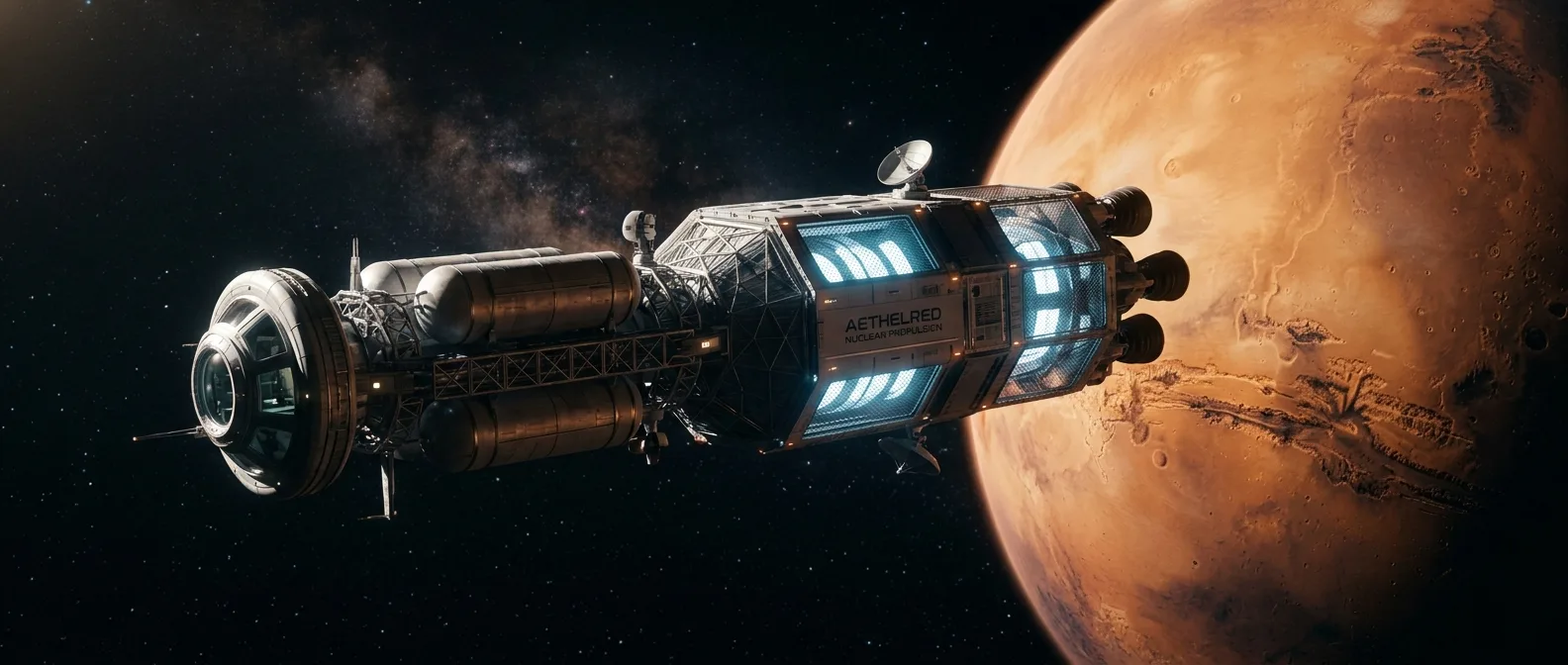
On March 24, 2026, NASA dropped a bombshell at their "Ignition" event. Space Reactor-1 Freedom will launch in 2028, carrying the first nuclear fission reactor ever designed for interplanetary travel. This isn't another solar-powered rover or RTG-equipped probe — this is a 20-kilowatt nuclear powerhouse that could transform outer solar system exploration.
📖 Read more: Nuclear Energy in Space: The Key to Mars and Beyond
🚀 Nuclear Electric Propulsion Changes Everything
Space Reactor-1 Freedom breaks with every previous Mars mission design. While previous missions relied on solar panels or radioisotope thermoelectric generators (RTGs), this spacecraft carries an actual nuclear fission reactor. The difference is staggering. RTGs, which power the Voyager probes and Perseverance rover, use the radioactive decay of plutonium-238. They generate a few hundred watts of electrical power for decades. But the SR-1 Freedom's fission reactor will produce 20 kilowatts — at least 40 times more energy. That power feeds into nuclear electric propulsion (NEP), a technology that ionizes gas atoms and accelerates them through electromagnetic fields to create thrust. Think ion drives on steroids. The thrust is tiny — less than a pound total. But unlike chemical rockets that burn out in minutes, ion engines can fire for years, eventually reaching speeds of 200,000 miles per hour.Why Nuclear Electric Beats Nuclear Thermal
NASA's approach differs sharply from previous nuclear propulsion attempts. The canceled DRACO project used nuclear thermal propulsion — heating liquid hydrogen directly with a reactor to create thrust, like a super-efficient chemical rocket. But nuclear electric propulsion sidesteps DRACO's biggest problems. Nuclear thermal requires testing on Earth, which means releasing radioactive exhaust. It also needs hydrogen refueling in space, which doesn't solve the logistics problem. Nuclear electric propulsion uses the reactor to generate electricity, which powers ion thrusters that can run on xenon or krypton — much easier to store and handle.📖 Read more: NASA Artemis III Moon Landing 2026: First Woman & Diversity
⚡ Why Nuclear Propulsion Took 60 Years to Happen
The history of nuclear space propulsion reads like a graveyard of ambitious projects. In 1965, NASA launched SNAP-10A — the first and only nuclear reactor to reach orbit. It worked for 43 days before failing. Since then, NASA has tried repeatedly to build nuclear propulsion systems. The most recent attempt was DRACO, a joint effort with DARPA. But last summer, DARPA officially canceled the project. Why did DRACO fail? According to DARPA's Rob McHenry, two key factors: First, SpaceX drove launch costs down so dramatically that nuclear thermal propulsion's benefits became less compelling. Second, nuclear electric propulsion proved more promising for long-term missions.The DRACO Cancellation: DARPA pulled the plug because cheaper launches made nuclear thermal less attractive, while nuclear electric propulsion offered better long-term prospects for deep space missions.
From Lunar Gateway to Mars
Interestingly, SR-1 Freedom will repurpose infrastructure originally designed for the Lunar Gateway — the permanently crewed space station that was supposed to orbit the Moon. But NASA has shifted strategy, now focusing on building a permanent base on the lunar surface instead. The reactor will contain low-enriched uranium and uranium dioxide, mounted at the end of a long boom to ensure radiation safety. The rest of the spacecraft will feature specialized heat radiator fins to dissipate excess heat and prevent components from melting.🔬 What SR-1 Freedom Will Actually Do
When the spacecraft reaches Mars, it will deploy Skyfall — a payload of helicopters similar to the successful Ingenuity that flew on the red planet in 2021. But the real significance isn't what it does at Mars, but proving the technology works. The mission represents a proof of concept for nuclear electric propulsion. If successful, it opens possibilities that seem almost like science fiction today. Nuclear electric propulsion could enable missions to the outer solar system with massive payloads. Imagine a telescope in Neptune's orbit, or a mission to Saturn's rings carrying the equipment of an entire research base. The technology could also enable crewed Mars missions with reasonable travel times. Instead of eight months with chemical rockets, astronauts could reach Mars in four or even three months.📖 Read more: iPhones on the Moon: NASA Allows Astronauts Smartphones
🛡️ The Safety Question Nobody Wants to Discuss
Launching nuclear material into space always raises concerns. In 1997, the Cassini-Huygens mission to Saturn faced intense protests. The mission carried 33 kilograms of plutonium-238, with estimates showing a 1-in-1,400 chance of launch accident. SR-1 Freedom faces similar concerns, but with a fission reactor, things get more complicated. Nuclear fission produces radioactive waste — we're essentially sending toxic garbage packages into the solar system. If any of these crash into a planet like Mars or a moon like Europa, the results could be catastrophic for any life that exists there. Nuclear reactors are protected with extremely durable graphite barriers reinforced with iridium and surrounded by special casings for atmospheric reentry protection. But the risk remains real.📖 Read more: Mars Volcanoes: Is There Still Magma Beneath the Surface?
🌌 The 2028 Gamble
Can NASA actually complete this ambitious project by 2028? History isn't encouraging. Since SNAP-10A in 1965, no nuclear propulsion mission has been completed successfully. But 2026 finds the space industry in a completely different state than 2000 or 2010. Ion engine technologies have matured, power generation is more efficient, and — most importantly — launch costs have dropped dramatically."For the Moon, we're moving to a focused, phased architecture that builds capability landing by landing, incrementally, and in alignment with our industry and international partners."
— Amit Kshatriya, NASA Associate Administrator