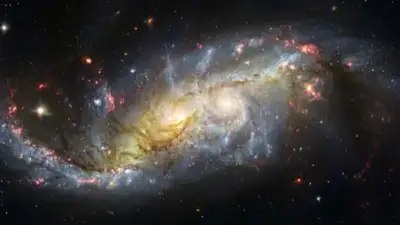
Tonight, if you look toward the constellation Andromeda, you can see a faint smudge of light with the naked eye. That smudge is the Andromeda Galaxy (M31) — 2.537 million light-years away, a spiral galaxy similar in size to our own Milky Way. It's the most distant object visible to the naked eye. And it's heading straight for us. Current measurements show Andromeda approaching at approximately 110 kilometers per second. In around 4.5 billion years, the two largest galaxies of the Local Group will collide in one of the most spectacular events in the history of the cosmos.
Confirmed by Hubble: Data collected by the Hubble Space Telescope between 2002 and 2010 allowed astronomers to precisely measure Andromeda's transverse motion. The result: Andromeda is heading almost directly toward us, with a lateral velocity of only 17 km/s — confirming a near head-on collision, not a close pass.
What Does “Galaxy Collision” Actually Mean?
The word “collision” is somewhat misleading. Galaxies are mostly empty space. The average distance between stars in the Milky Way is roughly 4–5 light-years. When two galaxies merge, the probability of any two stars actually hitting each other is essentially zero. What will catastrophically change is:
- Star orbits will be wildly disrupted — stars flung into entirely new trajectories
- Gas clouds will collide, triggering massive waves of new star formation (starburst events)
- The supermassive black holes at the centers of both galaxies will spiral toward each other and merge into one even more massive black hole
- The final merged structure will be an elliptical galaxy — already nicknamed “Milkomeda” or “Milkdromeda”
Timeline of the Galactic Collision
Evolution of the Collision
What Happens to Our Solar System?
For Earth — if any life remains 4.5 billion years from now — the collision doesn't mean direct destruction. The solar system sits approximately 26,000 light-years from the galactic center, in the outer regions of the Milky Way. The probability of our Sun directly colliding with another star from Andromeda is essentially zero.
However, gravitational perturbations may change the Sun's orbit within the new merged galaxy. NASA simulations (2012) by T.J. Cox and Abraham Loeb calculated a 12% probability that the solar system will be dynamically ejected outward into a much larger orbit — or even flung beyond the merged galaxy entirely. This would not immediately affect Earth physically, but would alter the long-term fate of our position in the cosmos.
"It is likely that the Milky Way and Andromeda will merge to form an elliptical galaxy. Our sun will almost certainly survive the collision, but its position in the galaxy could change dramatically."
— T.J. Cox & Abraham Loeb, Harvard-Smithsonian CfA (Monthly Notices of the RAS, 2008)What the Night Sky Will Look Like
Perhaps the most awe-inspiring consequence: the night sky will be transformed beyond recognition. Today Andromeda appears as a faint naked-eye smudge. Over the coming billions of years:
- Andromeda will grow visually larger in the sky as it approaches
- During the collision phase, it will span a vast arc across the sky
- Starburst regions will create bright new clusters visible across the merged system
- The night sky of Earth in 4 billion years will be completely unrecognizable to modern eyes
Why Are We Certain About This?
Hubble Space Telescope measurements taken between 2002 and 2010 allowed precise determination of Andromeda's proper motion across the sky. Before these measurements, only the radial velocity was known (blue-shifted, i.e., approaching). The critical question — whether the encounter would be a direct collision or a gravitational near-miss — was unresolved. The Hubble measurements confirmed: the transverse velocity is only 17 km/s, meaning the trajectory is nearly head-on. The collision is certain.
Sources: NASA Hubble Space Telescope, van der Marel et al. “The M31 Velocity Vector” (The Astrophysical Journal, 2012), Cox & Loeb “The Collision between The Milky Way And Andromeda” (Monthly Notices of the RAS, 2008), ESA Gaia Mission Data Release 3 (2022)
Related Articles
The Fermi Paradox
If the universe is full of planets, where is everybody?
Dark Matter & Dark Energy
95% of the universe is invisible. What holds galaxies together?
The Cosmic Microwave Background
The oldest light in the universe — echo of the Big Bang.
Betelgeuse: When Will It Explode?
When one of the sky's brightest stars goes supernova.
Hawking Radiation
Do black holes slowly evaporate? Stephen Hawking's prediction explained.
Gravitational Waves
LIGO detected ripples in spacetime — a new era in astronomy.