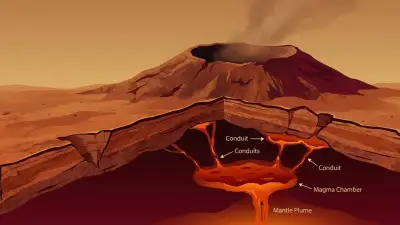
Mars is home to the largest volcano in the solar system: Olympus Mons. Standing 21.9 kilometers tall — roughly 2.5 times the height of Mount Everest — with a diameter of 624 kilometers, this shield volcano is a colossal monument to Mars's volcanic past. But the real question is different: is there still magma beneath the surface?
📖 Read more: The Asteroid Belt: How Sparse Is It and What Does It Hide?
🌋 Olympus Mons — The Largest Volcano
Olympus Mons is a shield volcano — it formed from fluid basaltic lava that built it up slowly without violent eruptions. Mars's low gravity (about 38% of Earth's) allows volcanoes to grow to enormous sizes that would be impossible on Earth. The Tharsis region hosts 4 giant shield volcanoes, forming an elevated plateau that dominates the western hemisphere of Mars.
🔥 A Living Planet?
For decades, scientists believed Mars's volcanic activity ended 500 million to 1 billion years ago. But recent studies (2021–2024) overturned this picture. Evidence from the Cerberus Fossae region shows volcanic activity as recently as 50,000 years ago — a time frame that's insignificant on a geological scale.
Young lava flows were identified in the Elysium Planitia region using orbital data. These flows are geologically very young, suggesting Mars is not as “dead” as we once believed.
📖 Read more: The Search for Extraterrestrial Life in 2026
📡 What InSight Found
NASA's InSight lander, which operated from 2018 to 2022, detected hundreds of “marsquakes.” Many of these had epicenters in volcanic regions, suggesting possible subsurface activity. The seismic data showed that Mars's interior is not as cold and dead as previously believed.
🧪 Magma Beneath Tharsis
A 2024 study proposed something stunning: a large magma chamber may still exist beneath the Tharsis region. Analyses of orbital data and gravitational anomalies suggest the presence of hot, fluid material at a depth of several kilometers. If confirmed, this would mean Mars is still geologically active.
🌍 Implications for Life: If active magma exists beneath the surface, it means heat and possibly liquid water. The combination of volcanic heat + water is precisely the scenario that supports microbial life on Earth — and perhaps on Mars too.
📖 Read more: Elon Musk's Pivot: From Mars Dreams to Moon Reality
💧 Volcanoes and Life
The connection between volcanoes and life is no coincidence. On Earth, hydrothermal systems near volcanoes host rich communities of microorganisms that survive without sunlight. If similar conditions exist beneath Mars's surface, it opens the door to possible microbial life.
Additionally, passive volcanic outgassing could partly explain the methane detections in Mars's atmosphere, a mystery that has puzzled scientists for years. Methane on Earth is primarily produced by biological processes, but can also come from geological mechanisms.
🔭 What Comes Next
Upcoming Mars missions, including Mars Sample Return and future seismic stations, are expected to provide definitive answers about Mars's interior. A confirmation of active magma would fundamentally change our understanding of planetary evolution and the prospects for finding life beyond Earth.