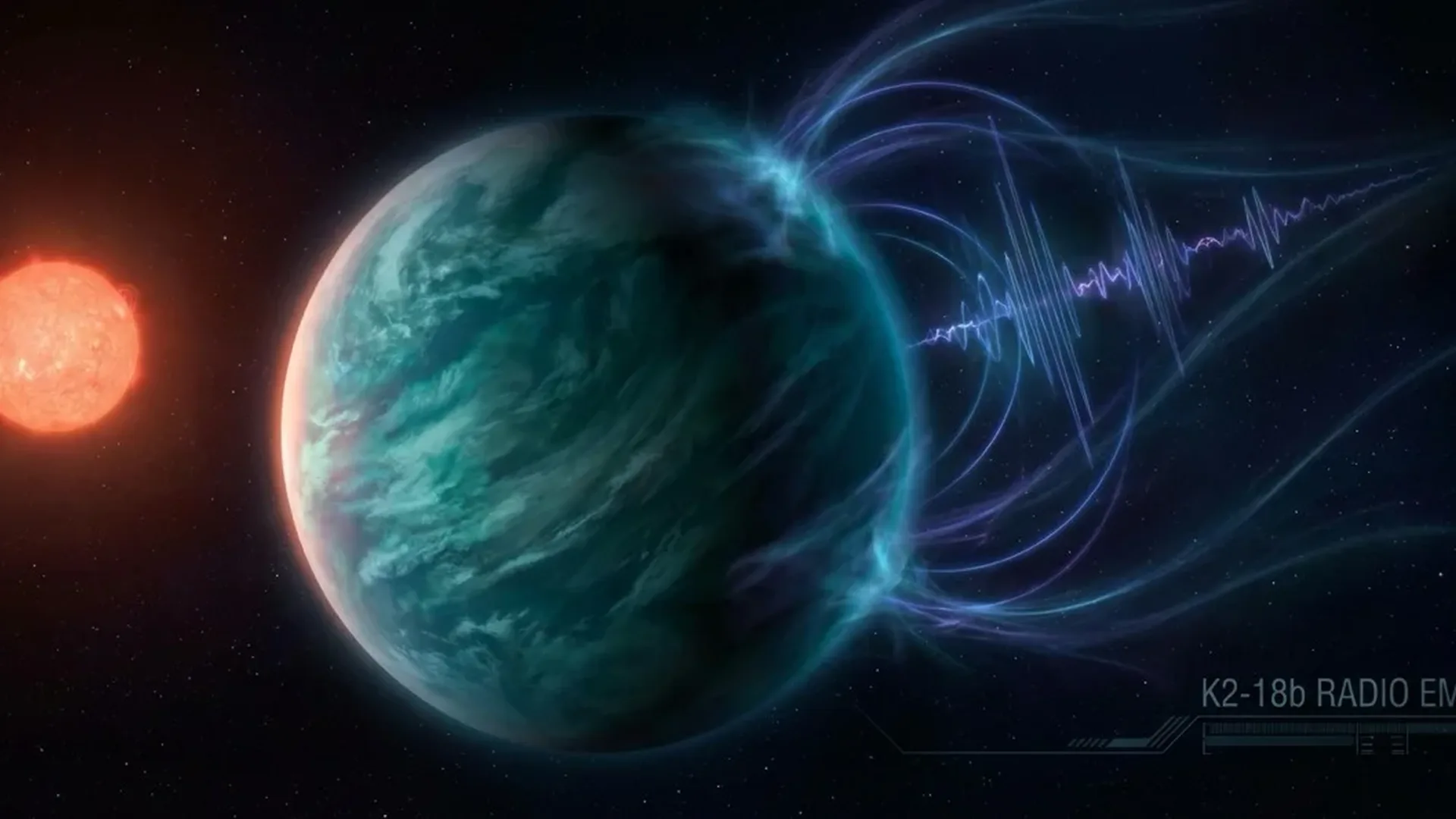
124 light-years away in the constellation Leo lies K2-18b — an exoplanet that has captivated the scientific community for years. The James Webb Space Telescope detected methane and carbon dioxide in its atmosphere, making it a prime candidate for a “Hycean world” — a planet with a global liquid ocean beneath a thick hydrogen atmosphere. Now, SETI researchers have turned the world's most powerful radio telescopes toward it, searching for technosignatures.
📖 Read more: The Search for Extraterrestrial Life in 2026
🔭 What Makes K2-18b So Special
K2-18b orbits a red dwarf star, sits within the habitable zone, and has a mass 8.6 times that of Earth. Unlike rocky planets, it's believed to possess a hydrogen-rich atmosphere covering a vast ocean — hence the term "Hycean world" (hydrogen + ocean).
JWST data revealed spectral signatures of CO₂ and CH₄ (methane) in its atmosphere — a chemical composition that on Earth is associated with biological processes. However, these molecules don't automatically mean life — they could also result from abiotic processes. The uncertainty is precisely what makes the mystery so compelling.
📖 Read more: Exoplanets with Life Conditions: What We've Found So Far
🔭 The Great Search: VLA + MeerKAT
In a rare coordinated effort, SETI researchers simultaneously used two of the world's most powerful radio telescopes: the Karl G. Jansky Very Large Array (VLA) in New Mexico and MeerKAT in South Africa. The goal: detecting narrowband radio signals — technosignatures analogous to those produced by human technology.
The team led by C. D. Tremblay published results on arXiv in February 2026. Despite millions of candidate signals recorded by the telescopes, none passed the identification filters. No artificial narrowband radio signal of equivalent technology was found.
"K2-18b might be quiet today, but we will continue to get much better at listening — if it ever does start to speak to us."
📖 Read more: James Webb Telescope: Reading Exoplanet Atmospheres
🔭 How Signals Are Filtered
The main challenge wasn't detection — it was separation. Earth generates enormous radio noise: cell phones, radar, satellites. The team applied five successive filters:
1. RFI Masking: Removed all data at frequencies with known terrestrial interference. 2. Doppler Effect: Signals with no Doppler shift were rejected — they could only come from Earth. 3. Signal-to-noise ratio: Signals too weak (SNR < 10) or too strong (SNR > 100) were cut. 4. Multi-beam analysis: A signal from K2-18b would appear only in the beam aimed at it. 5. Transit filtering: If the planet passed behind its star, the signal should vanish.
💡 What Does “Nothing Found” Really Mean?
Absence of a signal doesn't mean absence of life. It means there's no transmitter equivalent to or larger than the Arecibo radar in the K2-18 system. Potential life may simply not be broadcasting — or may transmit at frequencies we didn't measure.
📖 Read more: Alien Civilizations: Will We Ever Meet Them?
🔭 The Road Ahead: Square Kilometre Array
The most important result may not be “nothing found” but the validation of the automated filtering pipeline. Manually analyzing millions of signals would be impossible. These techniques are critical for future telescopes, especially the Square Kilometre Array (SKA) — a next-generation radio telescope with ten times the sensitivity.
Meanwhile, new JWST observations will probe K2-18b's atmospheric composition deeper, searching for biomarkers like dimethyl sulfide (DMS) — a compound that on Earth is produced almost exclusively by living organisms. The mystery of K2-18b remains wide open.
🔬 James Webb (JWST)
Detected CO₂ and methane in K2-18b's atmosphere — chemical signatures compatible with (but not proof of) biological activity.
📡 VLA + MeerKAT
Two top radio telescopes conducted a coordinated technosignature search — zero positive results after rigorous filtering.
🌊 Hycean World
A planet with dense hydrogen atmosphere above a global ocean. Theoretically habitable even if the surface isn't rocky.