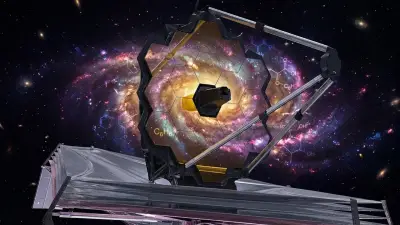
The James Webb Space Telescope (JWST) doesn't just explore exoplanets — it peers deep into the universe's past and finds the building blocks of life in galaxies that formed over 12 billion years ago. The discovery of complex organic molecules in such ancient galaxies challenges our models of early universe chemistry and opens fascinating possibilities about the origins of life.
📖 Read more: How James Webb Sees the Universe's First 400 Million Years
🧪 Organic Molecules in the Universe: What Are PAHs?
Polycyclic aromatic hydrocarbons (PAHs) are complex molecules of carbon and hydrogen that form the building blocks of organic chemistry. On Earth, we find them in fossil fuels, smoke, and grilling. In the universe, however, PAHs are ubiquitous — and they are considered precursors to amino acids and ultimately to life itself.
🖤 PAHs
Polycyclic aromatic hydrocarbons — the most complex organic molecules in the universe.
⭐ Carbon
The 4th most abundant element in the universe and the foundation of all organic chemistry.
💧 Water
H₂O is found everywhere in the universe — in nebulae, comets, and protoplanetary disks.
🧬 Amino Acids
The building blocks of proteins — found in meteorites and comets.
🌌 12 Billion Years Back: Organics in the Earliest Galaxies
The JWST detected PAHs in galaxies over 12 billion light-years away. These are some of the most ancient galaxies, formed just 1-2 billion years after the Big Bang. The discovery challenges models of early universe chemistry — scientists did not expect such complex organics at such an early stage.
PAHs were also found in Stephan's Quintet, a group of interacting galaxies where collisions create enormous shock waves — and yet, the organic molecules survive.
📖 Read more: The Search for Extraterrestrial Life in 2026
⭐ Protoplanetary Disks: Organics in the Cradles of Planets
The JWST also found organic molecules in protoplanetary disks — the clouds of gas and dust from which planets are born. In the Orion Nebula, an active star-forming region 1,344 light-years away, the JWST detected PAHs and other organics within disks surrounding newborn stars.
This means something profoundly significant: organic molecules exist before planets even form. This vastly increases the probability that the building blocks of life exist on many worlds throughout the universe.
🔬 MIRI — The Key to Detection
The MIRI (Mid-Infrared Instrument) is the key to detecting organics. It operates in the mid-infrared range (5-28 micrometers), where organic molecules leave their strongest spectral signatures. It is cooled to just 6.7 Kelvin (-266°C) to minimize thermal noise.
Without MIRI, detecting PAHs in distant galaxies would be impossible. The Hubble and previous infrared telescopes (Spitzer) lacked the sensitivity for such detections.
🌍 Cosmic Organics & Life on Earth: The organic molecules the JWST finds in the universe are similar to those found in meteorites that fell to Earth. Many scientists believe that the building blocks of life may have arrived on Earth from space — a theory known as panspermia.
🔭 What It Means for Life in the Universe
The discovery of organic molecules in such diverse environments — ancient galaxies, protoplanetary disks, nebulae — suggests a fascinating conclusion: the building blocks of life are ubiquitous throughout the universe.
This doesn't mean life is everywhere — it means its ingredients are available almost everywhere. The theory of panspermia — that the seeds of life travel via meteorites and comets — is strengthened by the JWST's findings. If organic molecules exist in galaxies 12 billion light-years away, then carbon chemistry is fundamental to the universe — and life, perhaps, is not the exception but the rule.