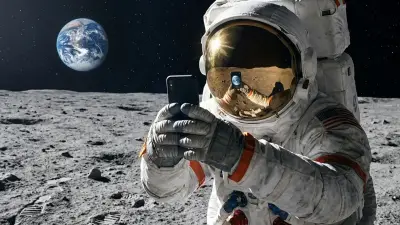
NASA is changing the rules: Artemis II and Crew-12 astronauts will be allowed to bring iPhones and modern smartphones to space and the Moon — a decision that marks a new era in how space missions are documented and shared with the world.
📱 The Announcement That Changes Everything
On February 5, 2026, NASA Administrator Jared Isaacman announced via X (formerly Twitter) a decision that will transform the way we experience space missions. The crews of Crew-12 and Artemis II will now be permitted to bring iPhones and modern smartphones aboard their spacecraft.
This means that for the first time on official NASA missions, astronauts will have access to the same cutting-edge photography and videography technology that billions of people use every day here on Earth. The iPhones will serve both as high-quality cameras for capturing stunning imagery and as personal devices that astronauts can use to document special moments for their families and the public.
"We are giving our crews the tools to capture special moments for their families and share inspiring images and video with the world," Isaacman wrote in his announcement post.
🔧 Why Hadn't This Happened Sooner?
It may seem surprising that NASA had not approved the use of smartphones on missions until now. The explanation lies in the agency's enormous bureaucracy and stringent certification requirements — what Isaacman calls “requirement bloat,” referring to the excessive accumulation of procedural demands over the decades.
Every device that enters a spacecraft must pass an exhaustive series of tests. These include radiation characterization of chips to ensure they can withstand the harsh space environment, battery thermal and vacuum tests to verify safe operation in the extreme conditions of space, outgassing evaluations to confirm that the device won't release harmful gases in the enclosed cabin atmosphere, and vibration testing to ensure it can survive the violent shaking of launch. The process was so time-consuming and resource-intensive that no one had dedicated the effort needed to certify modern smartphones.
The result was strikingly paradoxical: before this decision, the most modern camera approved for the Artemis II mission was a 2016 Nikon DSLR, accompanied by GoPro cameras that were a decade old. In an era when iPhones shoot 4K video with computational photography and night mode, NASA was still relying on technology that was already outdated.
⚡ The certification challenge: To approve an iPhone for spaceflight, NASA requires radiation characterization of its chips, battery thermal testing in vacuum conditions, outgassing evaluations, and vibration testing. Isaacman succeeded in completing this process on an expedited timeline — challenging long-standing bureaucratic practices that had been slowing NASA's modernization for years.
📸 From Apollo to iPhone
The relationship between photography and space missions dates back to the very beginning of space exploration. Apollo astronauts used specially modified Hasselblad cameras, which captured some of the most iconic images in human history — from the legendary “Earthrise” photograph to Neil Armstrong's first steps in the lunar dust.
During the Space Shuttle era, camera technology evolved significantly, but NASA always remained conservative in adopting new consumer devices. One notable exception was the final Space Shuttle mission, STS-135 in 2011, during which two iPhone 4s flew to space — primarily as part of an experimental program testing the devices' sensors in microgravity.
Today, astronauts aboard the International Space Station (ISS) use tablets to communicate with their families via the internet and conduct video calls. However, the official use of modern smartphones on NASA missions had never been approved — until now.
It's worth noting that private space missions, such as Polaris Dawn and Axiom missions, had already successfully brought smartphones to space. This made NASA's bureaucratic delay on the matter even more conspicuous and strengthened Isaacman's argument for reducing the “requirement bloat” that had been holding the agency back.
🚀 What This Means for Artemis Missions
This decision opens new horizons for the Artemis missions, particularly Artemis II, which will be the first crewed mission to orbit the Moon since the Apollo era. Astronauts will be able to capture the lunar surface, the breathtaking view of Earth from lunar orbit, and their daily activities inside the Orion spacecraft with image quality that was never before possible on a NASA mission.
Modern smartphones offer capabilities that far exceed professional cameras from a decade ago: 4K video with optical stabilization, computational photography for low-light conditions, ProRAW capture, slow motion, time-lapse, and even 3D spatial scanning with LiDAR. These tools will enable astronauts to document transient phenomena — such as flashes on the lunar surface or unusual shadow formations — that could be of interest to both the public and the scientific community.
Beyond scientific value, sharing these images and videos with the world through social media creates an unprecedented opportunity for public engagement with the space program. When people see the Moon through a familiar device — an iPhone — the experience becomes more accessible, more relatable, and more inspiring than ever before.
"Just as important, we challenged long-standing processes and qualified modern hardware for spaceflight on an expedited timeline. That operational urgency will serve NASA well."
🌙 The Moon Through an iPhone
Imagine seeing the lunar surface in 4K video, captured on an iPhone — the exact same device that billions of people hold in their hands every day. The images from Apollo changed the way humanity sees itself and its planet. The iconic “Earthrise” — the view of Earth rising above the lunar horizon — is considered one of the most important photographs in history.
Now, more than fifty years later, we are about to see the Moon through the lens of an iPhone. The comparison with Apollo-era photographs will be striking — not just as proof of technological progress, but because of the familiarity of the device. The Moon will feel closer, more real, more human.
The impact on social media is expected to be enormous. Images and video from the Moon, captured in smartphone quality, will inevitably go viral, inspiring a new generation to dream about space. At a time when NASA needs public support to fund its ambitious future missions, this decision may prove just as significant as any technological upgrade.
Isaacman's decision isn't simply about a phone. It represents a new philosophy: that NASA can move faster, modernize its processes, and leverage the same tools that the rest of the world uses. And if an iPhone can go to the Moon, then perhaps the Moon isn't as far away as we once thought.