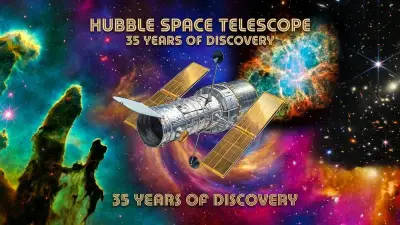
On April 24, 1990, the Space Shuttle Discovery carried one of the most important scientific instruments in human history into low Earth orbit: the Hubble Space Telescope. Thirty-five years later, this marvel of engineering continues to reveal the secrets of the universe, having fundamentally changed our understanding of the cosmos.
🔭 The Beginning: Launch and a Dramatic Fix
Hubble's story began with excitement but quickly turned into a nightmare. Just weeks after its launch on the STS-31 mission, scientists discovered that the telescope's primary mirror — 2.4 meters in diameter — had a spherical aberration of just 2.2 micrometers. Though microscopic, this flaw rendered the images blurry and essentially useless for precise scientific work.
NASA responded with one of the most impressive missions in spaceflight history. In December 1993, the STS-61 mission installed the COSTAR system — a set of corrective optics that acted as “glasses” for the telescope. The fix was so successful that Hubble exceeded every performance expectation.
🌌 Discoveries That Changed Everything
Hubble wasn't just a telescope — it was an instrument that rewrote the textbooks of astronomy. Its most stunning discovery came in the late 1990s, when observations of Type Ia supernovae revealed that the expansion of the universe is accelerating rather than slowing down. This discovery led to the concept of dark energy and earned the 2011 Nobel Prize in Physics for Saul Perlmutter, Brian Schmidt, and Adam Riess.
In 1995, Hubble pointed its lens at a seemingly empty patch of sky for ten consecutive days. The result — the Hubble Deep Field — revealed thousands of galaxies in an area smaller than a grain of sand held at arm's length, demonstrating that the observable universe contains hundreds of billions of galaxies.
🌑 Dark Energy
Revealed that the expansion of the universe is accelerating — a Nobel Prize-winning discovery.
🌀 Supermassive Black Holes
Proved that nearly every large galaxy harbors a supermassive black hole at its center.
🕰️ Age of the Universe
Helped precisely calculate the age of the universe at approximately 13.8 billion years.
🪐 Exoplanet Atmospheres
Pioneered the analysis of exoplanet atmospheres, detecting water and chemical signatures.
🔧 Five Rescue Missions
One of Hubble's greatest advantages was that it was designed to be serviced in space. Five Space Shuttle missions (SM1 through SM4, from 1993 to 2009) upgraded and repaired the telescope repeatedly.
The first mission (SM1, 1993) installed COSTAR to correct the mirror. SM2 (1997) added new wide-field instruments. SM3A and SM3B (1999–2002) replaced gyroscopes and installed the Advanced Camera for Surveys. The final mission SM4 (2009) was the most ambitious — astronauts repaired instruments that were never designed to be fixed in space, giving Hubble a new lease on life.
⚠️ Aging and Current Status
After 35 years in space, Hubble is inevitably showing signs of aging. The gyroscopes — critical for precise pointing — are the biggest concern. Of the original six gyroscopes, only one now functions normally. During 2024, Hubble entered safe mode multiple times due to gyroscope failures.
NASA transitioned to single-gyroscope operation, sacrificing some pointing flexibility but ensuring continued observations. With no possibility of new servicing missions — the Space Shuttles were retired in 2011 — Hubble is expected to operate until the 2030s before its orbit naturally decays. Despite this, it continues to produce over 10 terabytes of data annually.
📸 Hubble Deep Field: In December 1995, Hubble stared at a seemingly empty patch of sky for 10 consecutive days. It revealed approximately 3,000 galaxies in an area smaller than a grain of salt held at arm's length — forever changing our perception of the true scale of the universe.
🌟 Hubble's Legacy
Beyond science, Hubble transformed humanity's relationship with the cosmos. Its images — from the Pillars of Creation in the Eagle Nebula to the fine details of distant galaxies — became cultural icons. Named after astronomer Edwin Hubble, the telescope has produced over 19,000 published scientific papers, making it one of the most productive scientific instruments in history.
Even with the James Webb Space Telescope in operation, Hubble remains indispensable. The two telescopes work complementarily — Webb in the infrared and Hubble in visible and ultraviolet light. Together, they offer a complete picture of the universe that no single telescope could ever provide.
Thirty-five years after its launch, Hubble stands as a monument to human ingenuity. From a flawed telescope to a legendary observatory, its story reminds us that initial failure can become the greatest success — as long as there is the will and the courage to make it right.