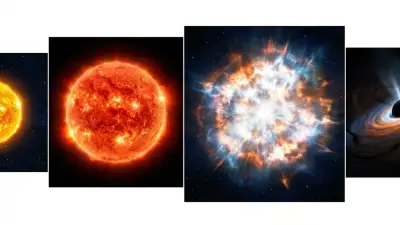
Every star you see in the night sky is a colossal nuclear reactor — a cosmic furnace that fuses hydrogen into helium and, gradually, into heavier elements. But nothing lasts forever. Every star, regardless of its size, will eventually die. How it dies, however, depends entirely on its mass — and the most spectacular deaths belong to the largest stars.
⭐ The Life of a Star
Every star begins its life inside a nebula — a vast cloud of gas and dust. Gravity compresses this material until the core temperature reaches millions of degrees, igniting thermonuclear fusion. The star then enters the “Main Sequence” — a long period of stability where radiation pressure balances gravity.
Our Sun has been in this phase for approximately 4.6 billion years and is expected to remain in it for another 5 billion years. Larger stars, however, burn through their fuel much faster — a star with 20 solar masses can exhaust its hydrogen in just a few million years.
🔴 Small Stars — A Quiet Death
Stars with less than 8 solar masses (like our Sun) don't die in an explosion. Instead, their death is slow and relatively peaceful. When the hydrogen in the core is exhausted, the star begins to fuse helium. Its outer layers swell dramatically, transforming it into a red giant — large enough to engulf planets.
Gradually, the outer gases are expelled into space, forming a beautiful planetary nebula. The core left behind is a white dwarf — an Earth-sized object with the mass of a star, composed of degenerate matter. Without an energy source, it slowly cools and fades into darkness.
💥 Massive Stars — Supernova
Stars with more than 8 solar masses die in the most spectacular way in the universe: a supernova. These stars successively fuse heavier elements in their cores — from helium to carbon, to oxygen, to neon, to silicon, until iron forms.
Iron is the endpoint: fusing it releases no energy. When the iron core exceeds the Chandrasekhar limit (1.4 solar masses), it collapses in milliseconds. Matter is compressed so extremely that protons and electrons merge into neutrons. This collapse rebounds off the core, creating a massive shockwave that blasts the outer layers into space.
At its peak, a supernova can outshine an entire galaxy — billions of times brighter than the Sun. The energy released in seconds equals the total energy our Sun will produce over its entire lifetime.
☢️ Types of Supernovae
Type Ia: A white dwarf in a binary system accretes matter from its companion star. When it exceeds the Chandrasekhar limit, it detonates completely. These supernovae almost always have the same luminosity, making them “standard candles” — tools for measuring cosmic distances. Thanks to them, we discovered that the expansion of the universe is accelerating.
Type II: The classic core collapse of a massive star. The iron core collapses, creating a neutron star or black hole. The shockwave ejects the outer layers, enriching the interstellar medium with heavy elements.
💎 Gold, uranium, platinum — every element heavier than iron was created inside supernovae or neutron star collisions. The jewelry you wear was literally born in the death of a star — this process is called stellar nucleosynthesis.
🔭 Famous Supernovae
SN 1987A: The most recent nearby supernova, in the Large Magellanic Cloud (168,000 light-years away). It was the first supernova visible to the naked eye since 1604 and the first from which neutrinos were detected — confirming the core-collapse theory.
Crab Nebula (SN 1054): Recorded by Chinese astronomers in July 1054. It was so bright it was visible even during daylight for 23 days. Today, the debris forms the spectacular Crab Nebula, with a pulsar spinning at its center.
Cassiopeia A: One of the youngest supernova remnants in our galaxy (approximately 340 years old). It serves as a primary source of study for supernova physics through radio telescopes and X-ray observations.
🌟 Betelgeuse — The Next One?
Betelgeuse, the distinctive red supergiant in the constellation Orion, is in the final stages of its life. In 2019-2020, a dramatic dimming was observed — the so-called “Great Dimming” — which was ultimately attributed to a dust ejection. Located approximately 700 light-years away, if it were to explode, it would appear brighter than the Moon for weeks.
When will it explode? Nobody knows — it could be in 100,000 years or tomorrow. In cosmic terms, it's ending soon. If it goes supernova, it will leave behind a neutron star or a black hole — and provide astronomers with an unprecedented spectacle.